Giant Tar Mat Reached Orange Beach in December 2010
A 2010 WKRG report documented emergency cleanup of a large tar mat that reached Orange Beach.
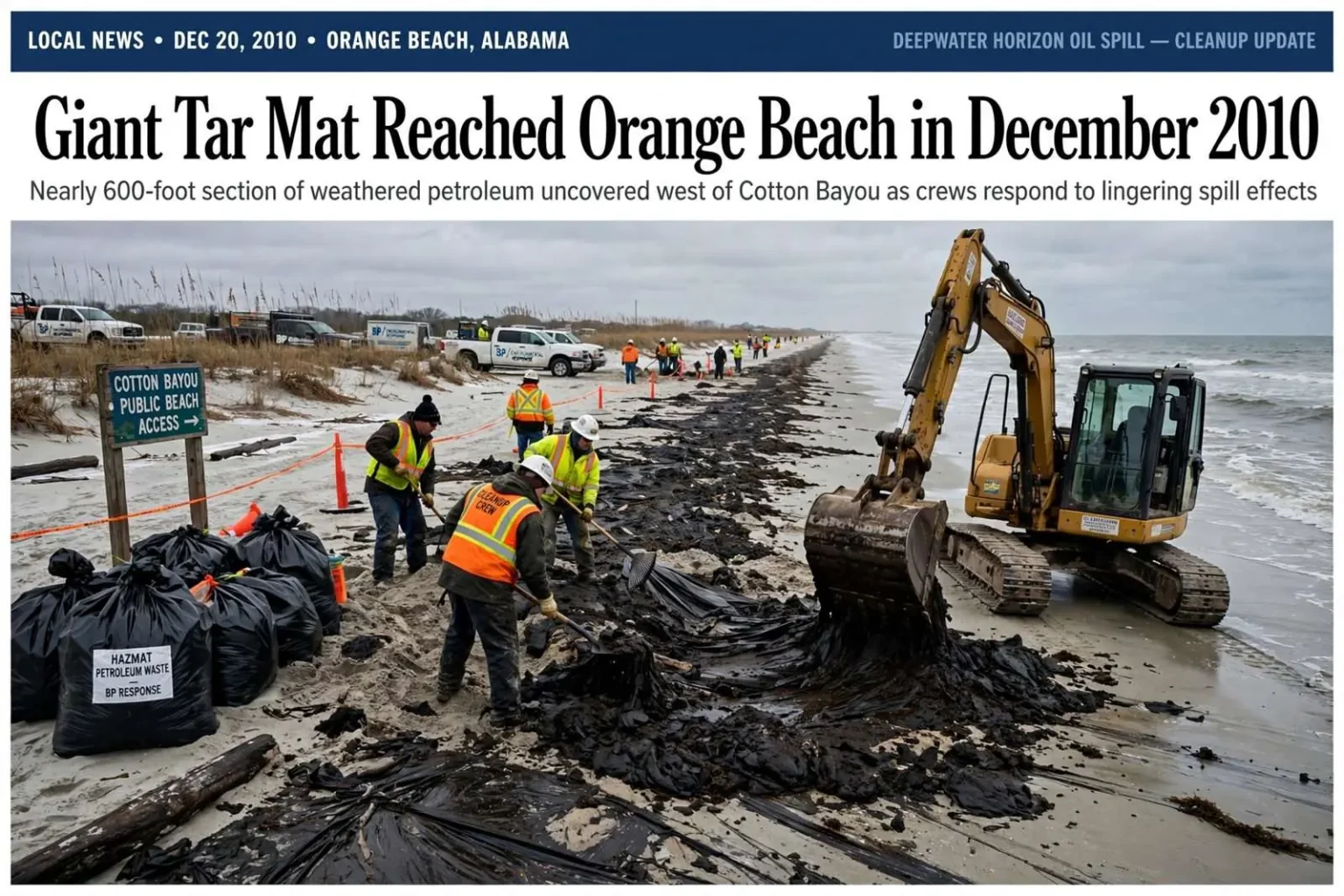
Cleanup crews rushed to Orange Beach in December 2010 after a large submerged tar mat came ashore west of Cotton Bayou, according to a local station. The report described the material as nearly an eighth of a mile long. Workers used heavy equipment to remove it after an incoming tide made it visible on the shoreline. Crews said the work would continue through the day as they removed the petroleum material from the sand.
The discovery was a reminder that the Deepwater Horizon oil spill, which began with the April 2010 explosion of the drilling rig in the Gulf of Mexico, was not finished with Alabama’s beaches when the well was capped that summer. Weathered petroleum had settled into the shallow water and sand along the Gulf Coast, and it kept surfacing months after the immediate crisis had passed. An incoming tide and shifting sand exposed the buried mat, placing it directly in the path of beachgoers and cleanup equipment alike.
A mat nearly an eighth of a mile long
Tar mats like the one found west of Cotton Bayou form when oil from a spill mixes with sand and sinks, creating dense, sticky pads that can lie buried beneath the surf zone for months. They are often invisible from the surface until tides, waves or storms strip away the sand covering them. That is what happened on the day of the Orange Beach discovery. As the tide came in, the dark material became visible along the shoreline, and response teams moved quickly to dig it out before it could break apart and spread down the beach.
Heavy equipment was brought in to lift the material off the strand. Removing a tar mat is labor-intensive work. Crews must dig down to the layer where the oil-and-sand mixture sits, load it into trucks, and haul it away for proper disposal, taking care not to strip away excessive amounts of clean sand in the process. Workers said the job would continue through the day, and similar efforts were repeated along the Alabama coast through the winter as new patches of weathered oil kept appearing.
Why Cotton Bayou matters
Cotton Bayou is one of the best-known public beach access points in Orange Beach, a resort city on the Baldwin County coast whose population swells dramatically with tourists in spring and summer. The beach west of the bayou sits between Perdido Pass to the east and the Gulf State Park shoreline to the west, putting it squarely in the heart of the city’s tourism district. Any petroleum material washing ashore there threatened not just the environment but the economic engine of the entire coastal community.
Orange Beach had already spent much of 2010 dealing with the fallout from the spill. Tar balls first reached Alabama’s beaches in early June of that year, and through the summer the city’s white sand was worked over daily by contracted cleanup crews, sifting machines and hand-picking teams. By autumn the beaches had largely been restored to their pre-spill appearance, and city leaders had promoted them heavily to bring visitors back. The sudden appearance of a large mat in December undercut the sense that the ordeal was over.
How buried oil resurfaces
The physics of a submerged tar mat explain why it appeared so abruptly. Crude oil that has weathered at sea loses its lighter components to evaporation and dissolution, leaving a thick, tar-like residue. In the nearshore zone that residue mixes with suspended sand and settles as semi-solid pads on the seabed or just beneath the surface of the beach. Wave energy and longshore currents can bury the pads deeper or uncover them, and a rising tide pushes surf directly against the berm where they rest.
That behavior meant no stretch of the Alabama shoreline could be declared permanently clean. Patrols continued along Gulf Shores, Orange Beach and Fort Morgan into 2011 and beyond, and small deposits of tar balls turned up after storms for years afterward. Residents and visitors were encouraged to report any oily material they found rather than handle it themselves, since petroleum residue can irritate skin and is best removed by trained workers with proper equipment.
The response to the December 2010 find fit into the larger structure of the Deepwater Horizon cleanup, which was coordinated through a unified command involving BP, the U.S. Coast Guard and state and federal agencies. Shoreline teams conducted regular assessments of Alabama’s beaches, and conditions could change quickly with the weather. A mat that was buried one week could be exposed the next, particularly during winter cold fronts that kick up heavier surf along the northern Gulf Coast.
After the blown-out well was capped in July 2010 and permanently sealed that September, many residents hoped the visible signs of the spill would disappear with it. Instead, weathered oil continued to wash ashore in the form of tar balls and buried mats through the fall and winter. Baldwin County officials and BP-contracted cleanup crews remained active along the strands, sifting sand and removing petroleum material as it appeared. The presence of submerged mats meant the work was not simply a matter of picking up what floated in; crews had to watch for material just under the surface of the sand and in the shallow water beyond the breaking waves.
Operation on the ground
On the day the mat surfaced, the work followed a pattern familiar to cleanup veterans by that point in the response. Crews roped off the affected stretch of beach, brought in loaders and excavators, and began peeling back layers of stained sand. The material was stockpiled, bagged and trucked offsite to licensed disposal facilities. Supervisors monitored the tide, because an incoming flow could re-cover the mat as quickly as it had been exposed, and workers adjusted their digging to keep pace with the water line.
Local station coverage noted that crews expected the removal to take the entire day. That estimate reflected the sheer scale of the deposit. A mat stretching nearly an eighth of a mile — more than six hundred feet of petroleum-stained material — represents a substantial volume of contaminated sand even if it is only a few inches thick. Removing it cleanly means excavating the full footprint, not just the visible surface, so that no residue remains to smear onto shoes, paws or tires after the crews leave.
The stakes for a tourism economy
Orange Beach and neighboring Gulf Shores depend overwhelmingly on visitors. The white-sand beaches are the reason millions of travelers come to Baldwin County each year, filling condominiums, restaurants, charter fishing boats and entertainment venues. In the months after the spill, local officials mounted an aggressive campaign to reassure travelers that the beaches were open and clean, because every canceled reservation rippled through payrolls across the coastal community. A tar mat surfacing in December — even one that crews could remove within a day — carried weight far beyond its size precisely because of where it appeared.
The timing added to the concern. December sits in the quiet season for Baldwin County tourism, but it is also when families begin booking spring and summer vacations. Images of heavy equipment digging petroleum material out of the sand were exactly what the coastal cities did not want circulating as the 2011 travel season approached. Quick removal and clear communication from cleanup officials were aimed at keeping the episode contained, both environmentally and economically.
Effects beyond the beach
The spill’s impact on the Alabama coast was never limited to the sand itself. State and federal waters off the coast were closed to fishing at various points in 2010, hurting commercial and charter fleets that operate out of Orange Beach and nearby ports. Seafood testing continued for months, and concern about the catch persisted into the following year. The tar mats that kept surfacing through the winter of 2010 and 2011 were part of the same picture: a spill whose aftermath unfolded over seasons rather than weeks.
Compensation programs run by BP eventually paid claims to businesses and individuals across the Gulf Coast, and restoration projects funded through settlement dollars later supported dune rebuilding, habitat work and infrastructure along the Alabama coast. None of that could prevent the immediate frustration of seeing oil return to a beach that had been declared clean months earlier, and the December find tested the patience of a community that had already endured a difficult year.
What the episode left behind
For coastal residents, the December 2010 cleanup underscored a lesson about the nature of offshore spills: the shoreline does not recover on a single schedule. Buried oil can resurface with a tide or a storm, and vigilance becomes a routine part of managing a public beach. Patrols, assessments and rapid-response digging remained part of life on the Baldwin County coast long after the well itself was sealed.
The mat west of Cotton Bayou was lifted out by crews working through the day with heavy equipment, and the sand was hauled away for disposal. The episode stands today as a historical note in the longer record of the Deepwater Horizon response, a measure of how far the weathered residue of the 2010 spill traveled and how long it lingered. For the workers who removed it and the residents who watched, it was a reminder that the Gulf’s beaches were cleaned not once but many times over, a little at a time, as each piece of the spill came home to shore.