Orange Beach Deep Cleaning Nearing Completion in 2010
A 2010 WKRG report described oil-spill cleanup crews nearing the end of deep cleaning work on Orange Beach.
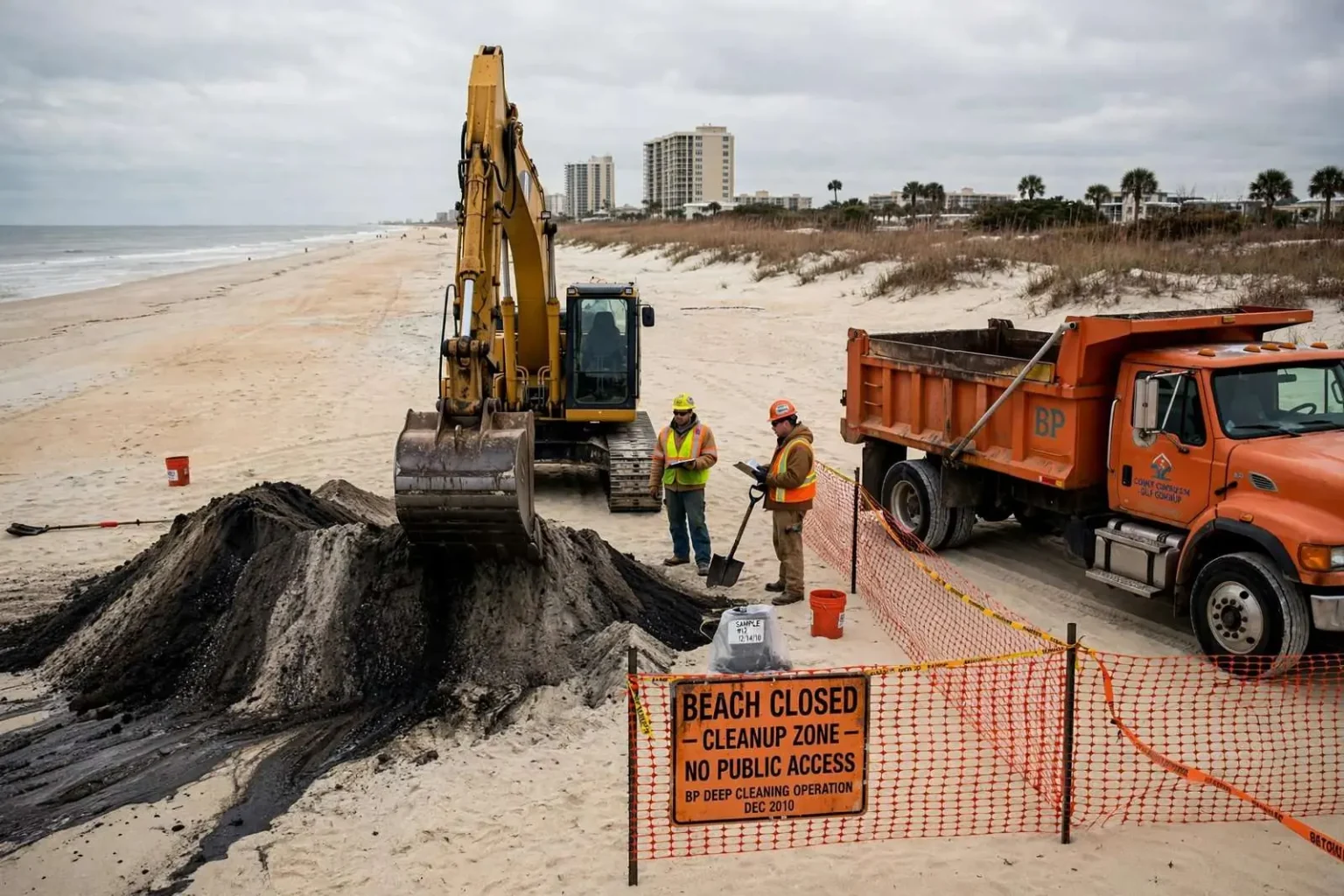
Orange Beach officials said in December 2010 that deep cleaning of the shoreline after the Deepwater Horizon oil spill appeared to be nearing completion, according to a local news report. BP crews had been excavating oil-covered material buried beneath sand and surf for about two months, and the work was approaching the point where the city would decide whether the job met its standards.
Mayor Tony Kennon said he hoped the work would finish before Christmas, while state environmental officials prepared to test the sand. Officials said the city would make its own assessment before signing off on the work — a point of pride for a barrier-island community whose beach is, in the most literal sense, its economic foundation.
Kennon also said cleanup teams should remain available for future tar-ball incidents, an acknowledgment that even after the deep cleaning ended, the spill’s legacy material would not necessarily be gone for good. Additional work continued in Gulf Shores, Fort Morgan and Dauphin Island, meaning the final chapter of the shoreline cleanup was being written all along the Alabama and Mississippi coast at once.
This is a historical summary of a December 2010 cleanup report. It is not a current beach-condition report.
The Spill and the Alabama Shoreline
The Deepwater Horizon rig exploded in April 2010, killing eleven workers and initiating the largest marine oil spill in United States history. For months, oil moved across the Gulf of Mexico, and although Alabama’s beaches escaped the heaviest impacts that befell some Louisiana marshes, tar balls and oil residue reached the white sand of the Baldwin County coast, prompting beach closures in the height of the summer season and a collapse in the tourism business that sustains Orange Beach and Gulf Shores.
Orange Beach sits on a barrier island along the Alabama Gulf Coast, its economy built almost entirely around the beach, the bay and the boating and fishing culture that surrounds them. Condominium towers, rental properties, charter fishing fleets and restaurants all draw their customers to the same seven or so miles of shoreline. When oil threatens that shoreline, the threat is not abstract or environmental in some distant sense — it is the town’s balance sheet, its identity and its future fiscal year, all at once.
The response through the summer and fall of 2010 had already included skimming offshore, boom deployments, beach sweeping and the removal of visible tar balls and oiled sand. But the December deep-cleaning operation addressed a subtler problem: oil that had been buried beneath the surface by tides and storms, sitting under a layer of apparently clean sand where ordinary beach-cleaning equipment could not reach it.
What the Deep Cleaning Involved
The roughly two-month excavation effort that BP crews carried out in Orange Beach was heavier machinery and heavier methodology than the routine sifting that had gone before. Crews dug into the beach itself — in the sand and in the surf zone where wave action had mixed oil into the substrate — hauling away oiled material by the load and backfilling with clean sand. The work was visible and disruptive: sections of beach closed off, heavy equipment operating where sunbathers and sand castles usually reign, and the noise of a construction project in a place whose entire purpose is to be pristine.
The timing mattered. Winter is the season for exactly this kind of work on a Gulf Coast resort beach. Visitor numbers collapse after Labor Day, condominium occupancy drops, and the shore can absorb months of heavy activity that would be unthinkable in July. Aiming for completion before Christmas positioned the beach to look whole for the holidays and to enter the spring booking season with the cleanup narrative formally closed, as much as any such narrative can close.
Deep cleaning at this scale also raised the question of when “done” is done. Excavation removes what can be found, but a beach is a dynamic system — tides and storms rework the sand continuously, and material that remains offshore or deep in the nearshore zone can reappear on the surface years later. That reality shaped both the mayor’s insistence on availability of cleanup teams for future tar-ball incidents and the testing regimen that state officials were preparing to run.
Testing and the City’s Own Assessment
Two layers of verification were coming together as the work wound down. State environmental officials prepared to test the sand, providing the scientific measurement of whether the cleaned beach met accepted standards for oil residue. And separately, the city said it would make its own assessment before signing off — a decision that reflected both the mayor’s posture toward BP and the practical reality that Orange Beach, not the state or the contractor, would live with any shortfall.
That insistence on local sign-off became a hallmark of how Gulf Coast municipalities handled the spill’s aftermath. Mayors and city councils along the coast pressed for a voice in operational decisions, fought over reimbursement of cleanup costs, and made clear that a contractor’s declaration of completion would not substitute for the community’s own judgment. In Orange Beach’s case, the beach is the asset, and the city treated acceptance of the work as a decision of municipal consequence, not a formality.
Testing sand after a spill cleanup is a technical exercise with practical stakes. Samples are analyzed for oil compounds, and the results determine whether the beach meets health and safety benchmarks for public use. Clean results close the chapter; questionable ones trigger more excavation. For residents and business owners watching the process, the tests were the difference between confidence and continued worry heading into a new tourism year.
Neighbors in the Same Boat
Orange Beach was not finishing alone. Additional deep-cleaning work continued at the same time in Gulf Shores, just to the west on the same barrier island, and on the Fort Morgan peninsula, whose quieter shoreline had also taken oil. Across Mobile Bay, Dauphin Island — a community particularly exposed to whatever the Gulf delivers — was undergoing its own cleanup. The shared timeline meant that the whole Alabama coast was moving through the same phase at once: excavation ending, testing beginning, and communities deciding what level of cleanliness they would accept.
The coordinated endgame also reflected how the response had been organized since the spring. BP, as the responsible party, funded and staffed the cleanup under the oversight of the federal incident command structure, with state and local governments pressing their own priorities. By December, the enormous summer operation — thousands of workers, staged equipment, boat fleets — had contracted down to targeted excavation crews finishing specific sections, with the institutional machinery preparing to shift from emergency response to long-term monitoring.
The Long Tail of Tar Balls
Kennon’s comment that cleanup teams should remain available for future tar-ball incidents captured what coastal residents already understood: weathering and wave action would continue to surface residual oil for years. In the winters after 2010, weather events did indeed deposit scattered tar balls on Alabama beaches, and response crews returned periodically to collect them. The deep cleaning reduced the reservoir of buried material, but no one involved expected it to be the last word.
That ongoing vigilance had a bureaucratic dimension as well. The legal process following the spill — claims for damages, penalties and restoration funds — unfolded over years, and documented recurring impacts strengthened the case of communities seeking compensation. A mayor who kept his city’s needs on the record in December 2010 was, in practical terms, building the file that the coast would rely on in the negotiations that followed.
For the people of Orange Beach, the December report carried a simple message: the heavy lifting was nearly done, the checking was about to begin, and the town would judge the result for itself. Nearly sixteen years later, the deep cleaning of 2010 stands as a snapshot of the spill’s aftermath in progress — heavy machinery on white sand, a mayor watching the calendar, and a community determined that its beach would be its own again.
This is a historical summary of a December 2010 cleanup report. It is not a current beach-condition report.
Winter on a Resort Beach
The December scene in Orange Beach — excavators working stretches of empty sand, dump trucks hauling oiled material, tourists reduced to a few winter regulars — captured the strange season that followed the spill along the coast. The summer of 2010 had been an economic disaster for the beach towns, with cancelled reservations and idle charter boats, and the fall became a period of repair in every sense. Getting the shoreline visibly whole by Christmas mattered to morale as much as to marketing, because the community’s recovery narrative and the beach’s physical state were one and the same thing.
Winter work also positioned the city for the spring booking season, when families plan the vacations that fill the high-rise condominiums and rental houses. Travelers choosing among Gulf Coast destinations in early 2011 would be comparing beach conditions, and a town that could say its deep cleaning was complete, tested and locally accepted had a clear answer. The before-Christmas target Kennon hoped for was, in that sense, a business deadline as much as a cleanup milestone.
The broader recovery effort that accompanied the shoreline work — claims payments, tourism advertising campaigns, seafood testing and restoration planning — was already reshaping how the coast thought about disaster response. Orange Beach’s insistence on its own assessment of the cleanup fed directly into that evolution: local officials learned through 2010 that the only way to protect the town’s interests was to verify everything independently, from air and water readings to the final state of the sand.
Remembering the Cleanup Years Later
Looking back from the present, the December 2010 deep cleaning occupies a specific place in the spill’s chronology. The emergency phase — the capped well, the fleeing oil, the closed beaches of summer — was over. The restoration phase — the large-scale projects funded through legal settlements that would later rebuild dunes, restore habitat and replenish the coast — had not yet begun. In between sat the cleanup’s unglamorous endgame: digging oiled sand out from under a beach that looked clean, testing to prove it, and keeping crews within reach for the tar balls that would inevitably return.
Historical summaries like this one matter because the details fade quickly. Within a couple of years, most visitors to Orange Beach had no idea the sand beneath them had been excavated and replaced by the truckload. The episode remains, though, a useful reminder of what a coastal community absorbed in 2010 — and of the local determination that turned a corporate cleanup into a town’s own project, verified by its own judgment, on its own timeline, with an eye always on the next tourist season.
This is a historical summary of a December 2010 cleanup report. It is not a current beach-condition report.