Orange Beach Began Independent Beach Testing in 2011
A 2011 WKRG report described Orange Beach's independent testing of beach sand following the oil spill.
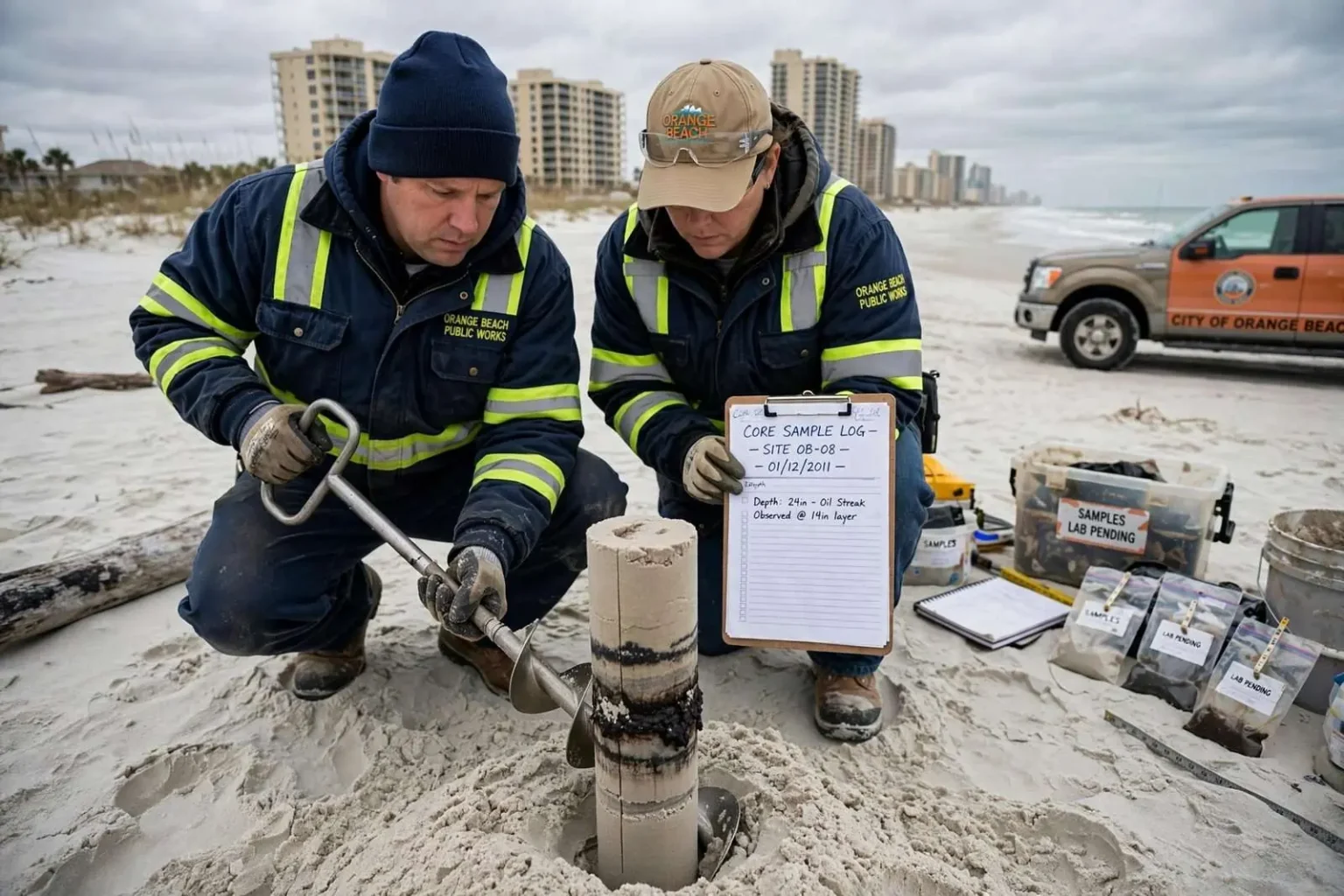
Orange Beach crews began testing beach sand independently in January 2011 as the city assessed its recovery from the Deepwater Horizon oil spill, according to a report from a local television station. The city’s own testing program came as officials grew impatient with the pace and transparency of the official cleanup assessments, and it marked a decision by the Baldwin County resort city to gather its own data about what lay beneath the surface of its most valuable asset — its beaches.
Workers used an auger to pull deep sand samples from the beach, inspecting the cores for lines of oil buried below the surface. The technique allowed crews to look beneath the visible layer of sand, where weathered oil from the spill had been known to settle in mats and streaks that casual inspection would miss. Deep sampling was a meaningful step beyond the surface observations that had guided much of the cleanup work to that point, because buried oil could resurface over time with tides and storms, prolonging the spill’s impact on the tourism economy.
Mayor Tony Kennon said at the time that the city wanted data before declaring conditions acceptable, reflecting a governing philosophy that put independent verification ahead of official reassurances. Kennon also said the city planned to involve scientists from Alabama research institutions in the effort, a partnership intended to give the city’s findings scientific credibility and to tap the expertise that existed at the state’s marine and environmental research centers.
The Deepwater Horizon Spill and Alabama’s Beaches
The Deepwater Horizon drilling rig exploded in the Gulf of Mexico in April 2010, and the resulting spill became the largest marine oil spill in American history. Oil from the well reached Alabama’s beaches in the weeks that followed, staining the white sand of Orange Beach and Gulf Shores and prompting closures that devastated the summer tourism season. Waves of tar balls and oil mats came ashore through the summer of 2010, and cleanup crews worked through the fall and into the winter removing what they could from the sand.
By January 2011, visible oil had been cleared from most of the public beach, but questions lingered about what remained beneath the surface. Storms and tidal action in the months after the spill reburied and re-exposed oil in unpredictable patterns, and residents and business owners reported tar balls turning up on the beach long after official statements declared the water clean. That gap between official assessments and what people were seeing on the ground was the backdrop for Orange Beach’s decision to test on its own.
How the Independent Testing Worked
The auger method used by Orange Beach crews involved drilling deep into the sand and extracting intact cores that showed the layering beneath the surface. Inspectors examined those cores for lines and streaks of weathered oil — material that had degraded from its crude form into a persistent, tar-like residue. Where samples showed buried oil, the city could flag those locations for additional cleanup rather than relying on surface sweeps that missed the problem entirely.
Independent testing of this kind filled a gap in the official response. The responsible party’s cleanup operations and the state and federal oversight agencies conducted their own sampling, but local governments along the coast had limited visibility into the data and limited control over where and how deeply crews tested. By generating its own results, Orange Beach gained a seat at the table in discussions about when the beaches were truly clean and what work still needed to be done.
The plan to bring in scientists from Alabama research institutions reflected the state’s existing network of marine science expertise. Institutions along the Gulf Coast — including the Dauphin Island Sea Lab and university marine and environmental science programs — had been studying the spill’s effects since the well was capped, and their researchers brought sampling methods, laboratory analysis, and analytical independence that strengthened any dataset they touched. For a city government, partnering with academic scientists also lent credibility that in-house testing alone could not provide.
The stakes for the city could hardly have been higher. Orange Beach’s economy is built almost entirely around the Gulf — condo towers, beach houses, charter fishing, and the restaurants and shops that serve visitors — and a sustained perception that the beaches were contaminated would have damaged bookings for years. City leaders understood that economic reality, and the testing program was as much about protecting the city’s economic future as it was about environmental monitoring.
The plan to bring in scientists from Alabama research institutions reflected the state’s existing network of marine science expertise. Institutions along the Gulf Coast — including the Dauphin Island Sea Lab and university marine and environmental science programs — had been studying the spill’s effects since the well was capped, and their researchers brought sampling methods, laboratory analysis, and analytical independence that strengthened any dataset they touched. For a city government, partnering with academic scientists also lent credibility that in-house testing alone could not provide.
What the Testing Meant for Recovery
Independent sampling programs like Orange Beach’s served several purposes at once. They gave the city a factual basis for deciding when conditions were acceptable, they documented the presence or absence of buried oil in a way that could support claims for additional cleanup, and they reassured or warned the public based on evidence rather than optimism. In the years that followed the spill, monitoring along Alabama’s beaches continued, with periodic findings of tar balls and buried oil mats appearing after storms — reminders that the spill’s residue did not disappear on any single schedule.
The dispute over cleanup standards was a recurring theme of the recovery period. Local officials along the Gulf Coast repeatedly pressed for deeper and more thorough removal than the official criteria called for, arguing that the tourism economy could not afford repeated discoveries of oil on the beach. The tension between the pace of official cleanup declarations and the concerns of coastal communities played out in public meetings and in the press, and Orange Beach’s independent testing was one of the ways a city asserted its own standard.
Kennon’s approach — demanding data before declaring conditions acceptable — became a hallmark of the city’s posture during the recovery. City leaders maintained that the burden of proof belonged with those claiming the beach was clean, not with residents who doubted it. That stance resonated with business owners and residents who had watched the spill upend their summer, and it aligned the city government with the people whose livelihoods depended on the answer.
A Historical Record
This account is a historical summary of a 2011 beach-testing report, not a current beach-condition report. The events described took place more than a decade into the past, and conditions on Alabama’s beaches today are monitored and reported by the agencies responsible for them in the present day. The value of the record lies in what it documents about how one Gulf Coast city responded to the largest environmental disaster in its history — by taking measurements into its own hands.
The Deepwater Horizon spill’s aftermath extended far beyond beach cleanup. Legal proceedings over damages ran for years, resulting in a multibillion-dollar settlement that directed money to the Gulf states for restoration, economic recovery, and environmental projects. Alabama’s share funded a range of efforts on the coast, from beach nourishment and habitat restoration to infrastructure and tourism promotion, shaped in part by the experiences of cities like Orange Beach during the response period.
The spill also left a lasting imprint on how coastal governments think about risk. Cities along the Alabama shore built experience in emergency response, environmental monitoring, and public communication that outlasted the cleanup itself, and the relationships formed between municipal officials and the scientific community during that period continued in later years. For Orange Beach, the January 2011 decision to test independently stands as an early example of a local government refusing to take recovery on faith — and insisting on the data before it declared its beaches acceptable.
Orange Beach itself is a city of a few thousand permanent residents that swells enormously during the tourism season, its population multiplied many times over by visitors filling the high-rise condominiums and rental houses that line its shore. The city incorporated in the 1980s, and in the decades since it has worked to balance development pressure with the environmental quality that draws people to it in the first place. Its waterways — Perdido Pass, Wolf Bay, and the back bays behind the barrier peninsula — are as central to the city’s identity as the beach itself, supporting a large charter and recreational fishing fleet.
The city’s beaches were renourished repeatedly even before the spill, part of the ongoing effort to maintain the sand supply that storms continually redistribute. Beach nourishment projects along the Alabama coast have dredged sand from offshore deposits and pumped it onto the shoreline, a cycle of maintenance that coastal communities across the Gulf and the nation rely on. After the spill, that existing expertise in sand management was directly relevant to the cleanup, because the same understanding of how sand moves — and how buried material migrates — informed where crews should look for oil.
Tourism officials in Orange Beach and Gulf Shores mounted a deliberate campaign in the years after the spill to rebuild visitor confidence, using advertising, publicity, and events to counter the lasting images of oiled beaches from the summer of 2010. Occupancy and visitor numbers recovered over time, aided by the settlement funds that supported coastal promotion. The recovery was not instant, and the 2011 testing program fell squarely within the period when every piece of news about the beach mattered to the coming season’s bookings.
Looking back from the present, the independent testing of January 2011 reads as a small but telling episode in the larger story of the spill response — a moment when a city decided that the truth about its beaches should be measured, not merely announced. The auger holes drilled into the sand that winter became part of a record that helped the community understand what it was dealing with, and they reflected a straightforward principle that endured: when the stakes are your town’s future, verify for yourself.