Baldwin County Tourism Reported Sharp Oil-Spill Decline in 2010
A 2010 WKRG report described a sharp summer tourism decline in Baldwin County's coastal communities after the Gulf oil spill.
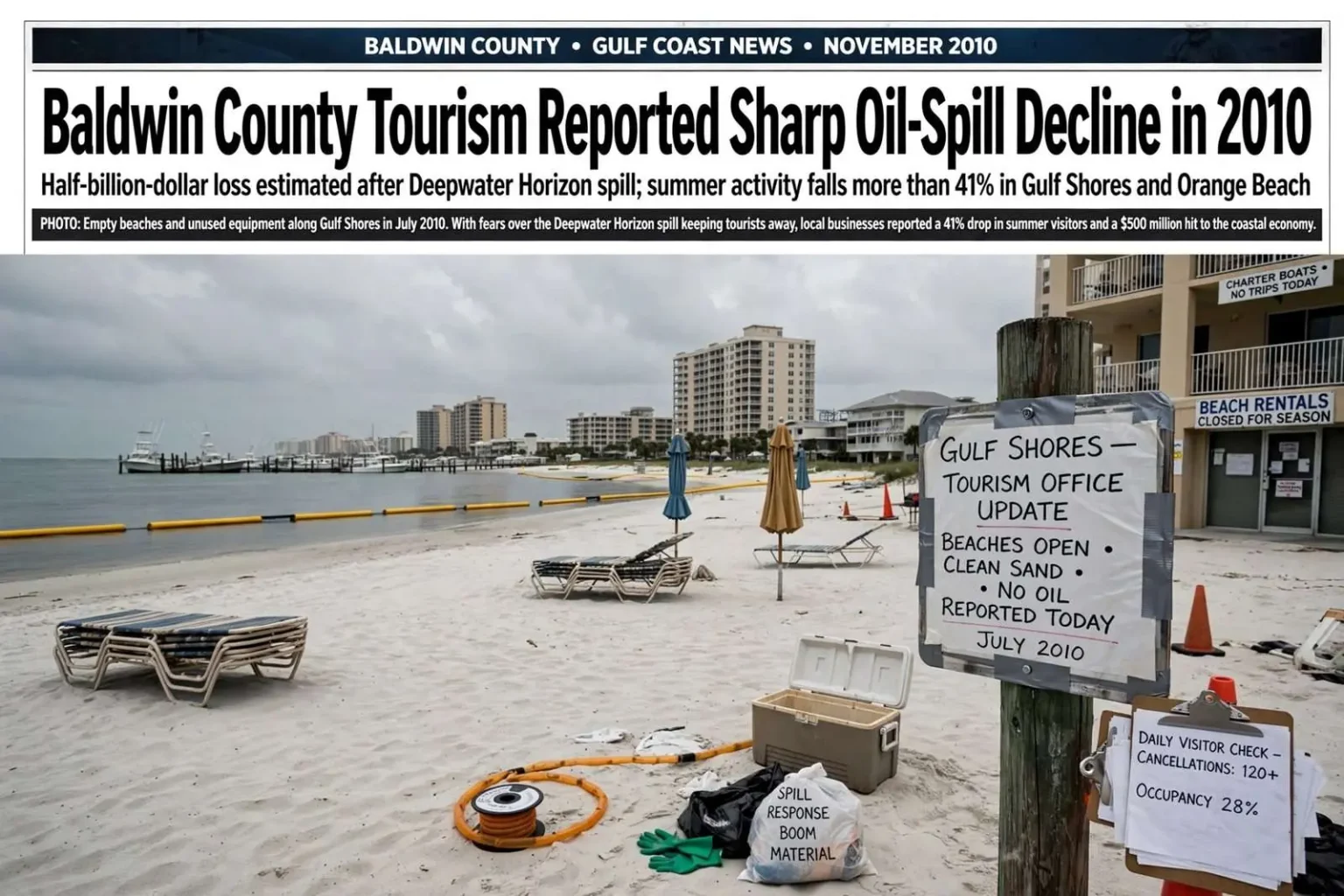
Tourism officials in Gulf Shores and Orange Beach reported severe losses during the summer of 2010 following the Deepwater Horizon oil spill, according to a local news report published that November. The report said Baldwin County’s coastal tourism industry estimated a half-billion-dollar hit, with summer indicators down more than 41 percent.
Officials said reduced lodging traffic also affected restaurants, shops and other local businesses, spreading the damage well beyond the hotels and condominiums that anchor the beach economy. When visitors stay away from the beach towns, the entire coastal service sector feels it — from the charter captains at the marinas to the servers and shop clerks who work the summer season.
The numbers told a stark story for a coast that had counted on its busiest season. A drop of more than 41 percent in summer indicators meant a near-halving of the activity that normally defines June, July and August in the beach communities, and the half-billion-dollar estimate captured losses that accumulated across every sector tied to the visitor economy.
The summer the oil came
The Deepwater Horizon rig exploded in April 2010, killing 11 workers and sending crude oil pouring from a well a mile beneath the Gulf of Mexico. For weeks through the spring, residents of Alabama’s beaches watched forecasts of where the slick might travel, and by early summer oil had reached the barrier islands and shoreline areas of the northern Gulf, including parts of Alabama’s coast.
The impact on tourism was immediate even where oil never came ashore. Days of uncertainty — will the beaches close, will the water be safe — emptied reservations that would normally have been confirmed months in advance. News coverage of oiled shorelines elsewhere in the Gulf kept would-be visitors away even on the many days when Gulf Shores and Orange Beach beaches were clean and open.
Local officials worked through the summer to communicate what was happening on their beaches: daily conditions reports, photos of clean sand and open water, and appeals to visitors not to cancel a season that, in many stretches, was proceeding with the white sand largely untouched. Those appeals fought against images that told a simpler, darker story.
The ripple through the local economy
Baldwin County’s coastal economy is built on tourism, and the losses moved through it in waves. Lodging took the first blow as bookings evaporated; restaurants followed as fewer visitors meant fewer dinners out; and charter fishing boats, amusement operators, rental agencies and retail shops all reported the same season-long decline.
Seasonal workers felt it too. The beach economy runs on summer jobs — students and seasonal residents who count on May-through-August employment — and a 41 percent drop in activity meant shortened hours and lost positions across the coast.
The half-billion-dollar estimate represented more than a season’s lost revenue. It measured cancellations, discounted rates, empty attraction tickets and the smaller purchases that add up when millions of visitor-days disappear from a community that lives on them.
The response along the coast
The tourism offices in Gulf Shores and Orange Beach did not spend the summer waiting. Their response became one of the more aggressive recovery campaigns on the Gulf: advertising aimed at telling travelers the Alabama beaches were open, reassurance campaigns built around real-time images of clean sand, and coordination with state and federal officials on cleanup claims that would eventually bring compensation to businesses and workers who lost income to the spill.
The messages had a specific target: the perception problem. Even as crews worked the shoreline and the well itself was finally capped in mid-July, the belief that the beaches were coated in oil persisted among potential visitors across the Southeast. Countering that belief with photographs, condition reports and word of mouth became the industry’s central task — and the one officials hoped would carry into the fall and winter seasons.
Claims processes added their own layer of complexity. Businesses filed for compensation tied to spill losses, and the sums businesses sought reflected the same arithmetic the half-billion-dollar estimate described: a season’s revenue that never arrived, and costs that continued regardless.
Looking toward the next season
By November, as the report noted, tourism leaders said they were looking toward the next season and hoped winter visitors would help spread the word that the beaches were open and recovering. The strategy was straightforward: bring in the winter guests — snowbirds, weekend travelers and holiday visitors — and let them carry accurate accounts of the coast back to their home communities.
Winter visitors have long been part of Baldwin County’s tourism rhythm. The snowbird season, when retirees from the Midwest and Canada settle into the beach towns for weeks or months at a time, fills lodging in months that would otherwise run lean. In 2010, that steady audience took on an added role as ambassadors for a coast working to rebuild its reputation.
Every satisfied winter visitor who went home saying the beaches looked beautiful, the water was clear and the seafood was as good as ever was, in the industry’s arithmetic, worth more than an advertisement — a credible voice reaching exactly the people who had canceled their 2010 summer trips.
What the 2010 numbers came to mean
The half-billion-dollar estimate and the 41 percent decline became the yardstick for measuring what the Gulf Coast had lost — and, in time, for measuring what it won back. The recovery that followed in subsequent summers, with record visitor numbers returning to the Alabama beaches, made the depth of the 2010 hole easier to see in hindsight.
The episode also left lasting changes in the region’s tourism industry: sharper crisis-communication playbooks, deeper diversification in the events and attractions calendar, and a clearer understanding of how quickly perception can undo a destination’s most valuable asset — the confidence of its visitors.
For the businesses that endured the summer of 2010, the report that November captured a season they would not forget: the summer the oil kept the crowds away, the indicators fell by more than 41 percent, and a half-billion dollars went missing from an economy that lives on sunshine, white sand and the families who come looking for both.
The hope expressed that fall — that winter visitors would carry the message of open, recovering beaches into the next season — was the first chapter of the comeback story Baldwin County’s coast would tell in the years that followed.
How the coast’s tourism economy works
To understand the size of the loss, it helps to understand what tourism means to Baldwin County’s coast. Gulf Shores and Orange Beach anchor a visitor economy built on the condominium towers, beach houses, hotels and campgrounds that house millions of visitor-nights a year, supported by restaurants, attractions, fishing charters and retail that exist almost entirely on tourist spending.
The summer quarter is the engine of the whole system. Rates peak, occupancy runs near capacity, and the revenue from June through August carries businesses through the leaner months of fall and winter. That concentration is why a single lost summer did damage far out of proportion to its three months on the calendar.
The county’s position matters too. Baldwin County is Alabama’s largest county by area, and its coastal strip is the state’s only oceanfront — when Alabamians want the beach, Gulf Shores and Orange Beach are where they go, joined by visitors from Tennessee, Georgia, Louisiana and across the Southeast who have made the Alabama beaches a family tradition across generations.
April 2010: the spill begins
The Deepwater Horizon disaster began on the night of April 20, 2010, when the drilling rig exploded offshore in federal waters. Eleven workers died, and in the days that followed it became clear that the well on the seafloor was leaking crude oil at rates that made it the worst spill in the Gulf of Mexico’s history — and one of the largest environmental disasters in American history.
For the coastal towns of the northern Gulf, the emergency unfolded in stages: first the uncertainty, as response vessels staged along the coast and forecasts tracked the slick’s drift; then the tar balls and oil mousse that reached Alabama’s shoreline in June; and through it all, the relentless drumbeat of national coverage that kept would-be tourists away regardless of the day-to-day conditions at any given beach.
Cleanup crews, boom lines and response vehicles became part of the summer’s scenery in the beach towns, and residents told a split story — stretches of sand that were clean and open on many days, alongside the contamination events that closed sections of shoreline and kept the crisis in the headlines.
The recovery years that followed
The story of the summer of 2010 did not end with the November report. Restoration money from the spill’s legal settlements later flowed into Gulf Coast projects, including enhancements to the Alabama coast’s parks, dunes and public amenities. The tourism industry rebuilt its marketing, its events calendar and its visitor base with a determination that became a regional hallmark.
Within a few seasons, the Alabama beaches were setting records for visitor numbers and lodging revenue — a comeback that made the half-billion-dollar loss of 2010 look, in retrospect, like the low point of a story the coast ultimately turned around.
But the memory of that summer remained a lesson in the coast’s vulnerability. An economy built on a beach depends on the health of the water beside it, and the 2010 report — with its 41 percent decline and its half-billion-dollar estimate — stands as the clearest measurement of what happens when that health is called into question.
It also stands as a record of the response: officials and businesses who spent the fall of 2010 not waiting for the next summer, but working to bring visitors back — one winter guest, one honest photograph and one encouraging story at a time.