Orange Beach Businesses Raised BP Claims Concerns in 2010
A 2010 WKRG report documented Orange Beach business owners' concerns over oil-spill claims ahead of a meeting with Kenneth Feinberg.
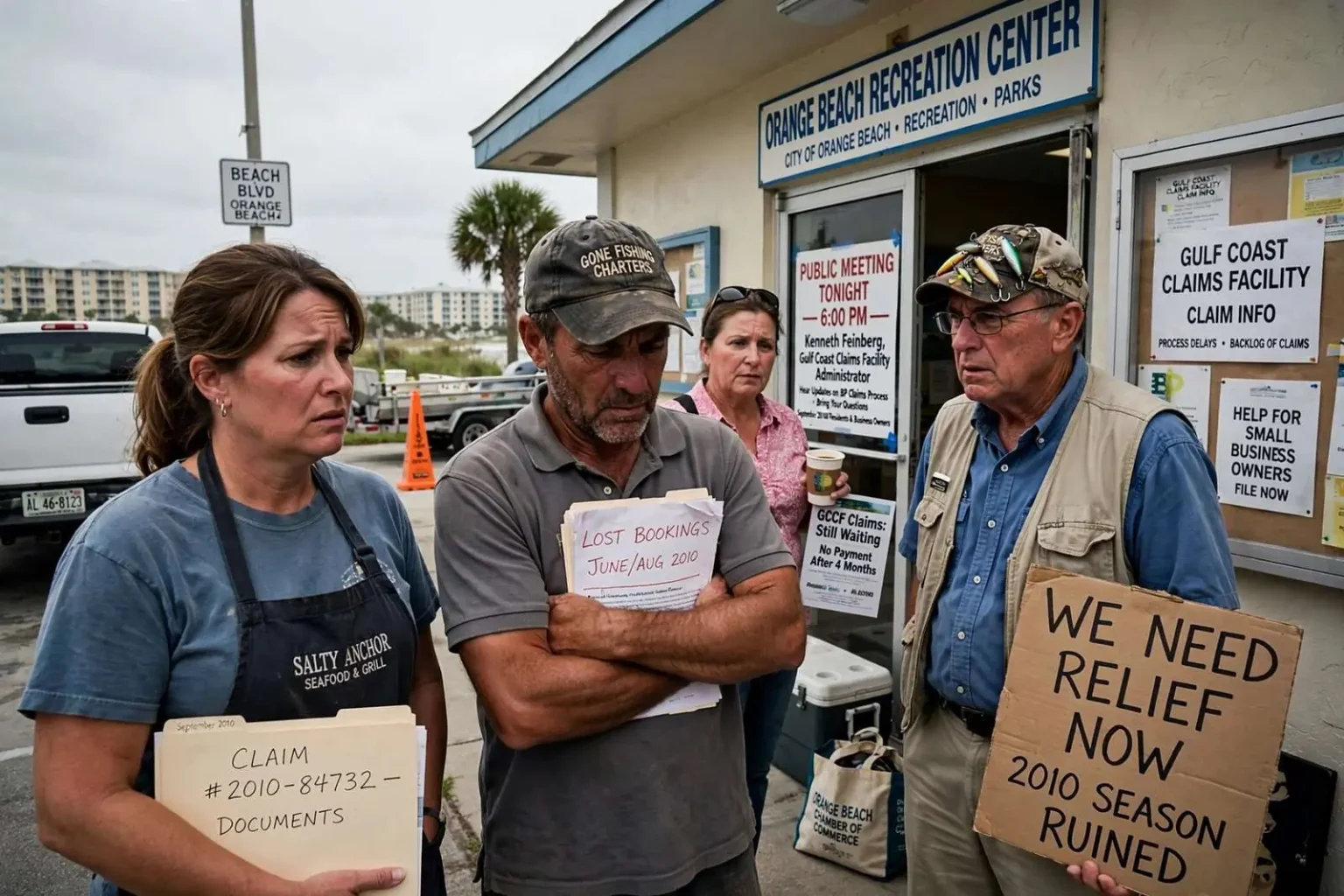
Business owners in Orange Beach voiced growing frustration in September 2010 over the slow pace of compensation payments tied to the Deepwater Horizon oil spill, telling a local television station that reduced customer traffic had strained their operations while promised relief had yet to arrive. Their complaints centered on the Gulf Coast Claims Facility, the fund created to pay spill-related losses, and on the difficulty many claimants faced in navigating its paperwork and payment schedules. In an effort to answer questions directly, a public meeting was planned with Kenneth Feinberg, the fund’s administrator, at the Orange Beach Recreation Center, where residents and business owners were expected to turn out in force seeking answers about the claims process.
The frustration expressed by Orange Beach business owners that month reflected a broader anxiety that had settled over Alabama’s Gulf Coast since the spring. The Deepwater Horizon drilling rig, leased by oil company BP, had exploded roughly fifty miles offshore in the Gulf of Mexico on April 20, 2010, killing eleven workers and setting off what would become the largest marine oil spill in United States history. In the weeks that followed, oil made landfall along stretches of the Alabama coastline, prompting beach closures, fishing restrictions and a wave of cancellations that hit coastal communities during the height of the summer tourism season.
A tourism economy under strain
Orange Beach sits on the eastern end of Alabama’s Gulf shoreline, a Baldwin County resort city whose economy is built almost entirely around visitors. Condominium towers, charter fishing fleets, seafood restaurants, gift shops and rental agencies line the beach highway, and the summer months supply the revenue that carries many of those businesses through the slower fall and winter seasons. When the spill arrived in early summer 2010, it struck at precisely the moment when those businesses would normally be earning the bulk of their annual income.
Even where oil never visibly reached the sand, the perception of a fouled coastline traveled far beyond the region. Vacationers who had booked Gulf Shores and Orange Beach rentals months in advance canceled their trips, and occupancy rates across Baldwin County fell sharply. Charter boat captains watched their calendars empty as offshore and inshore fishing grounds were closed. Restaurant owners reported that even diners who did come were wary of ordering the local seafood that is a signature of the coast’s dining scene. For small operators living season to season, the loss of even a few peak weeks could mean the difference between a profitable year and one that ended in debt.
Business owners who spoke with the station in September 2010 described exactly that squeeze. Customer traffic had fallen, they said, and their operations were strained as a result. What made the situation harder to bear, they told reporters, was that the compensation they had been counting on to bridge the gap had not arrived. Many had filed claims months earlier and were still waiting, or had received payments they considered far too small to cover documented losses.
The Gulf Coast Claims Facility
The fund at the center of those complaints had itself been born of controversy. In the immediate aftermath of the spill, BP operated its own claims process, which was widely criticized as slow, inconsistent and adversarial. Under pressure from the White House and Gulf Coast elected officials, BP agreed in June 2010 to establish an independent claims facility, and Kenneth Feinberg, a Washington attorney who had previously administered the compensation fund for victims of the September 11 attacks, was named to run it.
The Gulf Coast Claims Facility formally took over the payment of spill claims from BP in August 2010, becoming the sole channel through which individuals and businesses could seek compensation outside the courts. Claimants who accepted emergency payments gave up nothing, but accepting a final payment required signing away the right to sue BP and other responsible parties. That condition itself became a source of distrust along the coast, where many residents worried that quick settlements were being pushed on people who did not fully understand what they were signing.
By September, the GCCF was processing tens of thousands of claims from across the Gulf states, and the volume alone strained its capacity. Claimants described long waits, repeated requests for documentation and payments that arrived in amounts far below what they had requested. Businesses with seasonal income histories found the documentation requirements particularly burdensome, since many lacked the formal records the fund demanded as proof of losses. The result was a backlog that left money pledged by BP sitting undistributed while mortgage payments, payroll and supply bills came due in coastal towns.
Feinberg comes to the coast
Against that backdrop, the planned meeting at the Orange Beach Recreation Center took on outsized importance. Feinberg had begun holding public sessions across the Gulf Coast in an effort to hear complaints directly and to explain the fund’s procedures to the people affected by them. These town-hall-style gatherings were often contentious, with claimants lining up at microphones to describe unpaid claims and question why a multibillion-dollar fund seemed unable to move faster. For Feinberg, the meetings served a dual purpose: they gave him unfiltered feedback about where the process was failing, and they gave claimants a chance to put a face to the bureaucracy deciding their fates.
The Orange Beach session was expected to draw residents and business owners from across the resort city and neighboring communities, many of whom had been waiting on the GCCF for months. Organizers and local officials hoped the meeting would produce concrete answers about payment timelines, documentation standards and the distinction between emergency payments and final settlements. For the business owners who had spoken to the station, it was an opportunity to make their case publicly rather than through a toll-free number or an online form.
The fact that Feinberg was coming to Baldwin County at all was seen by some as a measure of how badly relations between the fund and the coast had deteriorated. City leaders and business associations had repeatedly pressed for a local presence, arguing that decisions about Gulf Coast livelihoods were being made by an administrator with offices in Washington and Bilbao-like distance from the communities he was serving. A recreation center meeting in a city whose very identity was tied to the water was, in that sense, a small concession to the demand for accountability.
What claimants were asking for
The questions Orange Beach claimants brought to the process were in many ways the same questions being asked all along the Gulf. How was a loss calculated for a business with no two years of identical seasonal income? Why did two nearly identical claims produce different payment amounts? What documentation could satisfy a claims adjuster when the loss itself — empty rental units, unfilled charter slots, missing dinner reservations — left no paper trail in the traditional sense? And how long would the process take, given that bills did not pause while claims were under review?
Emergency payments, the first stage of GCCF relief, had been intended as a stopgap: a monthly or single payment designed to hold claimants over until a full accounting of damages could be made. But many Orange Beach business owners said the emergency payments they received did not match their documented losses, and some received nothing at all while their applications sat in review. The gap between what the fund promised and what it delivered became the central grievance of the fall of 2010 along the Alabama coast.
There was also deep uncertainty about the future. No one in September 2010 knew how long the ecological and economic effects of the spill would linger, or whether the following summer’s tourist season would rebound. Accepting a final settlement meant betting on that unknown future. Declining it meant pursuing litigation against one of the largest corporations in the world, a path with its own years-long timeline and no guarantee of recovery. That dilemma — cash now versus a lawsuit later — hung over nearly every conversation about the claims process on the coast.
Baldwin County’s broader fight
Orange Beach was not alone in its frustration. Neighboring Gulf Shores faced the same collapse in summer bookings, and communities farther up Mobile Bay, from Fairhope to Bayou La Batre — the small working waterfront long famous for its shrimp fleet — felt the effects through tourism, seafood processing and commercial fishing.
Local officials spent the summer and fall of 2010 pressing state and federal agencies for help: marketing money to counter the perception that the beaches were ruined, grants to support affected businesses, and pressure on the claims process to speed up. The state mounted advertising campaigns aimed at potential visitors in nearby markets, and municipalities organized their own events to lure tourists back to sand that, in many stretches, had been cleaned and declared safe. Rebuilding confidence, officials found, was harder than cleaning the beaches themselves.
The meeting and its stakes
When the public meeting at the Orange Beach Recreation Center was announced, it was framed in local coverage as a chance for the claims administrator to hear directly from the people whose claims were stuck. The recreation center, a familiar community gathering point for the city, offered the kind of open, public setting that town officials wanted: no appointment necessary, no forms required, just residents and business owners with questions and an administrator on the hot seat. Attendance was expected to include not only those with pending claims but also residents who depended indirectly on the tourist economy — teachers, contractors, retail workers — whose livelihoods rose and fell with the beach season.
For the business owners who had first aired their complaints with the station, the meeting represented a test of whether the process was capable of responding to feedback. They had said plainly that they had not yet received the relief they expected, and that reduced customer traffic had strained operations to the breaking point. What they wanted was not sympathy but specificity: dates, dollar amounts, and a documented path from claim to check.
What the fall of 2010 meant for the coast
The months surrounding the meeting were among the most uncertain the Alabama coast had experienced since the spill began. The well that had gushed for most of the summer had been capped in July, and by September the visible threat of new oil reaching the shoreline had largely passed. But the economic aftereffects were only beginning to be tallied. Tax revenue in beach communities was down. Rental companies were negotiating with owners over missed income. Charter fishermen and seafood processors were waiting on reopening decisions and claims payments of their own. And the winter season, normally a quiet stretch the coast rode out on summer savings, loomed for businesses whose savings had been spent surviving the summer.
In that context, the pace of the claims facility was not an abstraction. For a restaurant in Orange Beach that had lost its peak season, an unpaid claim meant deciding whether to make payroll in October. For a condominium owner whose rentals had gone dark, it meant a mortgage payment due with no rental income to meet it. The frustration voiced in September 2010 was the frustration of people who felt the disaster had happened to them twice — once in the water and once in the paperwork.
This article is a historical summary of reporting from 2010. It describes the concerns and claims expressed by Orange Beach business owners and residents at that time, as well as the compensation process as it then existed. It does not describe current claims procedures, current conditions on the coast, or the outcomes of any individual claims. Readers seeking information about contemporary oil-spill claims or restoration programs should consult current official sources, including state and federal agencies administering Gulf restoration funds. The record of that autumn — the long lines, the unanswered questions and the meeting at the recreation center — stands as part of the coast’s history, and of the lesson learned there: that the true cost of a disaster is measured not only at the shoreline, but in the patience of the people waiting to be made whole.