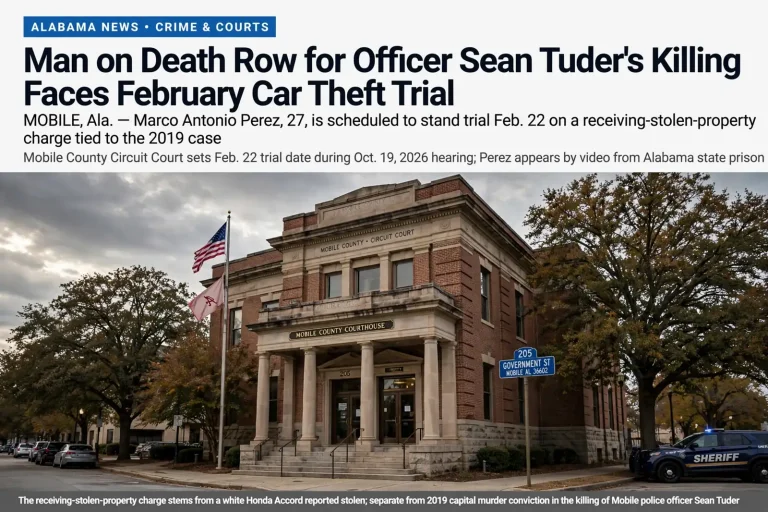
Baldwin County Judge in Long-Running Sewer Land Fraud Case Says He Has No Conflicts
Newly assigned Baldwin County Circuit Judge Clark Stankoski asked attorneys to flag any conflicts of interest as he took over a nearly six-year-old fraud lawsuit over a 242-acre Magnolia Springs property tied to Baldwin County Sewer Service.
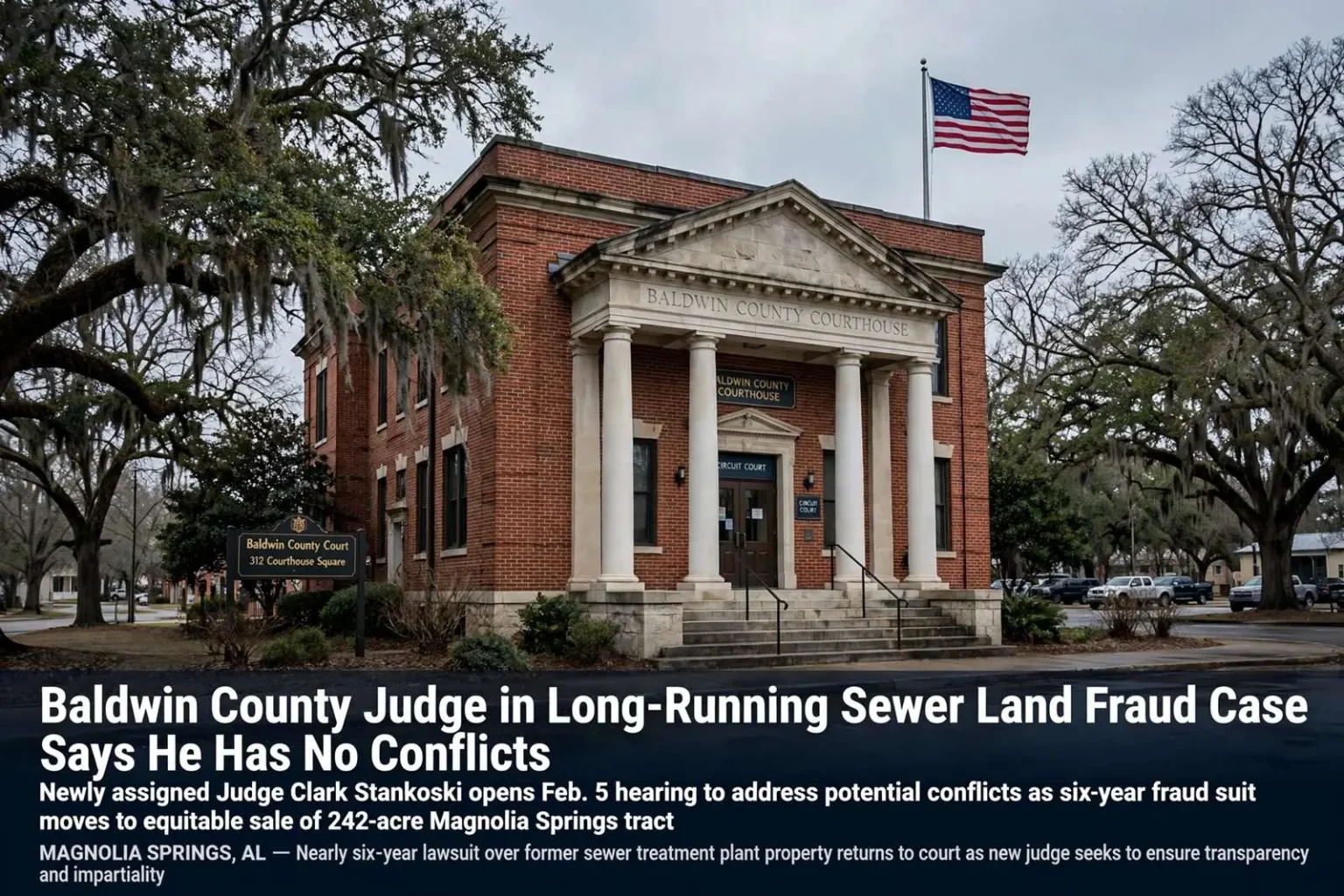
A Baldwin County Circuit Court hearing that lasted less than eight minutes turned into a moment of judicial self-scrutiny this month, as newly assigned Judge Clark Stankoski opened proceedings in a nearly six-year-old fraud lawsuit by asking attorneys on both sides to flag any conflicts of interest before the case moves forward.
“I know there have been all kinds of issues with Judge Norton. Having not had this case since 2014, what do I need to look at as far as any conflicts of interest? I want that on the record right now,” Stankoski told the parties gathered for the Feb. 5 hearing in the case of Bass Enterprises v. Pennstar LLC and other defendants.
Stankoski inherited the case in October after Judge Joe Norton recused himself. Norton had ruled against the plaintiffs on the substance of the fraud allegations just a week before the case was set to go to trial. He later disclosed a conflict of interest stemming from his relationship with a business partner connected to some of the defendants. Norton’s dismissal of the complaint had already been affirmed without a written opinion by the Alabama Supreme Court, and his recusal came the same day the Alabama Judicial Inquiry Commission confirmed it had received a complaint about his handling of the case and that the complaint would “receive serious consideration.”
At the center of the litigation is a 242-acre tract in Magnolia Springs that was purchased in 2005 as a potential site for a new sewer treatment plant for Baldwin County Sewer Service, the largest privately owned utility of its kind in Alabama. The only issue left to resolve in the case is an equitable sale for division of that property.
What the Conflict Allegation Involves
Norton’s disclosure of a conflict of interest came shortly after he had issued a ruling that effectively ended the fraud allegations that had been the focus of the case for years. The plaintiffs had argued that the purchase of the Magnolia Springs tract was structured in a way that defrauded the seller, and the case had been moving toward trial before Norton’s ruling dismissed the complaint. The Alabama Supreme Court affirmed that dismissal without a written opinion, which is the kind of procedural posture that often signals a relatively straightforward decision.
The conflict disclosure changed the trajectory of the case. Norton’s relationship with a business partner connected to some of the defendants raised questions about whether he should have disclosed the relationship earlier, and the Judicial Inquiry Commission’s confirmation that it had received a complaint suggested the matter had attracted formal scrutiny. Stankoski’s reassignment and his opening question to attorneys about conflicts of interest at the Feb. 5 hearing reflected an effort to reset the case’s procedural posture and address any lingering concerns about judicial impartiality.
The Property at the Heart of the Case
The 242-acre tract in Magnolia Springs was acquired in 2005 as a potential site for a new sewer treatment plant serving Baldwin County Sewer Service. The utility is the largest privately owned sewer utility of its kind in Alabama, and the Magnolia Springs property would have represented a significant expansion of its service capacity had the plant been built. The fact that the property was never developed into a treatment plant is at the center of the plaintiffs’ argument that the original transaction was structured in a way that was unfair to the seller.
Magnolia Springs, a small town on the Eastern Shore of Mobile Bay known for its riverfront lifestyle and annual Christmas on the River festival, has been one of the faster-growing communities in Baldwin County over the past two decades. The presence of a 242-acre tract zoned or planned for utility use in that growth corridor adds a layer of local interest to the litigation, even though the equitable-sale issue that remains to be resolved is fundamentally a question about how the property’s value should be divided among the parties.
What Happens Next in the Case
With the fraud allegations already dismissed and that ruling affirmed by the Alabama Supreme Court, the only remaining issue is the equitable sale for division of the Magnolia Springs tract. That process typically involves the court appointing a commissioner to sell the property at a public auction and distribute the proceeds according to the parties’ ownership shares, after accounting for any offsets or credits that the court determines are appropriate. The Feb. 5 hearing was the first opportunity for Stankoski to take stock of where the case stands and to address any procedural issues before the equitable-sale process moves forward.
The reassignment of the case to Stankoski and his careful opening questions also suggest that the court is aware of how the previous handling of the matter has been viewed. The combination of the undisclosed conflict, the dismissal of the fraud allegations a week before trial, and the Alabama Supreme Court’s decision to affirm without a written opinion has left the procedural record unusual, and Stankoski’s effort to put any new conflicts on the record early in his handling of the case is the kind of move judges make when they want to insulate the litigation from further procedural challenges.
Why the Case Has Drawn Attention
The Bass Enterprises v. Pennstar case has attracted more attention than its subject matter might otherwise warrant because of the procedural irregularities that emerged in the final weeks of Norton’s handling of the matter. Cases involving undisclosed conflicts of interest, abrupt dismissals and quick affirmances by appellate courts tend to attract the attention of both the legal community and the public, especially when the underlying dispute involves a property of significant value in a fast-growing part of Baldwin County.
For Baldwin County residents who have watched the case move through the courts over the past six years, the reassignment to Stankoski and the renewed focus on conflicts of interest are signals that the procedural aspects of the matter are being handled with renewed care. The remaining equitable-sale issue is, by itself, a relatively standard piece of litigation, but it is now unfolding in a context where the court is openly attentive to the kinds of issues that complicated the case under Norton’s stewardship.
What an Equitable Sale Means
An equitable sale for division is a remedy Alabama courts use when property is owned by multiple parties who no longer want to hold it together. Rather than forcing one party to buy out the other at a price they cannot agree on, the court orders the property sold at public auction and the proceeds divided according to the parties’ ownership shares. The procedure also allows the court to make adjustments for contributions one party may have made to the property — such as improvements, taxes or insurance payments — that exceed their ownership share.
For the 242-acre Magnolia Springs tract, an equitable sale would likely produce a public auction of the property, with the proceeds distributed according to whatever ownership structure the court finds is supported by the record. Because the property was purchased in 2005 as a potential sewer treatment plant site, its current value is shaped by Baldwin County’s growth over the past two decades and by the local real-estate market in the Magnolia Springs area, where prices have risen sharply since the original transaction.
Baldwin County Sewer Service in Context
Baldwin County Sewer Service, the utility that once planned to develop the Magnolia Springs tract, is one of several large private sewer utilities operating in Baldwin County, where rapid residential growth has outpaced the capacity of some municipal systems. The utility’s footprint along the Eastern Shore and in the county’s southern communities has expanded significantly since 2005, and the Magnolia Springs site would have represented one of its more ambitious service-area expansions had the project moved forward. That it did not is part of the context for the plaintiffs’ allegations about how the original transaction was structured.
The Magnolia Springs property itself sits in a part of Baldwin County that has seen significant residential and commercial development since the 2005 purchase. The town’s location along the Magnolia River and its proximity to the Gulf Coast beaches have made it a desirable address for second-home buyers and retirees, and land prices in the area have risen accordingly. A 242-acre tract in that market carries a meaningful value regardless of its original intended use, which is why the equitable-sale remedy that remains to be resolved is likely to produce a meaningful payout to whichever parties the court determines are entitled to a share of the proceeds.
How the Judicial Inquiry Commission Fits
The Alabama Judicial Inquiry Commission, which confirmed it had received a complaint about Norton’s handling of the case, is the state body responsible for investigating allegations of judicial misconduct. The Commission’s confirmation that the complaint would “receive serious consideration” does not itself indicate that Norton violated any specific rule, but it does signal that the complaint cleared an initial threshold and that the Commission intends to gather more information before deciding whether to take further action. Norton’s recusal from the Bass Enterprises case came on the same day the Commission confirmed it had received the complaint.
For Stankoski, who inherited the case after Norton’s recusal, the Commission’s involvement adds a layer of public attention to the litigation. Even if the Commission ultimately takes no further action against Norton, the procedural history of the case is now part of the public record, and Stankoski’s careful handling of the Feb. 5 hearing reflects an awareness that any future appellate review of the case will scrutinize the procedural record with the conflict-of-interest issue in mind.