Blacktip Sharks Filmed in the Shallows at Gulf State Park Pier Over Labor Day Weekend
A Wedowee visitor filmed blacktip sharks swimming in shallow water near the Gulf State Park pier over Labor Day weekend, prompting a reminder about swimming near fishing piers.
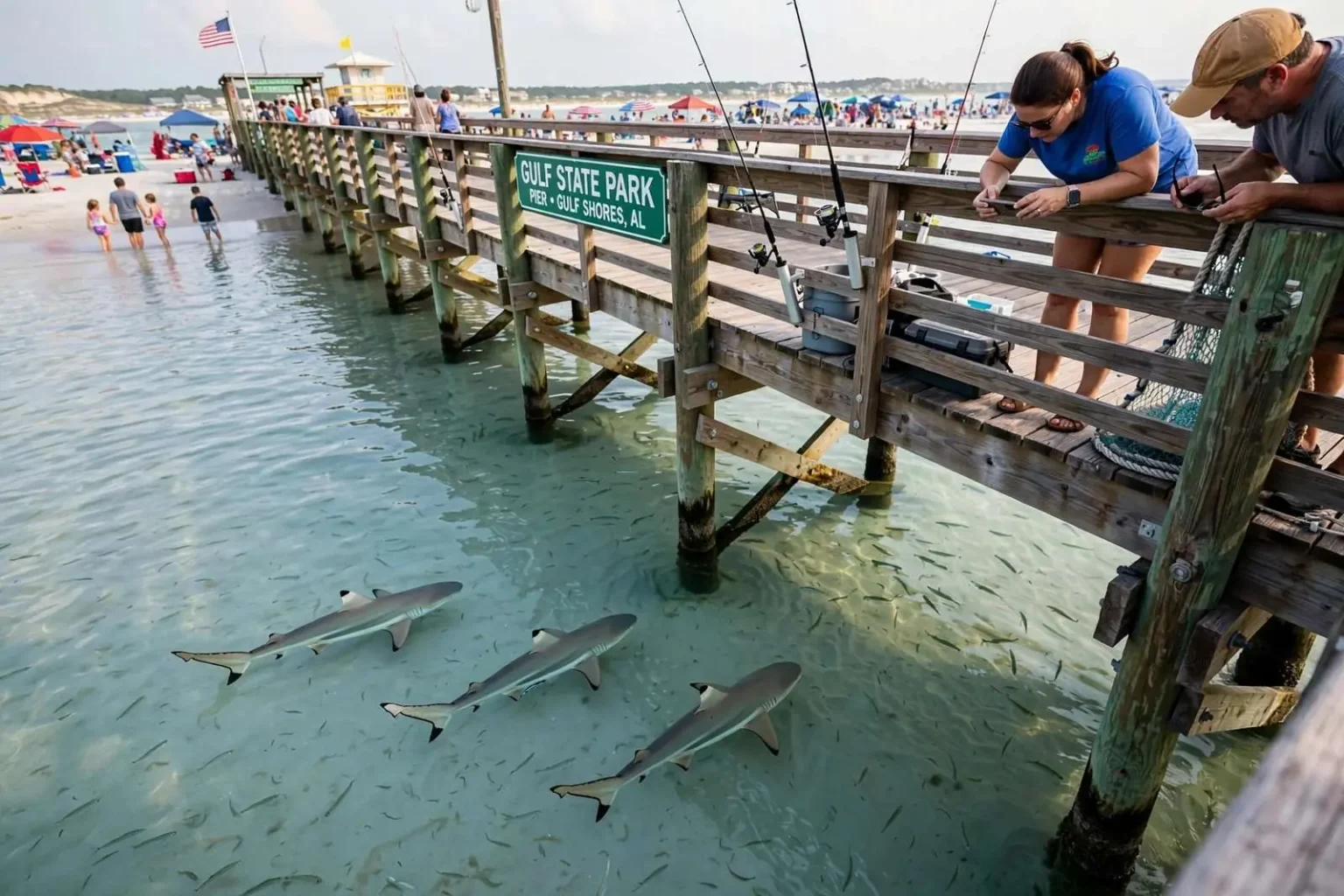
Multiple sharks were spotted Friday at the Gulf State Park pier in Gulf Shores, and the video is doing what shark video always does on a holiday weekend.
Bonny Huddleston, of Wedowee, captured blacktip sharks on camera near the pier. Sharks are often seen swimming around the structure, but with Labor Day weekend bringing tourists to the area, Huddleston said she wanted others to be aware.
“They were so shallow,” Huddleston said. “I was thinking, ‘Boy, those sure are close to those little kids down there swimming.’”
What a Blacktip Is
Blacktip sharks grow to around eight feet and can be seen swimming alone or in schools. They are among the most common sharks in the northern Gulf of Mexico and are a routine presence in nearshore waters along the Alabama coast.
They are named for the dark markings on their fin tips. They feed primarily on schooling fish — mullet, menhaden, small jacks — and their movements follow their prey, which is precisely why they turn up close to shore and around structures.
Blacktips are also known for a distinctive feeding behavior: they will accelerate vertically through a bait school and spin clear of the water, a display that makes for dramatic footage and often generates alarm from people who are watching a shark eat a fish.
Why the Pier Attracts Them
A fishing pier is, functionally, a fish-attracting device.
The pilings create structure that draws baitfish. Baitfish draw predators. Anglers add to it by chumming, cleaning fish and losing hooked fish — each of which puts scent and struggling prey into the water, which is exactly the stimulus a nearshore shark is built to detect.
The Gulf State Park pier is among the longest piers on the Gulf of Mexico, extending well past the first sandbar, which places its outer sections over water that holds species not typically found in the swash zone. That is the pier’s appeal to fishermen and the reason sharks congregate near it.
Sharks in shallow water near a pier are therefore an expected observation rather than an unusual one.
The Actual Risk
Shark bites remain extremely rare relative to the number of people who enter the water. Far more swimmers are injured or killed by rip currents each year along the Gulf Coast than by sharks, and the disparity is not close.
That said, standard risk-reduction guidance from marine safety authorities is worth restating, particularly on a crowded holiday weekend:
- Avoid swimming near fishing piers, jetties or anyone actively fishing
- Avoid dawn, dusk and nighttime swimming, when many sharks feed most actively
- Do not swim near visible bait schools, diving birds or areas of surface commotion
- Avoid murky water, where visibility is poor for both swimmers and sharks
- Remove shiny jewelry, which can resemble fish scales
- Swim in groups rather than alone
- Follow beach flag warnings and lifeguard instructions
The first item on that list is the most relevant here. Alabama’s beach communities generally prohibit swimming immediately adjacent to fishing piers, both for shark-related reasons and because of hooks, lines and sinkers.
Lulu’s Law
Alabama now has a formal mechanism for notifying beachgoers after a shark attack.
State Rep. David Faulkner, R-Mountain Brook, sponsored legislation in 2025 establishing a shark attack alert system modeled on the Amber Alert. Known as Lulu’s Law, it allows authorities to send a digital alert within a specific geofenced area after a shark attack.
The geofencing is the key design element. A statewide alert about an incident 60 miles away would produce alarm without useful information and would train people to ignore future alerts. A geofenced notification reaches the phones of people actually in the affected stretch of coast, at the moment the information matters.
The law was enacted following shark attacks along the Gulf Coast that prompted questions about how quickly beachgoers in the immediate area learned what had happened. It functions as a notification tool after an incident rather than a predictive warning system.
What This Sighting Is and Is Not
No attack was reported, and no alert was issued. A person with a phone filmed sharks doing what blacktip sharks do near a structure that concentrates their food supply.
The value of the footage is not that it reveals a new danger. It is that it makes visible something that is present most of the time and simply not usually seen — a useful reminder for visitors who may assume that clear water and a crowded beach mean an empty ocean.
Huddleston’s instinct in sharing the video was the reasonable one: not to clear the beach, but to make sure the families in the water knew what was around them.