Federal Appeals Court Revives Parts of Mobile Meditation Center’s Zoning Lawsuit
A federal appeals court has thrown out portions of a lower court ruling against a Mobile Buddhist meditation center, sending the group's religious freedom lawsuit over a denied zoning request back for further review.
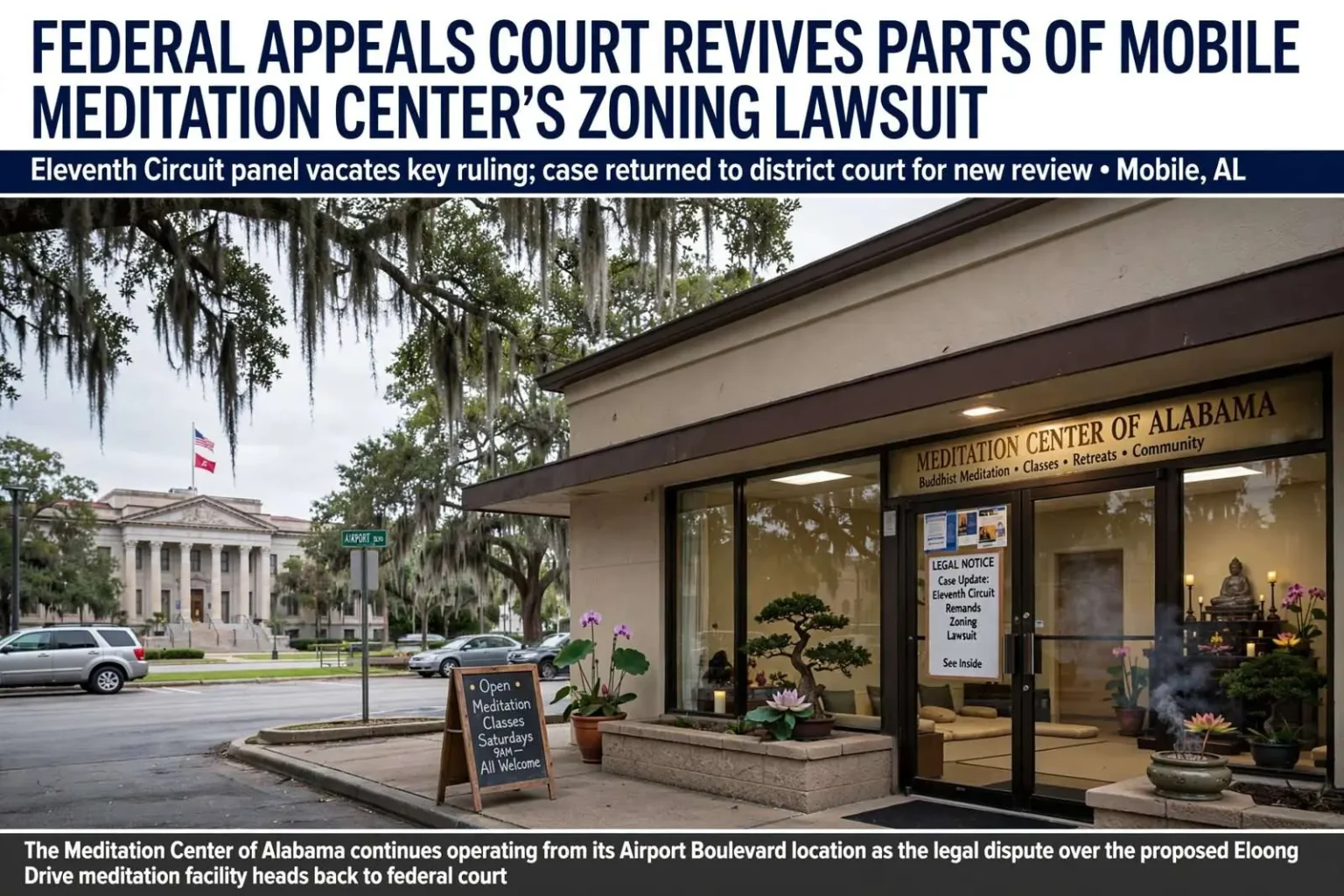
A long-running legal dispute between the city of Mobile and the operators of a Buddhist meditation center is headed back to federal court after a panel of appellate judges vacated key portions of an earlier ruling that had gone against the group.
The Eleventh Circuit Court of Appeals in Atlanta, in a decision handed down this week, found that a federal district judge misapplied several legal standards when he rejected most of the claims brought by Lar Nimityongskul and the Meditation Center of Alabama against the city over a rezoning request that was denied following pushback from neighbors.
The center currently operates out of a strip mall location on Airport Boulevard.
What the center wanted to build
Seeking a quieter, more spacious setting for meditation classes, retreats and visits from Buddhist monks, Nimityongskul purchased a roughly 5,000-square-foot home on nearly seven acres along Eloong Drive, near Dog River, with plans to convert the property into a dedicated meditation facility.
The proposal called for zoning changes that would have allowed construction of a small cottage to house visiting monks, a meditation hall, restroom facilities and additional parking.
Neighboring residents objected strongly to the plan, and after a wave of public opposition, both the Mobile Planning Commission and the Mobile City Council voted to deny the necessary zoning applications.
The objections centered on the character of the Dog River area, a peninsula of winding streets, mature trees and waterfront homes in west Mobile where residential density is low and commercial activity is scarce. Residents who spoke against the project worried that turning a large residential property into an assembly use would bring traffic, noise and activity that the quiet neighborhood had never been asked to absorb.
The lawsuit
In response, the meditation center and its incorporators filed a federal lawsuit accusing the city of violating the Free Exercise and Equal Protection clauses of the U.S. Constitution, the federal Religious Land Use and Institutionalized Persons Act, the Alabama Constitution and various state common-law protections.
Following a bench trial held last year, the presiding federal judge ruled against the plaintiffs on nearly every count.
The appeal
On appeal, attorneys for the meditation center argued the trial judge misread the standard for what counts as a “substantial burden” on religious exercise under federal land use law.
That term is the heart of the Religious Land Use and Institutionalized Persons Act, known as RLUIPA, a federal statute Congress passed in 2000 to protect churches, temples, mosques and other religious institutions from zoning and landmarking rules that interfere with religious exercise. Under the law, a zoning decision that imposes a substantial burden on religious exercise must advance a compelling governmental interest and use the least restrictive means available — a demanding test that ordinary zoning decisions never face.
Courts have wrestled for two decades with what makes a burden “substantial.” A denial that leaves a congregation with no viable place to worship plainly qualifies, but cases involving expansions, relocations and accessory uses — like the cottage, hall and parking proposed here — sit in a gray zone where outcomes vary widely. The Eleventh Circuit’s decision to vacate portions of the earlier ruling suggests the appellate panel saw error in how that standard was applied to the Meditation Center of Alabama’s claims.
The panel’s order returns the case to the district court, where the vacated portions will be reconsidered under the corrected legal standards. That does not mean the center has won anything yet; it means the analysis must be done again, this time under rules the appellate judges found the trial court failed to follow.
What the appeals court looked at
Beyond the substantial-burden question, the panel examined how the trial judge weighed the equal protection claim — the argument that the center was treated differently from comparable land uses because of its religious character. Equal protection claims in land use cases require plaintiffs to point to a similarly situated use that received better treatment, a showing that is difficult but not impossible to make when the record contains comparative zoning decisions.
The court also reviewed the constitutional free exercise claim and the state-law counts, which mirror the federal arguments but rest on the Alabama Constitution’s own religious liberty protections. Alabama’s constitution has long contained stronger language on religious freedom than the federal First Amendment, and state courts and federal courts sitting in Alabama must give that text effect when it applies.
The zoning fight in context
Mobile, like most Alabama cities, processes rezoning requests through its Planning Commission, which studies each application and makes a recommendation, followed by the City Council, which holds a public hearing and votes. Rezoning battles of this kind are routine in growing cities, but they become harder when the applicant is a religious institution, because federal law adds a layer of scrutiny on top of the usual political process.
Public opposition shaped the outcome here just as it shapes outcomes across the Gulf Coast. Residents along Dog River and in surrounding west Mobile neighborhoods are organized and accustomed to speaking at council meetings, and objections about traffic, drainage and neighborhood character carry real weight with elected officials. The tension in cases like this one is between that local voice and the federal requirement that zoning not be used to suppress religious institutions.
The property at the center of the case — a roughly 5,000-square-foot home on nearly seven acres along Eloong Drive — would have given the center room that its current strip mall location on Airport Boulevard cannot provide. Airport Boulevard is one of Mobile’s busiest commercial corridors, an unlikely setting for quiet retreats, and the strip mall space offers limited room for the classes, retreats and visits from Buddhist monks that the center hosts.
What happens next
The remand gives both sides another round in federal court rather than a final answer. The district judge will reconsider the vacated claims under the appellate panel’s instructions, and his new ruling will almost certainly be subject to appeal again unless the parties settle.
In the meantime, the Meditation Center of Alabama continues to operate from Airport Boulevard, serving the small but active Buddhist community in the Mobile area. Its leaders have spent years and substantial resources on a property they have never been able to use as intended, an outcome that illustrates how long land use litigation can stretch even for a modest nonprofit.
For Mobile’s other religious institutions, the case is being watched as a marker of how far RLUIPA reaches when a rezoning denial follows neighborhood opposition. If the corrected standards on remand lead to a different result, the decision will join the growing body of appellate law that shapes how cities across the Southeast handle requests from houses of worship.
The bigger legal picture
RLUIPA cases against Southern cities have multiplied since the statute took effect, and courts have held that zoning processes cannot treat religious assemblies worse than secular ones. The statute applies whenever a government imposes or implements a land use regulation that burdens religious exercise, regardless of whether officials intended any discrimination — a key feature that makes it a powerful tool for institutions that lose votes at city hall.
The equal protection route, by contrast, depends on proving that officials treated the plaintiff differently than a similarly situated secular use. Plaintiffs often pair the two theories, as the Meditation Center of Alabama did, because one compensates for the weaknesses of the other: RLUIPA asks whether the burden was substantial, while equal protection asks whether similarly situated uses got better treatment.
Alabama’s constitutional protections add a further dimension. The state constitution’s religious liberty provisions predate the modern federal doctrine and, in some readings, offer broader protection than the First Amendment provides. Litigants in Alabama land use cases increasingly invoke them alongside federal claims, and appellate courts have shown growing willingness to engage with the state-law arguments rather than dismiss them.
The Meditation Center of Alabama’s case has already outlasted the zoning dispute that started it, moving from commission chambers to council chambers to a bench trial and now an appellate remand. Each stage has taken years, and the remand process will add more before any final outcome is known.
Until the district court rules again, the center’s plans for the Eloong Drive property remain on hold, the strip mall location on Airport Boulevard remains its home, and the legal question of whether Mobile’s zoning decisions burdened the group’s religious exercise remains open in federal court.
Why the dispute has lasted so long
Part of the answer lies in how federal land use litigation moves. A case like this one passes through pleading, discovery, a bench trial and post-trial rulings before an appeal is even filed, and each step takes months. The appellate panel’s decision adds a new layer, sending the key claims back for a second round of analysis that will again be reviewable on appeal.
The stakes extend beyond one property. Religious institutions across the Gulf Coast — churches expanding into growing suburbs, temples outgrowing leased space, mosques seeking permanent homes — regularly encounter the same sequence the center faced: a purchase, a rezoning application, organized neighborhood opposition, and a series of votes. The legal standards the Eleventh Circuit has now clarified will shape how similar disputes unfold for years.
For the neighbors who fought the project, the remand does not reopen the zoning votes themselves. Whatever the district court decides on remand, the council’s denial stands unless a court orders the city to revisit it, and the practical dispute over the Eloong Drive property remains frozen while the litigation continues.
The center, meanwhile, has continued holding classes and retreats from its Airport Boulevard storefront, an arrangement its members have described as workable but far from what the Eloong Drive property was meant to provide. Whether that changes depends on how the federal court applies the appellate panel’s corrected standards to the record built during last year’s bench trial.