Woods Fire Off Highway 225 Snarls Traffic Near Spanish Fort Estates
A woods fire burning off Highway 225 near Spanish Fort Estates forced crews to reduce the highway to one lane Wednesday, with officers escorting traffic past the scene.
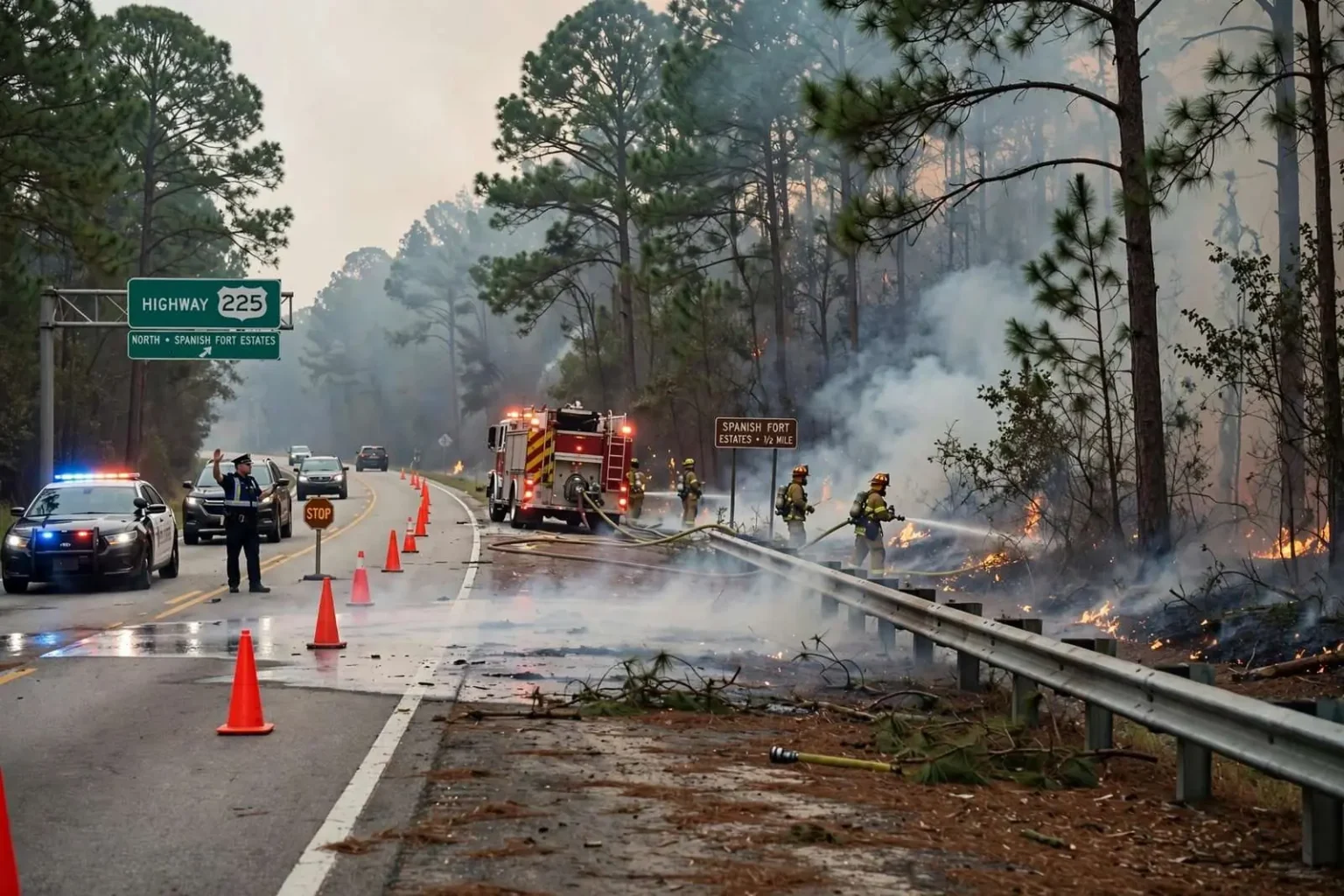
A woods fire burning off Highway 225 in Spanish Fort disrupted traffic on the roadway Wednesday, forcing crews to reduce the highway to one lane as they worked to keep the flames from spreading. The fire broke out in a wooded area near Spanish Fort Estates, sending smoke across the highway and prompting an immediate response from local fire personnel.
Highway 225 is one of the principal north-south corridors in southern Baldwin County, linking Spanish Fort to communities farther inland and carrying a steady mix of commuter, school and commercial traffic every day. When smoke began drifting across the pavement and flames were reported close to the roadway, drivers approaching the scene found visibility reduced and conditions unpredictable, creating a hazard that extended well beyond the fire line itself.
With visibility reduced and flames close to the roadway, officers were called in to help manage the flow of vehicles through the area. Rather than shutting the highway down completely, police officers escorted drivers past the burning area a few vehicles at a time, keeping traffic moving safely on the single open lane while crews continued working the fire line.
The escort approach is a common tool when a roadway incident leaves at least one lane passable. By holding eastbound and westbound drivers at a controlled point and releasing them in small groups, officers can keep a buffer of empty pavement between the public and the firefighting operation. That buffer protects both the crews dragging hose lines along the shoulder and the motorists who would otherwise encounter smoke, falling debris or parked equipment with little warning.
Motorists traveling through the Spanish Fort area were urged to slow down, watch for personnel and equipment along the shoulder, and expect delays until the scene was cleared. Fire apparatus, tankers and brush trucks often stage partly in the travel lane at woods fires because the soft shoulder and roadside ditches limit where they can park, making slow, attentive driving essential through the affected stretch.
Why woods fires flare up in Baldwin County
Woods and brush fires are not uncommon in Baldwin County during periods of dry weather, when fallen leaves, pine straw and underbrush can ignite easily and spread quickly through wooded lots. The county’s landscape is dominated by longleaf pine, slash pine and mixed hardwood stands, and the thick layer of dried pine straw that accumulates beneath those trees burns fast and hot, especially when it has gone weeks without rain.
Fire weather in south Alabama follows a familiar seasonal rhythm. Late summer stretches without meaningful rainfall, combined with low humidity and steady wind, can drop fuel moisture to the point where a discarded cigarette, a spark from a trailer chain or an unattended debris pile can start a fire that outruns a homeowner’s garden hose within minutes. Wind-driven fires in wooded lots adjacent to residential subdivisions present a particular concern in fast-growing communities like Spanish Fort, where new neighborhoods increasingly sit against undeveloped timberland.
Fire officials routinely caution residents against outdoor burning during dry stretches and ask anyone who spots smoke or flames near roadways to notify 911 promptly so crews can respond before a fire grows large enough to threaten nearby property or traffic corridors. Early reports matter because a small fire at the edge of a lot can often be knocked down with hand lines and a brush truck, while the same fire twenty minutes later may require tankers, dozers and multiple departments to contain.
Across Baldwin County and the rest of Alabama, outdoor burning is regulated through the Alabama Forestry Commission, which requires a burn permit for many prescribed and land-clearing fires and can impose burn bans when conditions turn dangerous. Local fire departments add their own guidance during dry spells, and officials consistently stress that even a legally permitted fire can escape quickly when winds pick up or humidity drops.
What drivers should do when smoke crosses the road
Safety officials offer straightforward guidance for motorists who encounter smoke on a highway. Speed should come down well before the smoke is reached, headlights should be switched to low beams so other drivers can see the vehicle, and drivers should avoid sudden lane changes inside the smoke itself. A vehicle’s horn or flashing lights can help alert following drivers, but the safest course is always to follow the direction of law enforcement officers stationed at the scene.
No injuries were reported in connection with the fire. Drivers in the Spanish Fort area were advised to seek alternate routes if possible while the one-lane restriction remained in place, and to follow the direction of officers stationed along Highway 225 until the roadway reopened to normal traffic flow.
For residents along the Highway 225 corridor, the incident was a reminder of how quickly a routine Wednesday can turn into a traffic headache. Spanish Fort has grown substantially in recent decades, with residential developments spreading out from the old town center toward the Interstate 10 interchange and the Eastern Shore Trail, and many of those neighborhoods are bordered by exactly the kind of pine hardwood lots where Wednesday’s fire broke out.
School traffic adds another layer to any disruption on the highway. Parents running afternoon pickup routes and buses making their runs all funnel through the same limited set of roads, and when a main artery narrows to one escorted lane, the ripple effect reaches intersections miles from the actual fire. Local drivers often know the alternate routes — older county roads that parallel the highway — but visitors passing through may have no option other than to wait out the escort.
Fire departments in the area typically attack a woods fire on two fronts at once. Crews on the fire line work to establish a perimeter, cutting break lines through leaf litter and spraying down the burning edge, while other members protect the structures nearest the flames, clearing pine straw away from fence lines and wetting down shingles and decks. Aerial support from the Alabama Forestry Commission, including tractor-plow units, can be requested when a fire threatens to run through more than a few acres.
Water supply is a defining challenge in rural and semi-rural firefighting. Hydrants are sparse outside developed areas, so departments rely on tanker shuttles, portable drop tanks and relay pumping to keep water moving to the fire line. That logistics chain takes time to set up, which is one more reason early 911 reports from passing drivers are so valuable — the sooner the first engine arrives, the smaller the fire it has to fight and the less water has to be hauled in.
Protecting homes at the woods edge
Homeowners who live beside wooded lots in Spanish Fort and the surrounding county can reduce their own risk with modest seasonal maintenance. Clearing pine straw and dead leaves away from the immediate footprint of the house, keeping gutters free of debris, trimming low branches so a ground fire cannot climb into the canopy, and moving firewood piles away from exterior walls all shrink the chance that a passing woods fire finds a path onto the property.
Emergency managers describe this as defensible space: a buffer of managed vegetation around the home that slows a fire’s approach and gives firefighters room to work. In a county where wildland and subdivisions meet along hundreds of miles of edge, those individual efforts add up, and they also make a difference to the crews themselves — a house with a clean perimeter can often be skipped in favor of saving three others that were not maintained.
Insurance and safety agencies also recommend that families in fire-prone edges of town keep vehicles fueled, back driveways so exits are not blocked, and prepare for the possibility of an evacuation order, even though most woods fires in Baldwin County are contained well before homes are threatened.Pets, livestock and important documents should all be part of a simple go-plan that can be executed on short notice.
The broader fire season picture
Incidents like Wednesday’s fire are typically short-lived but resource-intensive. A crew may spend only a few hours knocking down flames in a few acres, yet the mop-up that follows — checking for smoldering roots and hot spots inside burned stump holes — can occupy firefighters into the night, particularly when wind is expected after dark. Departments therefore often leave a unit assigned to the scene long after visible fire is gone.
The financial and human cost of escaped debris burns and roadside ignitions is a recurring theme in Alabama fire statistics, and local officials use each incident as an occasion to renew the same appeals. Check conditions before burning anything outdoors. Never leave a fire unattended, even for a moment. Keep water and tools at hand. And when smoke appears where it should not be, make the call to 911 early rather than assuming someone else has already reported it.
For the commuters and residents who sat in the escorted line on Highway 225 on Wednesday, the scene was a display of the routine cooperation that defines responses like this one: firefighters holding the fire line, police officers metering traffic, and a community that returned to normal once the smoke cleared. The one-lane restriction was lifted after the scene was secured, and the highway reopened to normal traffic flow.