Mobile Council Rejects Rezoning for Spring Hill Animal Clinic Near Historic Sand Town
The Mobile City Council unanimously denied a rezoning request for a new Spring Hill Animal Clinic building near the historic Sand Town neighborhood, after developers and neighbors failed to reach a compromise.
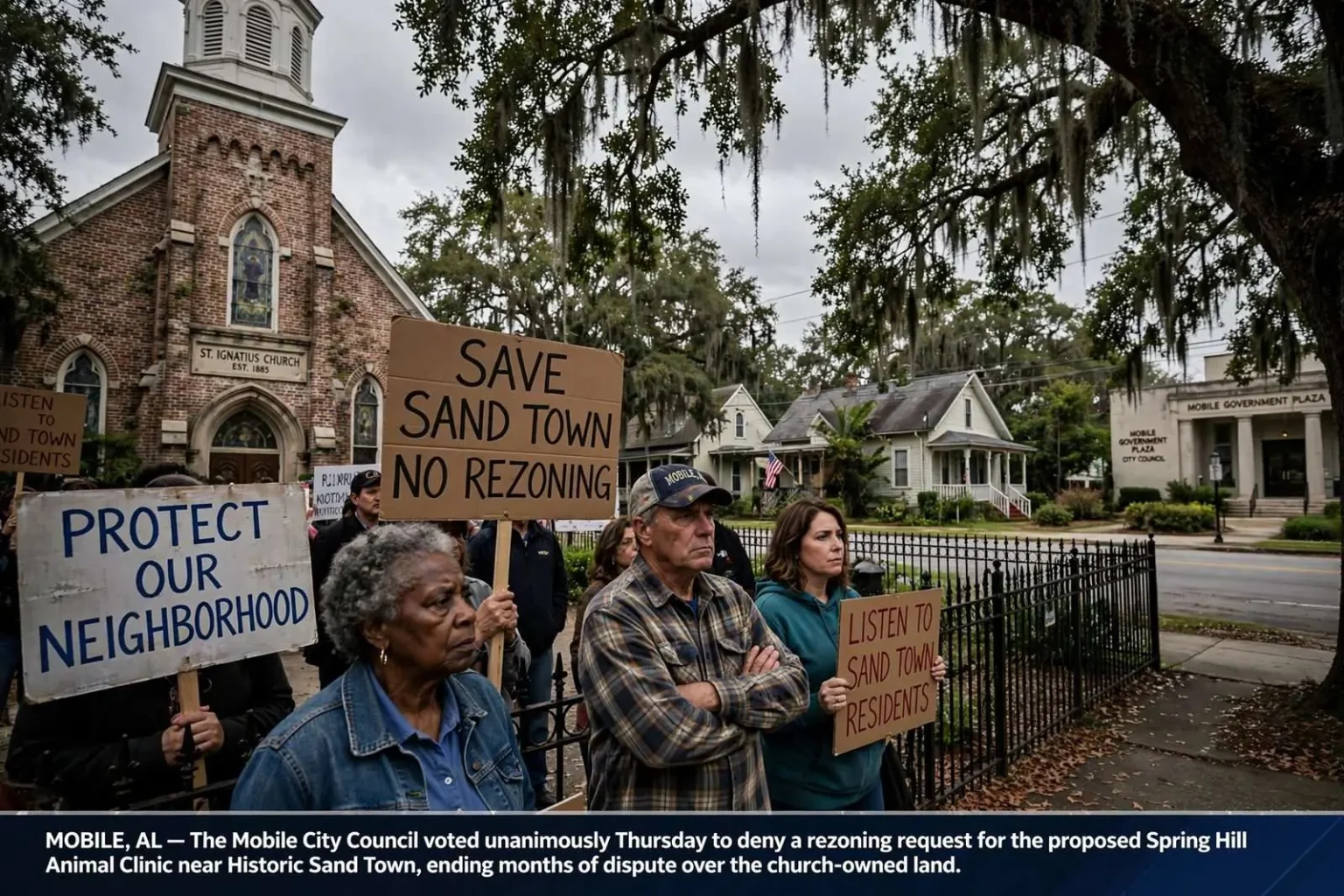
The Mobile City Council voted unanimously on Thursday to deny a rezoning request that would have cleared the way for a new veterinary clinic on church-owned land bordering a historic Black neighborhood, ending a contentious months-long fight between developers and residents.
The proposal would have rezoned a parcel owned by St. Ignatius Church from residential to commercial to allow Spring Hill Animal Clinic to build a new office and boarding facility. The council had delayed a final vote for two weeks in hopes that developers and neighbors could reach a compromise, but no agreement materialized before Thursday’s meeting, and members ultimately sided with the city’s planning staff, who had recommended denial.
The two-week deferral was the council’s customary attempt to let zoning fights settle themselves. In Mobile, as in most Alabama cities, a contested rezoning that reaches the council with neighbors and applicant still at odds presents elected officials with an uncomfortable choice: overrule the neighborhood and invite resentment and litigation, or side with it and risk a lawsuit from the applicant. The negotiation window is offered precisely so the council does not have to make that choice.
The land at the center of the fight belongs to St. Ignatius Church, whose Spring Hill campus has anchored the neighborhood for generations, and the church’s decision to make the parcel available for commercial development is what set the process in motion. Under the city’s zoning code, a change from residential to commercial classification requires council approval after review by the Planning Commission — a two-step process that gives opponents two bodies to persuade and two at which to organize.
The council’s dilemma, in Daves’ warning
Councilman Joel Daves, who joined his colleagues in voting down the rezoning, said he worried the decision could still end up in court. He pointed to a past dispute over a proposed CVS Pharmacy near Airport Boulevard and University Boulevard, where the council likewise denied a rezoning request only to see developers prevail in a subsequent lawsuit. The pharmacy now sits at that intersection.
“I wish a compromise could’ve been worked out,” Daves said. “If the application goes to circuit court, it has a good chance in succeeding.”
The CVS precedent Daves cited is the case every Mobile council member keeps in mind when weighing a contested rezoning. A denial that survives on the record is defensible; a denial that looks like simple hostility to development, with no documented planning justification, can be unwound by a circuit judge. The lesson of the pharmacy case was that a council victory can prove temporary — and that the property can end up developed anyway, without any of the conditions the council might have negotiated.
Councilwoman Gina Gregory, who represents the area that includes the historic Sand Town community, cautioned residents that a successful lawsuit could leave the clinic’s developers free to build without any of the restrictions that had been under discussion, since a court victory would remove the city’s ability to attach conditions beyond what state law already requires.
Gregory said she hopes neighbors and the clinic’s owners can move forward now that the council has acted, acknowledging that the vote was unlikely to satisfy everyone in her district.
“This issue has been a very long and difficult one,” Gregory said. “I really hate what I’ve seen happen to a small portion of my district over an animal clinic.”
Gregory also said the debate had grown personal at times, telling council members she had received an email accusing her of secretly holding an interest in a shell company connected to the case. “Usually I let those go, but this one was a new low,” she said.
The accusation she described — baseless, by her account, but delivered with the specificity that makes such claims hard to ignore — illustrates how rezoning fights metastasize. What begins as a dispute over buffers and building heights acquires, over months of public hearings, a cast of characters, a set of conspiracies and a level of personal animus that outlasts the land use question itself. Gregory’s decision to answer the charge from the council floor rather than let it stand was itself a measure of how far the episode had gone.
What the clinic offered
Mary Edmonds, a veterinarian and partner in Spring Hill Animal Clinic, told the council that the clinic’s owners had offered numerous concessions during negotiations with neighbors but received little in return. “We made concessions, but the neighbors didn’t make any concessions,” Edmonds said. “We were hoping for compromise and are very disappointed that we didn’t have one.”
Among the changes Edmonds said the clinic proposed were an enlarged 20-foot buffer along the property line, a building design intended to blend with the surrounding neighborhood, a ban on commercial traffic using Knowles Lane, a prohibition on weekend business hours, restrictions on outdoor kennel activity during church services and the addition of a small neighborhood park.
“The neighbors don’t want any change,” Edmonds told the council.
The package was substantial by the standards of conditional rezoning. A 20-foot planted buffer exceeds what the code would typically require; the Knowles Lane restriction addressed the neighbors’ most concrete fear, that delivery trucks and boarders’ cars would turn a quiet residential lane into an access road; and the weekend-hours ban acknowledged the rhythm of a neighborhood organized around a church. The proposed park, a small amenity offered for the community’s benefit, signaled how far the clinic was prepared to go to win the vote it ultimately lost.
The council’s unanimous margin also carried a message to both sides. For the clinic’s owners, it signaled that no individual member could be peeled off by further concessions — the objections were held to be about the rezoning itself, not its terms. For the neighbors, it affirmed that the council treats compatibility with a historic residential community as a threshold question rather than a negotiating position. Unanimity in zoning votes is uncommon in Mobile, where district interests usually produce at least one member arguing for a colleague’s project; its absence here underscored how thoroughly the staff’s reading of the request had carried the room.
The clinic’s plans called for a creole cottage-style office building with kennel runs beneath it for boarding dogs, along with an eight-foot retaining wall. Neighbors had raised concerns throughout the process about noise from dogs kept outdoors and the effect a commercial use could have on the character of the residential area.
The architectural answer the clinic settled on — a cottage-scale building rather than a conventional commercial box — was aimed directly at the character argument. In Spring Hill, where the built environment of cottages and mature trees defines the area’s identity, a veterinary office that looked like a residence was the developers’ way of conceding the point: the use would be commercial, but the streetscape would not be.
The property sits on land owned by St. Ignatius Church and is currently zoned for residential use. The Mobile Planning Commission had recommended that the council approve the rezoning to commercial to allow the clinic to move forward, but the council’s planning staff recommended denial, and the full council followed that recommendation in its unanimous vote.
The split between the Planning Commission and the professional planning staff gave council members two conflicting expert readings of the same request, and the council chose the more restrictive one. That choice reflected the particulars — a residential parcel bounded by a historic Black neighborhood and a church — as much as any general policy about commercial development.
Sand Town and the wider stakes
The dispute highlights the tension city officials increasingly face between accommodating new commercial development and protecting the character of long-established residential communities, particularly those with deep historical roots. Sand Town, the neighborhood bordering the proposed clinic site, is among Mobile’s older Black communities, and residents have voiced concern in past zoning disputes about preserving the area’s identity as development pressure increases nearby.
That history gives the fight a weight beyond its square footage. Older Black neighborhoods in Mobile and across the South have watched commercial pressure nibble at their boundaries for decades, and residents have learned that a single rezoning can be the first of many. In Sand Town’s case, the fear voiced in past disputes — that the community would be developed around rather than with — was exactly what opponents of the clinic said was at stake this time.
It remains unclear whether the clinic’s owners will pursue legal action following the council’s denial. Any appeal would likely be filed in Mobile County Circuit Court, where the outcome of the earlier CVS Pharmacy dispute suggests such challenges can eventually succeed even after a rezoning request is rejected at the council level.
For now, the record of Thursday’s vote is what both sides will build on: a unanimous council alignment with its staff, a developer that offered concessions its opponents would not match, and a neighborhood that won the argument by insisting that in a residential district bordering one of Mobile’s oldest Black communities, the burden of proving a commercial use compatible was one the clinic could not carry. Whether that record holds in circuit court — where the CVS precedent warns it might not — is the next question, and no one at Thursday’s meeting pretended to know the answer.