
Attorney: Gulf Shores Woman Indicted for Impersonation Was Working as Licensed Private Investigator
A Gulf Shores woman indicted on charges of impersonating a state investigator was working openly as a licensed private investigator during a recorded witness interview, her attorney says.
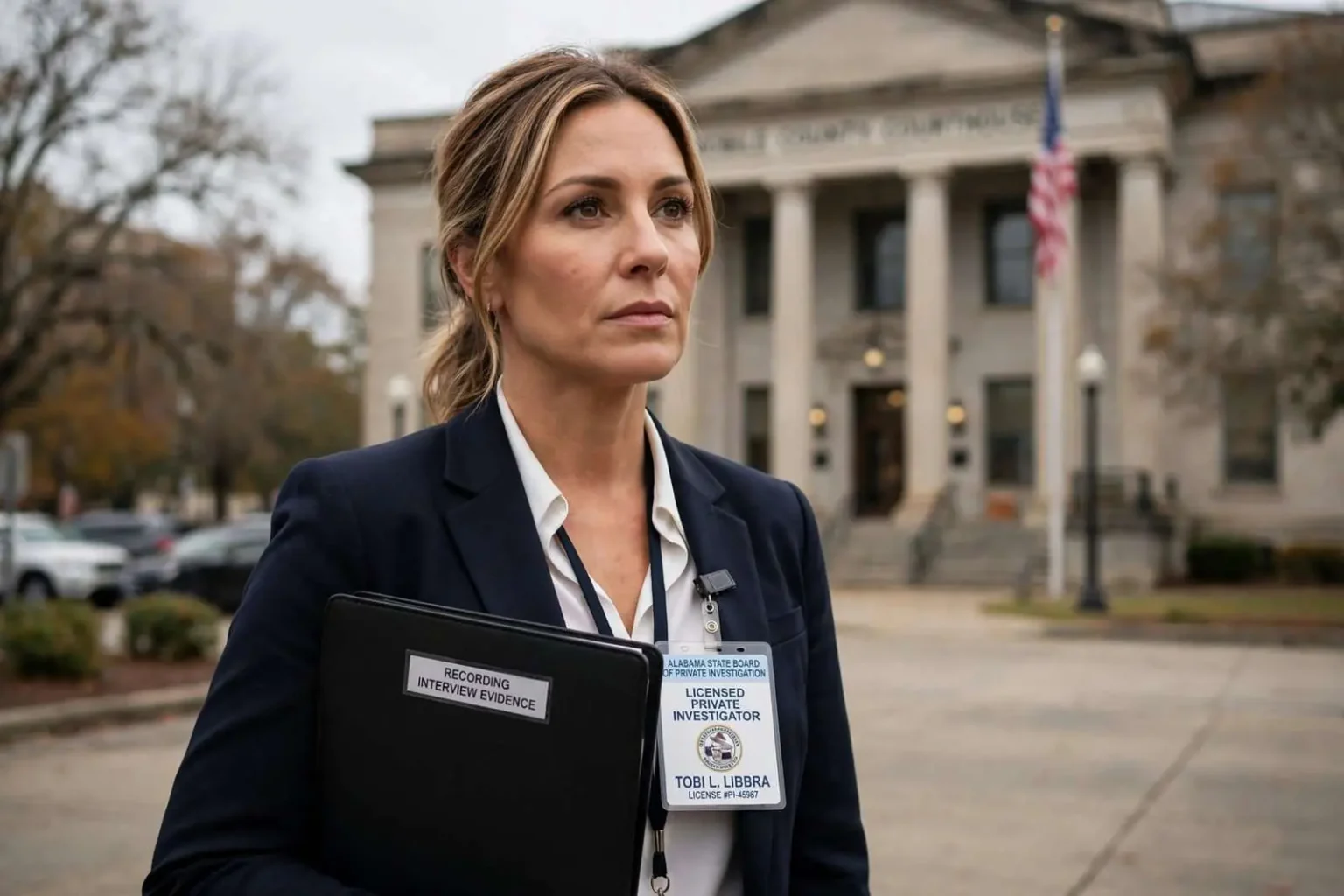
MOBILE, Ala. — An attorney for a Gulf Shores woman indicted on charges of impersonating a state investigator says she was working openly as a licensed private investigator when she interviewed a witness in a Mobile County civil case.
Tobi Lynn Libbra was indicted by a Mobile County grand jury on charges of impersonating a peace officer and impersonating a public servant. The indictment alleges Libbra claimed on Oct. 6, 2025, to be an investigator for the State of Alabama in order to contact and interview someone.
The Defense Account
Attorney John Beck disputes that account. In a statement, Beck said Libbra is a private investigator licensed by the state and was hired to interview witnesses for South Alabama Medical & Rehab in a civil case brought by the Mobile County District Attorney’s Office.
According to Beck, Libbra recorded the entire interview, identified herself by name, said she and her partner were private investigators, identified their client, and told the witness they were “an independent third party trying to gather the facts.” Beck says the interview was conducted in plain language, with no claim of police authority and no use of any badge or uniform.
He said Libbra wore her state investigator’s license on a lanyard, as required by law, and never identified herself as police, an officer, deputy or detective during the roughly 13-minute interview. The defense has framed the recording as the strongest evidence in Libbra’s favor, since it captures her actual words and tone during the conversation at the center of the case.
A Recording at the Center of the Case
Beck said the recording was provided to the District Attorney’s Office months before Libbra was charged — a point he frames as central to the defense. He also contends the witness told Libbra she had not used language attributed to her in a sworn civil complaint and did not write an affidavit bearing her signature.
“Mrs. Libbra has conducted herself throughout with care and professionalism, and with a documentary record to prove it,” Beck said. “She does not deserve this. We will defend her vigorously.” Beck’s statement suggests the defense intends to press the recording into evidence and to argue that the prosecution’s theory of the case cannot be reconciled with what the recording actually shows.
What Happens Next
Libbra was indicted Aug. 21, arrested Monday morning and released from Mobile Metro Jail about an hour later on $8,000 bond. The arrest and release followed standard procedures for the charges, with bond set consistent with similarly classified offenses in Mobile County.
The case now moves toward the circuit court docket, where prosecutors will need to establish that Libbra held herself out as a state investigator rather than a private one. Defense attorneys in impersonation cases typically focus on exactly that distinction — what was said, to whom, and whether any statement created a false impression of police authority.
The charges remain allegations. A grand-jury indictment is not a conviction, and Libbra is presumed innocent unless and until proven guilty in a court of law. Grand juries in Alabama consider evidence presented by prosecutors and decide whether there is probable cause to charge someone with a felony; they do not weigh the merits of a defense.
Neither the District Attorney’s Office nor South Alabama Medical & Rehab has publicly commented on the defense’s account. Additional filings in the case are expected in the coming weeks as both sides exchange evidence and prepare for pretrial motions.
What Alabama Law Says About Impersonation Charges
Alabama’s impersonation statutes make it unlawful for a person to falsely represent themselves as a peace officer, public servant or other official in order to obtain something they would not otherwise be entitled to receive. Convictions under those statutes can carry fines and, depending on the circumstances, jail or prison time. The core question in most cases is whether the defendant knowingly made a false claim of official authority and used that claim for some specific purpose.
Private investigators in Alabama are licensed by the Alabama State Board of Private Investigation. The licensing framework requires background checks, training and adherence to professional standards, and it requires investigators to identify themselves truthfully when conducting interviews or gathering information. State law treats licensed private investigators as a regulated profession rather than as public law enforcement officers.
Why the Distinction Matters
The line between a licensed private investigator and a sworn peace officer is at the heart of this case. Private investigators routinely interview witnesses, take recorded statements and gather evidence for civil litigation, often on behalf of one side in a lawsuit. Their authority comes from the client who hires them and the licensing that regulates their conduct, not from any police power.
Prosecutors in impersonation cases typically rely on testimony from the people who heard the alleged false statements and on any physical evidence that the defendant used props, uniforms or other items to suggest official authority. In Libbra’s case, Beck has indicated the defense intends to use the audio recording of the interview to argue that no such statements were made and that Libbra clearly identified herself as a private investigator throughout.
Looking Ahead in the Court Process
Cases like this often turn on a relatively narrow set of facts: exactly what was said, in what context and to whom. Defense motions are likely to focus on the recorded interview, the licensing records that establish Libbra’s status as a private investigator and any communications between the defense and prosecutors in the months before charges were filed.
As the case moves toward trial, the Mobile County District Attorney’s Office will continue to rely on the indictment returned by the grand jury, while Beck has signaled he will press the case’s recording and licensing records as the foundation for Libbra’s defense. Both sides are expected to file additional pleadings in the weeks ahead as discovery continues and the circuit court docket takes shape.
Public Interest and Local Attention
The case has drawn attention in part because it touches on questions that come up in private investigation work generally: how clearly investigators identify themselves, how they conduct interviews and what legal protections apply when someone believes they have been misled about the investigator’s role. Gulf Shores, where Libbra is based, and the broader Baldwin County legal community will likely be watching closely as the case develops in Mobile County.
For now, Libbra remains free on bond while her defense team prepares what they have described as a vigorous defense. The next public step in the case will likely come in the form of pretrial filings and scheduling orders from the Mobile County Circuit Court.
How Impersonation Cases Are Built
In Alabama, an impersonation charge generally requires proof that a defendant knowingly pretended to be someone with legal authority in order to obtain something — a piece of information, access to a place, a person’s cooperation or some other benefit. Prosecutors often build these cases using witness testimony, body camera footage, written communications and recordings that capture the alleged false statements.
Defense attorneys, in turn, frequently argue that the defendant either never made a false claim, that any statement was a misunderstanding or puffery rather than an intentional misrepresentation, or that the defendant had no intent to obtain anything through the alleged claim. The wording used by the defendant, the context in which it was spoken and the credibility of any recording all become central to the case.
What Comes Next in the Court System
The Mobile County Circuit Court will handle pretrial motions, hearings and, if the case proceeds, a trial. Defense filings in the coming weeks are likely to include motions for discovery, motions related to the indictment and possibly motions to dismiss. Prosecutors typically respond by filing their own pretrial motions and by preparing witness lists.
Cases like this can resolve in several ways: through a plea agreement, through dismissal, through a jury trial or, less commonly, through a bench trial. Given the defense’s public statements and the existence of a recorded interview, pretrial motions are likely to be especially active as the case moves forward.
The Role of the Grand Jury in This Case
Grand juries in Alabama are made up of citizens who review evidence presented by prosecutors in a closed setting. Their role is to determine whether probable cause exists to charge someone with a felony, not to weigh the strength of a defense. Because grand jury proceedings are not adversarial — the defense does not present its case at that stage — the resulting indictment is one step in the process rather than a final judgment.
For Libbra, that means the indictment marks the beginning of formal court proceedings rather than the end of the legal conversation. The audio recording her attorney has highlighted was not part of the grand jury’s review in the same adversarial way it is likely to be presented at trial, where the recording’s contents can be played for a jury and dissected in open court.
Prosecutors have laid out their own account of the contact. Mobile County District Attorney’s Office spokesperson Tara Zieman said the allegations stem from an October 2025 interview Libbra had with one of the state’s collaborating affiants in its Deceptive Trade Practices lawsuit against South Alabama Medical & Rehab, and that Libbra’s involvement was not authorized by the District Attorney’s Office. According to the indictment, Libbra allegedly represented herself as “an investigator with and/or for the State of Alabama” while attempting to “engage, elicit cooperation and/or compliance, initiate a consensual contact, obtain information, and/or to interview” the individual.
The alleged interview surfaced publicly during a July 17 hearing, when an attorney representing the clinic offered a recording of the questioning in open court and later provided prosecutors with a copy. That hearing involved an amended request by prosecutors to shut down the broader network of affiliated injury clinics, which the state accused of continuing the same alleged “claim-jacking” operation outside Mobile.
The civil case has grown considerably since it was filed in July 2025, after the DA’s office accused the Old Shell Road clinic and its affiliates of obtaining crash victims’ personal information, using telemarketers to contact them with offers of “free” medical treatment and steering them into standardized care plans and preselected legal representation. Circuit Judge Michael Windom first ordered South Alabama Medical & Rehab closed, then extended injunctions to affiliated clinics in Huntsville, Homewood and Montgomery, and prosecutors have added telemarketing companies, management firms, holding companies and law firms to the suit. The District Attorney’s Office has also acknowledged a parallel criminal investigation into how crash victims’ information was obtained so quickly, including whether protected law enforcement data was accessed improperly.
According to her online resume, Libbra is a partner and chief operations manager for ketWork Investigations in Gulf Shores and the CEO of 459 Consulting LLC, an investigative firm for corporate clients. It remains unclear who retained her or what interest she was representing when the October 2025 interview occurred.
