11th Circuit Upholds Immunity for USA Officer in 2012 Shooting of Student Gil Collar
The 11th U.S. Circuit Court of Appeals has ruled that a University of South Alabama police officer is protected by qualified immunity in the 2012 shooting death of freshman Gil Collar, upholding an earlier district court decision and closing out the family's appeal.
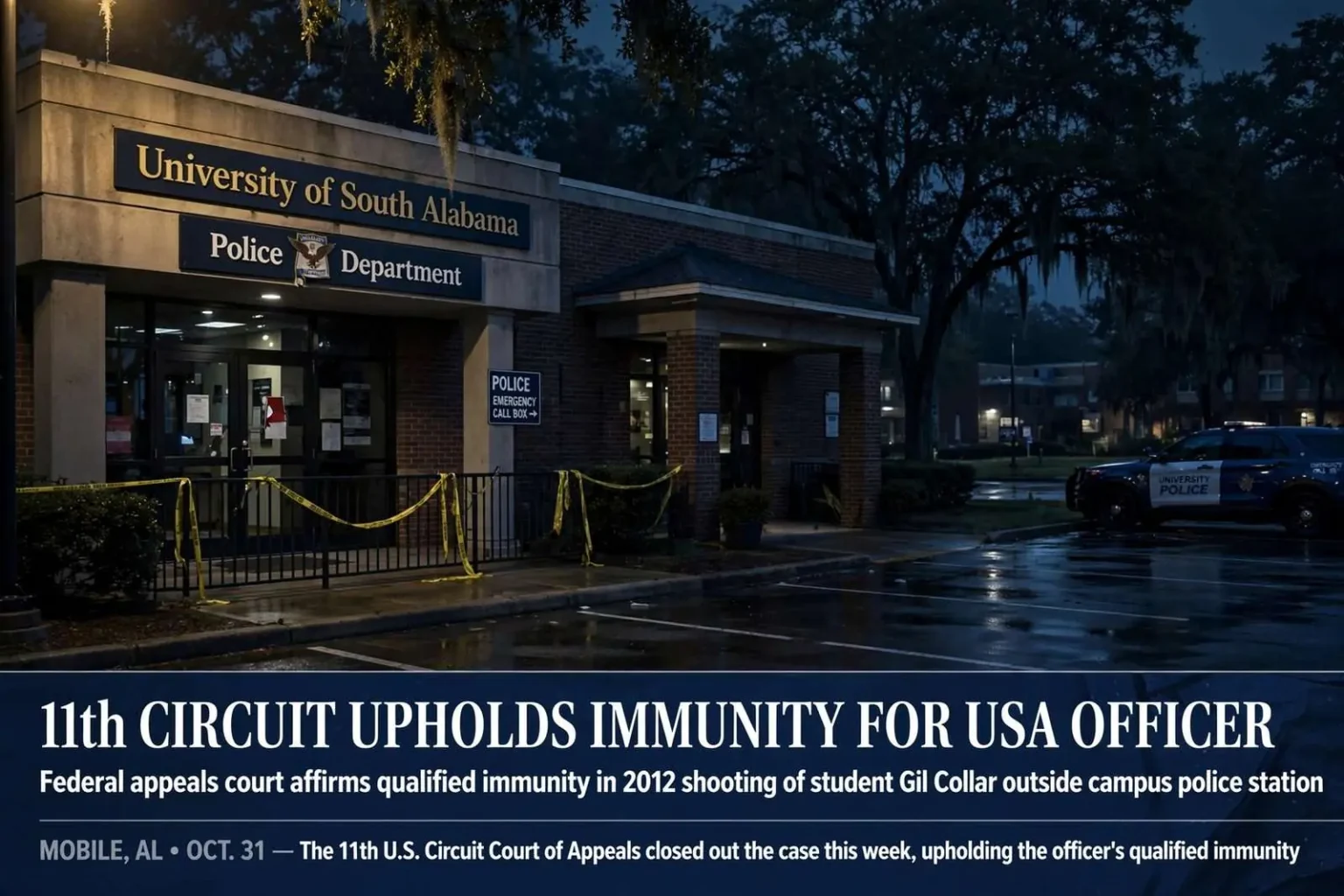
A federal appeals court has affirmed that a University of South Alabama police officer is legally protected from a lawsuit over the 2012 shooting death of an 18-year-old freshman, closing out one of the most closely watched police use-of-force cases in the Mobile area in recent years.
In a mandate issued Oct. 31, the 11th U.S. Circuit Court of Appeals sided with USA police officer Trevis Austin, ruling that he is shielded by qualified immunity in the fatal shooting of Gil Collar outside the university’s campus police station in October 2012. The decision upholds a federal district judge’s earlier finding and closes out an appeal brought by Collar’s parents, Bonnie and Reed Collar, who had hoped to bring their case before a jury.
The ruling ended a legal fight that had stretched across more than two years of litigation and had become a touchstone in the wider national argument over how police respond to people in medical or drug-induced crises. The Mobile-area case drew sustained attention because it raised a question that has haunted use-of-force litigation for decades: when a confrontation unfolds in seconds, does the Constitution demand that an officer reach for the least lethal tool first — or only that he act reasonably in the moment he is given?
How the Night Unfolded
The shooting unfolded in the early morning hours when Collar, who witnesses said had ingested the psychedelic designer drug known as 25I earlier that night, was seen walking naked around campus and allegedly assaulting passersby. He eventually made his way to the university’s police station, where he pounded on the windows and shouted, drawing Austin’s attention.
According to the court’s account of the encounter, the confrontation between Austin and Collar lasted roughly 25 seconds and ended just as a second officer, Bernard Parrish, was arriving on scene as backup. Austin fired a single shot, and Collar died from the wound.
The 25I compound at the center of the story belongs to a family of synthetic hallucinogens marketed in the early 2010s under labels like “N-Bomb,” sold as LSD-like substances and known for producing violent agitation, paranoia and episodes in which users appear detached from reality. Emergency rooms and campus health officials around the country were grappling with the drug at the time, and cases of young users acting erratically — sometimes lethally to themselves — were being reported in college towns from Florida to California. Collar, a freshman at South Alabama, had no apparent history that would have predicted the night, which is part of why the case resonated so strongly with parents of college students and with campus police departments evaluating their own training.
The confrontation itself was brief enough that nearly every physical detail became contested evidence. Witnesses and investigators differed on how fast Collar was moving, how close he came to Austin, and whether the officer had room to retreat further before firing. The district court, reviewing the record, concluded that the encounter offered Austin no meaningful opportunity to de-escalate, and the appeals panel agreed that a reasonable officer facing a rapidly advancing, agitated individual outside a police station in the pre-dawn hours could perceive an imminent threat.
The Pepper Spray Question
A central question in the case was whether Austin should have reached for pepper spray instead of his firearm. The appeals court rejected that argument, noting that Austin carried his pepper spray on the same side of his belt as his handgun. Attempting to reach it, the court found, would have required him to holster his firearm, open a second holster, remove the canister, aim it and fire it, all in the span of a few seconds while he was backing away from a rapidly approaching Collar.
Under those circumstances, the judges concluded, a reasonable officer could have determined there simply was not time to try the spray, and that expecting him to attempt it would have amounted to demanding near-perfect judgment under extreme pressure — a standard the law does not impose.
Qualified immunity, the doctrine at the heart of the ruling, protects government officials from civil liability unless they violated a constitutional right that was “clearly established” at the time. In practice, that means a plaintiff must point to a prior case with closely matching facts in which a court found the conduct unlawful. The 11th Circuit, which covers Alabama, Georgia and Florida, has long been regarded as one of the more demanding circuits on that standard, and Mobile-area civil rights litigants have repeatedly found themselves dismissed at the summary judgment stage for want of a clearly established precedent. The Collar family’s lawyers argued that the right at stake — not to be shot when a less-lethal alternative was available and the threat was ambiguous — was sufficiently obvious. The court disagreed, finding no precedent that clearly established the proposition under facts like these.
The doctrine has drawn sustained national criticism, from both ends of the political spectrum, precisely because it lets cases end before a jury hears them. Critics argue that it shields officers whose conduct would shock a community; defenders answer that it protects officers from hindsight-driven second-guessing in split-second decisions. The 11th Circuit’s mandate in the Collar case fit squarely within that second view, and its outcome in Mobile became one more data point in a debate that Congress, state legislatures and police reform commissions have revisited repeatedly since.
What It Meant for the University
For the University of South Alabama, the resolution removed a cloud that had hung over its police department for years. The Mobile campus, one of the state’s largest universities with an enrollment in the tens of thousands, maintains its own sworn police force responsible for patrolling dormitories, parking decks and the medical campus in the city’s midtown area. Campus forces across Alabama operate under the same constitutional constraints as municipal departments, and the case became required reading for administrators weighing how their officers are equipped and trained for encounters with people in crisis.
The university faced its own reckoning with the incident’s aftermath. Student grief, community questions and the long litigation cycle all played out while the lawsuit moved through the federal courts in Mobile, and the October 2012 date meant the case paralleled the national conversation that intensified after other high-profile shooting cases later in the decade. Local observers noted that the outcome — dismissal rather than a verdict — left some of the larger questions unanswered, because a jury never weighed whether the university’s training and staffing on that night were adequate.
Legal observers in Mobile followed the district court’s ruling and the appeal closely because the collision of circumstances — a drug-fueled medical crisis, a bare-handed and unarmed young man, and an officer alone at the threshold of his own station — compressed nearly every hard question in modern policing into a quarter of a minute. The family’s lawsuit was the only forum in which the officers’ conduct could be tested, since the constitutional claim had to survive the threshold of qualified immunity before any jury would hear the underlying facts. Its dismissal without a trial underscored how rarely use-of-force cases reach the jury box in the 11th Circuit, a pattern that civil rights attorneys in Mobile have long lamented and that police unions have defended as the system working as designed.
The litigation also left a record that other agencies have studied. The court’s narrative of the encounter — the naked wandering, the pounding on the station windows, the 25-second confrontation, the single shot — became one of the clearest written accounts anywhere in the region of how a hallucinogen crisis can escalate from a disturbance call to a fatal shooting before backup arrives. For campus and municipal departments weighing whether to position less-lethal options differently, or to pair officers more closely on night shifts, the accounting of those seconds offered a concrete illustration of how little margin such decisions leave.
The ruling also placed the university’s police department in the company of campus forces nationally that have faced similar scrutiny. Departments at large public universities patrol environments where the population skews young, where synthetic drugs circulate despite enforcement, and where the early-morning hours produce the kinds of encounters that municipal officers meet downtown. The Mobile campus’s experience became, for administrators across the state, a case study in the limits of what an individual officer can be asked to weigh in the moment — and in why the composition of a shift, the placement of backup and the expectations set by training matter long before any confrontation begins.
The End of the Road
The Oct. 31 mandate formally closed the appellate chapter. With the 11th Circuit’s affirmance, Bonnie and Reed Collar had exhausted the ordinary civil path, and the single-shot death of their son outside the campus police station would be judged, in the law’s final word, as the act of an officer acting reasonably within the seconds he had. The case stands in Mobile’s legal memory as a study in how quickly such encounters unfold, how narrowly the law draws the question, and how much turns on the difference between what a family believes should have happened and what a court can require an officer to have done.