What Baldwin and Mobile County Voters Need to Know About the 2016 Alabama Amendments
Baldwin and Mobile County voters weighed 14 statewide constitutional amendments and five Baldwin-specific measures Nov. 8, covering everything from Gulf State Park funding to golf carts on city streets.
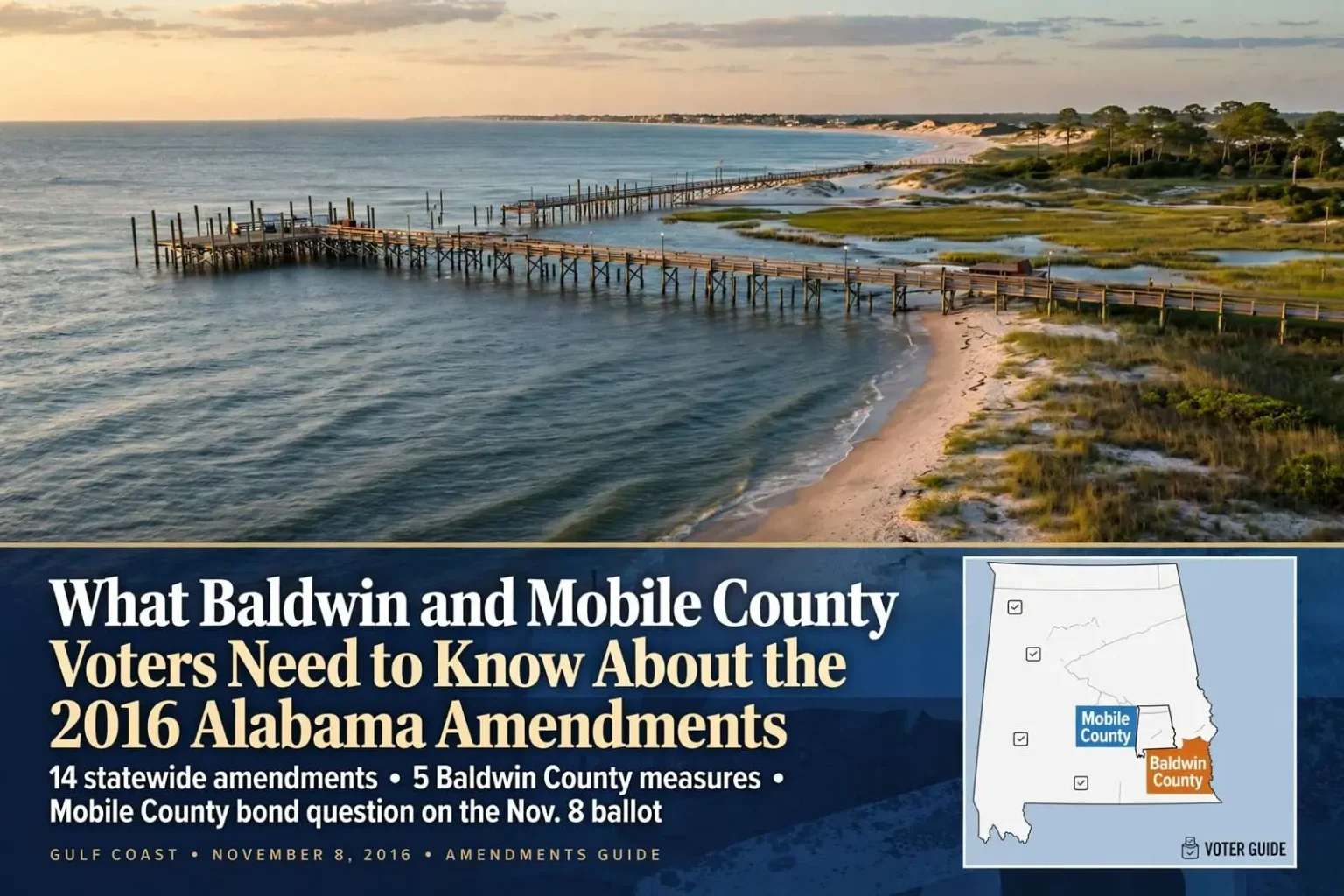
Alabama voters headed to the polls Nov. 8 faced a lengthy list of proposed constitutional amendments, 14 statewide measures plus five additional amendments specific to Baldwin County. The sheer volume reflects a long-running pattern in Alabama politics: rather than rewriting the state’s famously bloated constitution, already the longest governing document in the country at nearly 900 amendments, lawmakers and voters have simply kept adding to it.
Statewide Amendments With Gulf Coast Stakes
Several of this year’s amendments carried real weight for the Gulf Coast. Statewide Amendment 2 would prevent money generated by state parks, including Gulf State Park, a major economic driver for Baldwin County tourism, from being diverted to other state uses. Supporters, including Alabama Wildlife Federation executive director Tim Gothard, argued the change would let parks plan ahead for repairs without fear of budget raids that had already forced reduced hours and fee increases at some facilities. The amendment would also let private companies operate hotels, restaurants and golf courses on state park land, clearing the way for projects like the planned lodge and conference center at Gulf State Park under a 20-year agreement with Hilton. Critics, including commentator Glynn Wilson, called that provision a backdoor to privatization that could have been avoided with ordinary legislation.
Amendment 3 would change who decides whether a proposed amendment affecting only certain counties or cities appears solely on local ballots or goes before the entire state. Currently, a Local Constitutional Amendment Commission makes that call; under the proposed change, the decision would shift to the Legislature, with any single lawmaker able to force a measure onto the statewide ballot. State Sen. Trip Pittman, R-Montrose, said the current system lets legislators object to local measures outside their own districts for reasons that have nothing to do with the substance of the issue, sometimes, he said, purely for political retribution. The Mobile County Commission endorsed a “yes” vote, arguing it would put local decisions back in the hands of local voters.
Amendment 4 would let counties regulate weeds, junk yards, litter, noise, pollution, unsanitary sewage and animal control without first putting the question to local voters, so long as the new rules don’t raise taxes or restrict property rights. It builds on the 2005 Alabama Limited Self Governance Act, which gave counties some authority to act without approval from Montgomery. The Alabama Policy Institute backed the change as a step toward greater local control, and Mobile County commissioners said requiring a public vote for routine regulatory decisions had become an unnecessary hurdle.
TIF Sales and Toll Road Authority Measures
Amendment 11 would let cities and counties sell publicly owned land within designated Tax Increment Financing (TIF) zones or manufacturing areas to private companies below fair market value, a departure from current law, which requires sales at or above market value. TIF zones, which can be established wherever a private entity plans to invest at least $100 million across 250-plus contiguous acres, freeze property taxes in the designated area for a period of years so that revenue from rising property values can fund redevelopment or attract further investment. Mobile Mayor Sandy Stimpson voiced strong support, saying the tool helps municipalities “aggressively compete for large-scale industrial projects.” Mobile had previously used TIF proceeds to help finance the RSA Tower and a $4.5 million contribution to a downtown apartment development.
Amendment 12, while technically a statewide measure, applies only to Baldwin County. It would authorize the Legislature to let municipalities establish toll road and bridge authorities capable of issuing revenue bonds, a mechanism that could help finance projects under discussion in Baldwin County, including an extension of the Beach Express from Interstate 10 to Interstate 65 and a new bridge connecting Pleasure Island to the southern part of the county.
Age Limits and Retroactive Local Laws
Amendment 13 would eliminate age restrictions on running for or being appointed to most public offices, though a late change in the Senate version preserved the existing rule barring judges from seeking re-election after age 70. The bill was originally sponsored by Rep. Victor Gaston, R-Mobile.
Perhaps the most consequential item on the ballot, Amendment 14 would retroactively validate hundreds of local laws, including more than 40 affecting Mobile County and its cities, such as the 1985 Zogby Act that established Mobile’s current form of government, that were passed using a legislative shortcut called a Budget Isolation Resolution (BIR). A Jefferson County judge invalidated one such law in December 2015 after ruling it hadn’t been properly enacted, raising the prospect of legal challenges to dozens of similar local laws dating back to 1984. Rep. Chris Pringle, R-Mobile, said the ruling created “a case where one lawyer is spitefully creating a situation that could be disastrous for the entire state.” The Mobile County Commission urged voters to approve the amendment, warning that failure to do so could jeopardize laws supporting schools, volunteer fire departments, hospitals and charities.
Baldwin County’s Local Amendments
Baldwin County voters also faced five local amendments. Local Amendment 1 would let the mayor of Bay Minette appoint two additional members, who must live within the police jurisdiction, to the city’s Municipal Planning Commission. Local Amendment 2 would allow Baldwin County mayors to participate in the state Employees’ Retirement System, a benefit currently available to only some mayors. Local Amendment 3 mirrors the statewide toll road measure but would let the Baldwin County Commission itself, not just municipalities, create a toll authority, giving it a path to pass even if the statewide version fails.
Local Amendment 4 would let individual Baldwin County municipalities decide for themselves whether to allow golf carts on public streets, an issue state Rep. Steve McMillan, R-Gulf Shores, said had been debated for years, with support coming from residents of Magnolia Springs, the Craft Farms development in Gulf Shores and Silverhill. Golf carts would remain barred from county roads and state highways regardless of the outcome. Local Amendment 5 would change how quickly Baldwin County judges appointed to fill circuit or district court vacancies must face election, moving their first election to six months after taking office rather than the next scheduled primary, however soon that may fall.
Mobile County’s Bond Question
Mobile County voters, meanwhile, faced a single, more familiar local question: whether to authorize the County Commission to issue up to $48 million in bonds under its Pay As You Go construction program, which funds road and bridge projects using proceeds from a special property tax placed in a fixed-interest account and used to purchase and resell bonds. The program does not raise taxes.
Alabama’s constitution, originally adopted in 1901 and amended hundreds of times since, is the longest governing document in the United States by most measures. Proposals to replace it entirely have circulated for decades but have consistently failed to advance through the Legislature, leaving amendment-by-amendment as the practical mechanism for changing how the state is governed.
Gulf State Park, on the Gulf Coast between Gulf Shores and Orange Beach, is one of Alabama’s flagship state parks and a major economic driver for Baldwin County tourism. The park’s beach, campground, golf course and nature programs draw millions of visitors annually, and a major renovation project completed in recent years added a lodge, conference center and other amenities under a long-term agreement with Hilton.
The Tax Increment Financing, or TIF, mechanism referenced in Amendment 11 allows municipalities to capture the future property tax gains from a designated redevelopment area and apply them to current infrastructure or incentive payments. Alabama’s TIF framework, established in 2012, has been used to help finance large-scale industrial and mixed-use developments in Mobile and other Alabama cities.
Alabama’s Local Constitutional Amendment Commission, established to filter local constitutional amendments before they reach the ballot, has historically been a gatekeeper for measures that would otherwise appear on ballots statewide. The commission’s screening process has drawn criticism from some legislators who argue that local issues should be decided by local voters without a statewide vote.
Alabama’s amendment process requires a three-fifths vote of each chamber of the Legislature, followed by approval by a majority of voters in the statewide election. Local constitutional amendments follow a similar path but require local approval rather than statewide approval. The 14 statewide amendments on the 2016 ballot, plus five Baldwin County amendments, reflect the volume of measures that tend to accumulate on Alabama ballots in even-numbered years.
Mobile Mayor Sandy Stimpson’s administration has been a vocal supporter of TIF financing as a tool for industrial recruitment and downtown redevelopment. The city’s previous TIF projects, including the RSA Tower and contributions to a downtown apartment development, have shaped how Mobile competes with peer cities for major industrial projects. Amendment 11 would have given the city additional flexibility to use below-market land sales as part of those packages.
Mobile County’s Pay As You Go program, funded by a dedicated property tax, has financed a series of road and bridge projects over many years. The program issues bonds that are repaid using the property tax revenue, allowing the county to fund large infrastructure projects without raising tax rates. Voters have approved the program’s renewal multiple times, reflecting broad support for the approach.
Baldwin County’s rapid growth has put pressure on local infrastructure, including roads, schools and public services, that has been a recurring theme in county politics. The five local amendments on the 2016 ballot reflected the county’s response to that growth, with measures addressing planning commissions, retirement benefits for mayors, toll authorities and golf cart regulations. The cumulative effect of those amendments is to give county and municipal governments more flexibility to address the pressures of continued growth.