

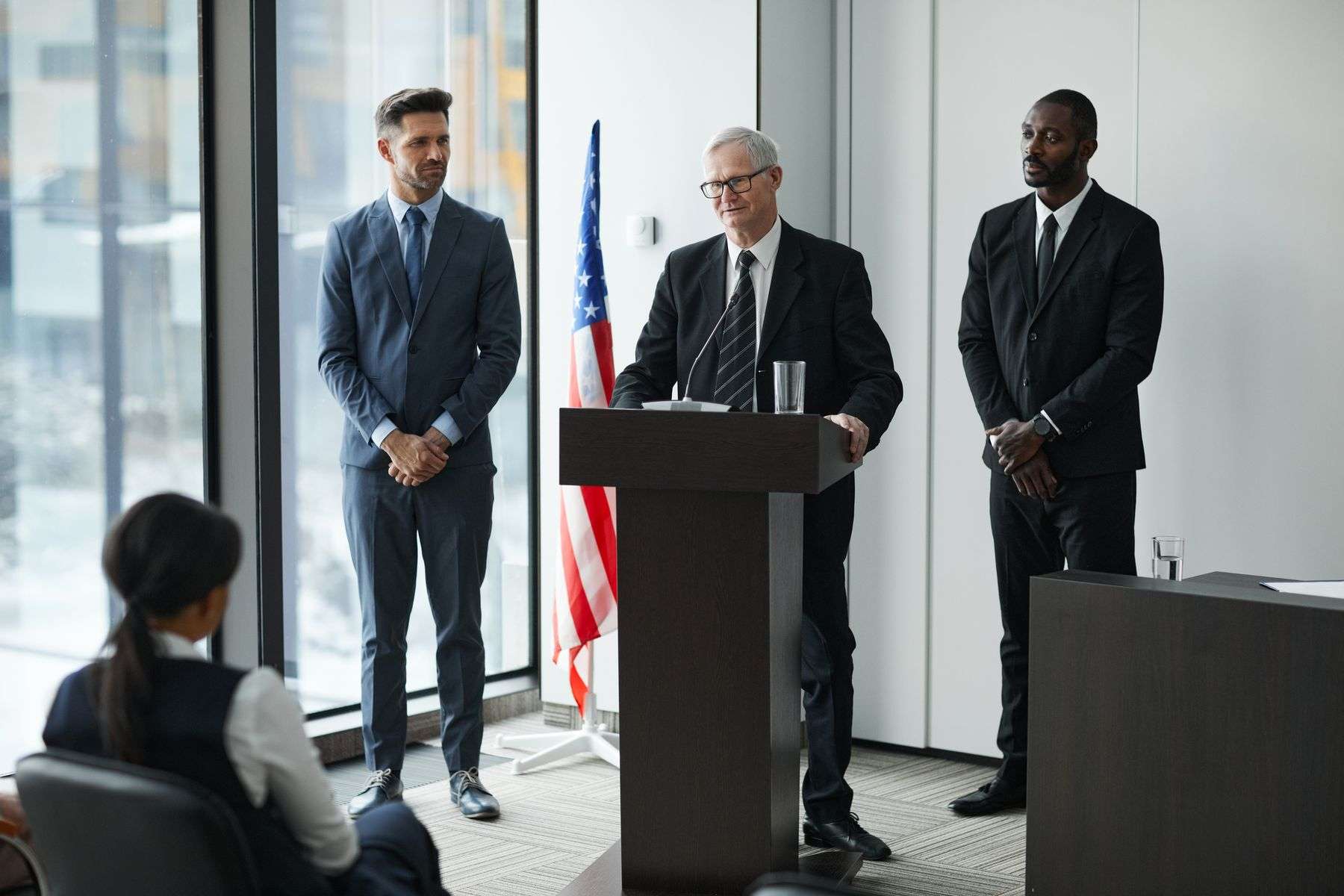
Alabama Attorney General Luther Strange drew a packed crowd to Westminster Presbyterian Church in Mobile on Monday night, delivering one of his first campaign-style addresses since announcing plans to seek the U.S. Senate seat held by Jeff Sessions.
The event, hosted by the Mobile County Republican Executive Committee, doubled as an early test of local support for Strange and offered a preview of what could become a crowded Republican field. Sessions has been nominated for U.S. Attorney General under President-elect Donald Trump, and his confirmation would trigger a vacancy in Alabama’s Senate delegation. Governor Robert Bentley has said he will name a temporary replacement once Sessions is confirmed, with a special election to follow in 2018 rather than being held immediately.
The unusual mechanics of the coming vacancy — an appointee chosen by a governor, then a statewide vote potentially years away — has shaped every move by prospective candidates, who must court both the man in the governor’s office and the party activists who will dominate a primary electorate. Few forums matter more in that calculation than county executive committees, and few are larger than Mobile County’s.
Strange makes his case
Strange used the appearance to make the case that he is best positioned to hold the seat long term, pointing to both his record as attorney general and the financial support his campaign has already built.
“I have already announced that I’m running for the Senate … and I’m really encouraged by the support we’ve got,” Strange told the crowd. “I’ve raised over $700,000 from all across the state … I’d be honored to be selected [by Bentley] but ultimately the people of the state are going to decide who’s going to be their senator. I’m prepared to run because I feel like, based on my record and experience, I’m the best person to take Jeff Sessions’ place.”
The fundraising figure was the night’s most concrete number, and its significance went beyond cash. More than $700,000 gathered from donors across the state before a vacancy even exists signals to both the governor and potential rivals that a Strange campaign would enter any race with resources already in hand — a deterrent in a state where statewide campaigns must reach from the Tennessee line to the Gulf in a single election cycle.
Strange’s decision to announce before the appointment also carries a calculated risk. By declaring openly, he removes any pretense that his selection by Bentley would be incidental, and he invites opponents to frame the seat as one he is engineering an inside track toward. His answer to that framing — that the people, not the governor, will ultimately decide — was the centerpiece of his address.
Rivals in the room
Notably, Strange’s audience Monday night included at least two men who could end up competing against him for the same seat. State Senators Trip Pittman of Baldwin County and Bill Hightower have each interviewed with Bentley as potential temporary appointees to the seat, putting all three men in the unusual position of being simultaneously allies within the state Republican Party and potential rivals in a future statewide race.
Pittman, who chairs oversight of the state’s general fund budget, addressed the crowd about his own interview with the governor, framing his candidacy around his background as a husband, father, businessman and military veteran.
“We had a very good interview,” Pittman said, with Strange standing nearby. “I think I made a point of who I am, what I stand for as a husband, father, a businessman. I’ve served in the military. I’m prepared to offer myself for this important position, to try to follow the footsteps of Jeff Sessions, who’s a great senator.” Pittman added that his political plans hinge on Bentley’s eventual pick. “Now we’re going to see who the governor appoints, and then I’m going to evaluate that, and then, you know, I’m considering running for the seat, depending on what happens there,” he said. “I think the people of Alabama need to decide who’s going to be their next U.S. Senator.”
The image of two men courting the same seat sharing a church fellowship hall — one addressing the crowd while the other waited nearby — captured the awkwardness of a race that exists only in anticipation. Party committees like Mobile County’s are precisely where such rivals must coexist in the meantime, since the activists filling the pews will staff campaigns, cast early primary ballots and shape the field long before any votes are counted.
Hightower, who represents portions of Mobile and Baldwin counties in the state Senate, was also present at the Westminster Presbyterian Church gathering as speculation continues over whether he too will seek the seat, whether through a gubernatorial appointment or the ballot box in 2018. His presence mattered for a geographic reason: any Republican hoping to carry Alabama statewide will need to run well in south Alabama, and Mobile County’s party organization is the region’s gatekeeper.
A waiting game set by Washington
For now, the timeline remains in Bentley’s hands. The governor has said he will not name a permanent successor until Sessions is formally confirmed by the U.S. Senate, and that any special election for Alabama voters to fill the seat on a long-term basis will not take place before 2018.
That leaves Strange, Pittman, Hightower and any other prospective candidates in a holding pattern, working to shore up support among local party organizations like the Mobile County Republican Executive Committee in the meantime. The interval between a Senate confirmation and a special election can stretch across multiple legislative sessions and budget cycles, giving every candidate time to build — or lose — momentum.
The appointment itself carries its own strategic weight. An interim senator chosen by Bentley would serve with the advantages of incumbency: office budgets, staff, committee assignments and a voting record accumulated before anyone else can campaign. That is why the interviews with the governor have drawn as much attention as any speech, and why candidates who miss the appointment must immediately pivot to arguing that the seat should be won by voters rather than inherited.
Alabama’s senators historically have served long tenures, and Sessions’ seat in particular has been held by conservative icons in the state’s modern political memory. Whoever ultimately fills it will spend years defining themselves against that legacy, which is why both Strange and Pittman invoked Sessions by name on Monday night — each positioning continuity with the outgoing senator as a credential rather than a burden.
Monday’s meeting offered an early glimpse of how that competition might unfold within south Alabama’s Republican ranks, as the state’s political class waits on developments in Washington that will ultimately set the race in motion. Until then, the campaigns exist in miniature: a church crowd here, a county committee there, and three men sharing a room while insisting that the voters — not the governor, and not each other — will have the final word.
The night ended without endorsements, without announcements and without any of the three closing the door on a race all of them can see coming. In a state where a Senate seat can define a political generation, that kind of restraint rarely lasts long once the vacancy becomes official.
The dynamics on display Monday night mirror Alabama’s recent statewide history. Senate vacancies in the state have produced some of its most consequential political contests, and the combination of a gubernatorial appointment followed by a delayed special election has historically rewarded candidates who can sustain an organization — fundraising, county chairmen, volunteer networks — across a gap that can stretch well past a year.
Mobile County’s role in that arithmetic is difficult to overstate. As the state’s second-largest county and the anchor of south Alabama’s Republican organization, it supplies votes, money and media attention in quantities that can decide statewide primaries. Candidates who invest time in the county committee circuit, as all three men did this week, are following a playbook that has governed Alabama Republican politics for a generation.
The church setting added its own resonance. Westminster Presbyterian, like many Mobile congregations, regularly hosts civic and political gatherings, and events of this kind blend the state’s two most durable institutions — party organization and church community. For candidates whose self-descriptions lean on faith and family, as Pittman’s did Monday night, the venue is not incidental; it is the audience.
What happens next depends on Washington. Until Sessions’ confirmation is complete, no appointment can be made and no campaign calendar can be fixed, leaving the field frozen in the posture on display Monday: declared intentions, private interviews, careful courtesies and an unspoken agreement to compete without yet campaigning. When the vacancy becomes official, that restraint will end, and the courtship of committees like Mobile County’s will convert into the open contest it has been rehearsing all along.