
Republican hopefuls in Alabama’s 1st District, Senate races post strong fundraising
Third-quarter filings show strong fundraising in Alabama's 1st Congressional District and U.S. Senate Republican races, led by Jerry Carl and Bradley Byrne.
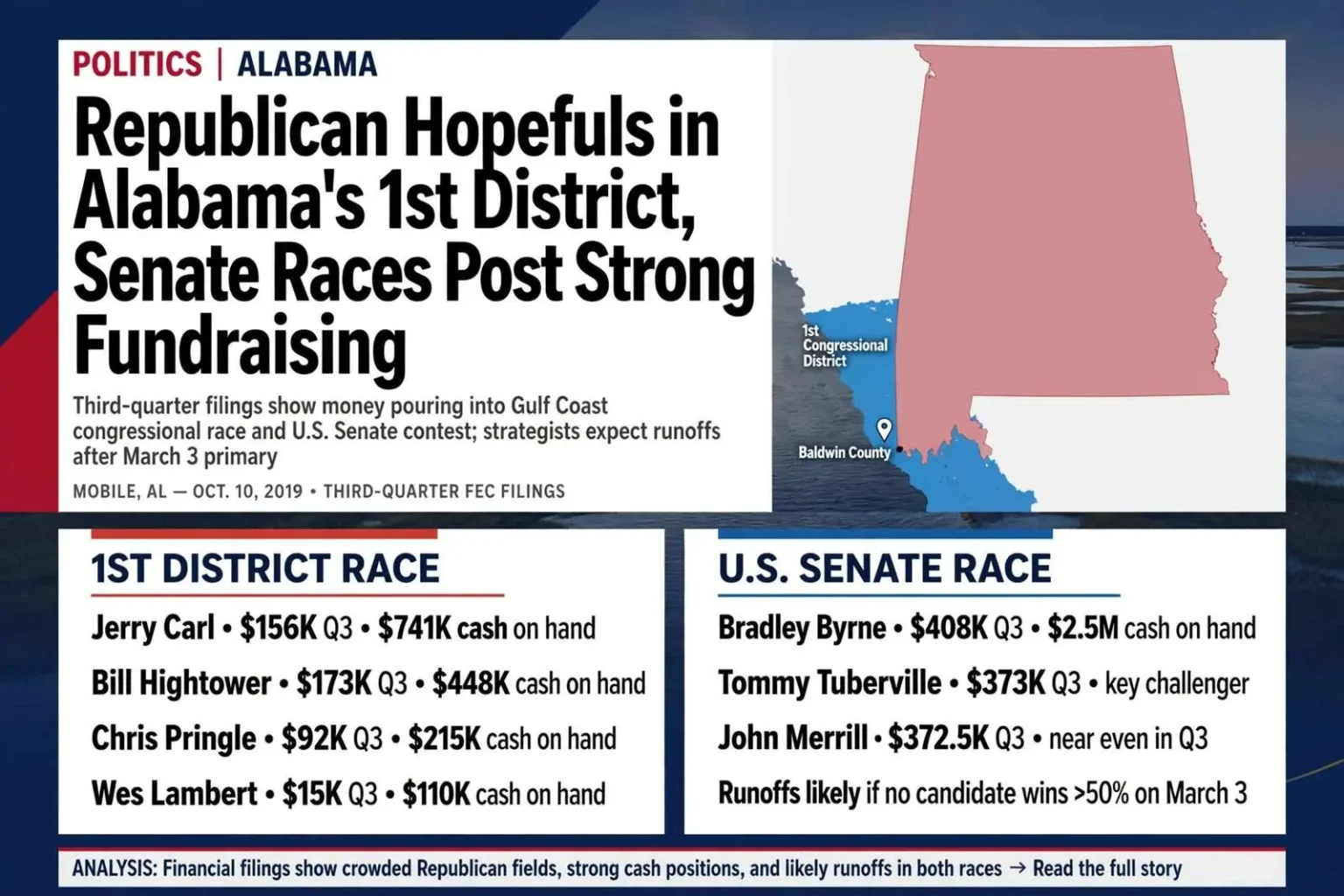
Money is pouring into Republican campaigns for Alabama’s 1st Congressional District and the U.S. Senate, according to third-quarter federal filings reviewed by a Mobile-based political strategist. The filings, covering the quarter that ended Sept. 30, sketch out the financial shape of two of the state’s most watched 2020 races — an open congressional seat on the Gulf Coast and a statewide Senate contest — and they show candidates raising and spending at levels that make the fields unlikely to grow before the March 3 primary.
The 1st District field
Four Republicans are vying for the Lower Alabama congressional seat being vacated by Bradley Byrne, who is running for the U.S. Senate. The district, which sweeps across Mobile, Baldwin and Washington counties along the state’s Gulf Coast and southern tier, has been reliably Republican, making the party’s March 3 primary the decisive contest for the seat — and the reason the fundraising race among the four contenders carries such weight.
Among them, former state Sen. Bill Hightower led third-quarter fundraising with $173,000, lifting his cycle total to $560,000. Hightower, a Mobile-area legislator who built his profile in the Statehouse before entering the congressional race, used the quarter to close ground on his chief rival in total receipts, demonstrating the fundraising capacity that political observers had identified as the key test of his candidacy.
Mobile County Commissioner Jerry Carl raised $156,000 in the quarter for an overall total of $857,000, including a $405,000 personal loan. Carl’s reliance on his own money — more than $400,000 of his cycle total — gave him the largest war chest in the field by a wide margin, a factor that has shaped the race’s strategic math: with the best-funded campaign, Carl can sustain advertising through the campaign’s final stretch regardless of the pace of outside contributions.
State Rep. Chris Pringle brought in $92,000 for a $308,000 total, while Baldwin County’s Wes Lambert raised $15,000 for $173,000 overall. Pringle, a veteran of the Statehouse with deep roots in Mobile politics, held the field’s third position in both quarterly and cycle fundraising, while Lambert’s Baldwin County base kept him in the race despite the fundraising gap.
Carl led the field in cash on hand at the end of September with $741,000, ahead of Hightower’s $448,000, Pringle’s $215,000 and Lambert’s $110,000. Cash on hand is the number campaigns watch most closely in the final quarter before a primary, since it measures what a candidate can actually spend on television, digital advertising and field operations in the months when voters begin paying attention.
The Senate race money race
In the Senate race, Byrne held a large cash lead with $2.5 million on hand, though third-quarter totals were fairly even among the front-runners: Byrne took in $408,000, former Auburn coach Tommy Tuberville $373,000 and Secretary of State John Merrill $372,500. The contest to succeed Sen. Doug Jones, the Democrat who won a 2017 special election, has drawn a crowded Republican field, and the third-quarter numbers showed the leading candidates within roughly $35,000 of one another in new receipts — a virtual tie in the quarter even as Byrne’s banked cash advantage gave him the clearest path to a sustained media campaign.
State Rep. Arnold Mooney raised $242,700, while former Chief Justice Roy Moore collected $63,000. The totals mapped the field’s structure: the three front-runners in a tight cluster, Mooney in a distant but functional fourth, and Moore — whose 2017 Senate candidacy ended in a loss that cost Republicans a seat — trailing the field at a fraction of the others’ pace. Moore’s modest quarter stood out in a race where his name recognition alone was once expected to drive fundraising.
The Senate contest’s stakes explain the money. Alabama’s seat is among the Republicans’ best pickup opportunities in the 2020 map, and national attention — and the donor networks that come with it — has flowed into the state accordingly. A Republican primary win in March is widely viewed as tantamount to election in November, which concentrates the entire contest into the primary and its likely runoff.
Runoffs expected
The strategist, Jon Gray, predicted runoffs in both races after the March 3 primary, noting the sums already raised make late entries unlikely. Gray’s analysis reflects Alabama election law, which requires a candidate to win a majority of the primary vote to claim the nomination outright; absent a majority, the top two finishers advance to a runoff weeks later. In multi-candidate fields like these, where no single contender has broken away in the polls or the money race, a runoff is the default expectation of experienced state operatives.
The financial filings also serve as a deterrent to new entrants. A candidate joining either race after the third quarter would face opponents who have already banked hundreds of thousands of dollars in the congressional contest and millions in the Senate race, with less than half a year remaining to close the gap. In both contests, the window for a credible late campaign closed, in practical terms, with the quarterly filing deadlines — one more reason Gray’s runoff prediction assumes the current fields hold.
For the region’s voters, the filings offered the clearest public measure yet of how the contest for the congressional seat is shaping up. Fundraising cannot tell anyone who will win in March, but it does show which campaigns have the resources to introduce themselves on television, which are relying on organization and name recognition, and which may run out of runway before the voters who have not yet tuned in start paying attention. By those measures, the third quarter left Carl out front, Hightower charging, Pringle holding and Lambert hoping for a Baldwin County consolidation strong enough to overcome the gap — the field, in other words, exactly as the runoff math would want it.
What the money means for the campaign’s final phase is straightforward. Carl’s cash advantage in the 1st District lets him define the terms of the race on air while his rivals raise the means to respond; Hightower’s quarterly surge suggests he will have the resources to contest that narrative; and Pringle and Lambert will need to make smaller budgets stretch through organization and earned media. In the Senate race, Byrne’s $2.5 million reserve towers over a quarter in which his rivals matched his fundraising pace — meaning Tuberville and Merrill closed the gap in momentum without yet closing it in capability, and leaving both races, as the filings closed out the year’s third quarter, exactly where the strategists expected them: headed to March, and likely to runoffs.
How the 1st District got here
The vacancy that set the congressional race in motion came with Byrne’s decision to run for the Senate instead of seeking another House term. Byrne, a former state senator and university system chancellor who had held the 1st District seat since a 2013 special election, chose the statewide contest over an easy House re-election, instantly converting a safe incumbent seat into an open scramble among ambitious Gulf Coast Republicans. Open seats in safe districts reliably produce crowded primaries, and the 1st District’s 2020 contest fit the pattern: four candidates with legislative, county and business credentials, each with a regional base and a theory of the race.
The district’s geography shapes those theories. Mobile County, the state’s second-largest county and the district’s population anchor, is home territory for Carl, whose county commission post gave him name recognition across the city and its suburbs, and for Hightower and Pringle, both Mobile-area legislators. Baldwin County, the fast-growing communities across Mobile Bay, is Lambert’s base — smaller in raw votes than Mobile but reliably conservative and intensely local in its politics. A candidate who sweeps his home county while holding his own in the others can build a primary plurality; sweeping both major counties outright is difficult, which is precisely why runoff expectations are built into the race’s arithmetic.
What third-quarter filings do and don’t show
Federal quarterly filings report receipts, expenditures and cash on hand as of the quarter’s end, and operatives read them for what they reveal about viability. A candidate’s quarterly total measures the breadth of his donor network; the cash-on-hand figure measures his capacity for the final push; and the composition of receipts — small contributions against large ones, self-funding against borrowed money — tells professionals how sustainable the pace will be. Carl’s $405,000 personal loan, for instance, reads very differently from Hightower’s $173,000 in raised money: the first is a bet on himself that cannot be repeated indefinitely, the second evidence of an expanding network of givers.
The filings also discipline the candidates themselves. A weak quarter invites second looks from potential endorsers, local officials and donors who prefer to back a winner, and a strong one can consolidate a field’s second-tier support behind its front-runner. With both contests now past the last quarterly deadline before the primary, the money race as reported is, for practical purposes, the money race as it will be fought — and by the numbers filed at the end of September, both Alabama Republican races enter their final stretch with clear financial hierarchies, crowded fields and every expectation of an extra round in the runoff that March 3 may not settle.


