
Byrne posts strong fundraising for U.S. Senate bid
Mobile Congressman Bradley Byrne raised $1.2 million in the first quarter of 2019 for his U.S. Senate campaign.
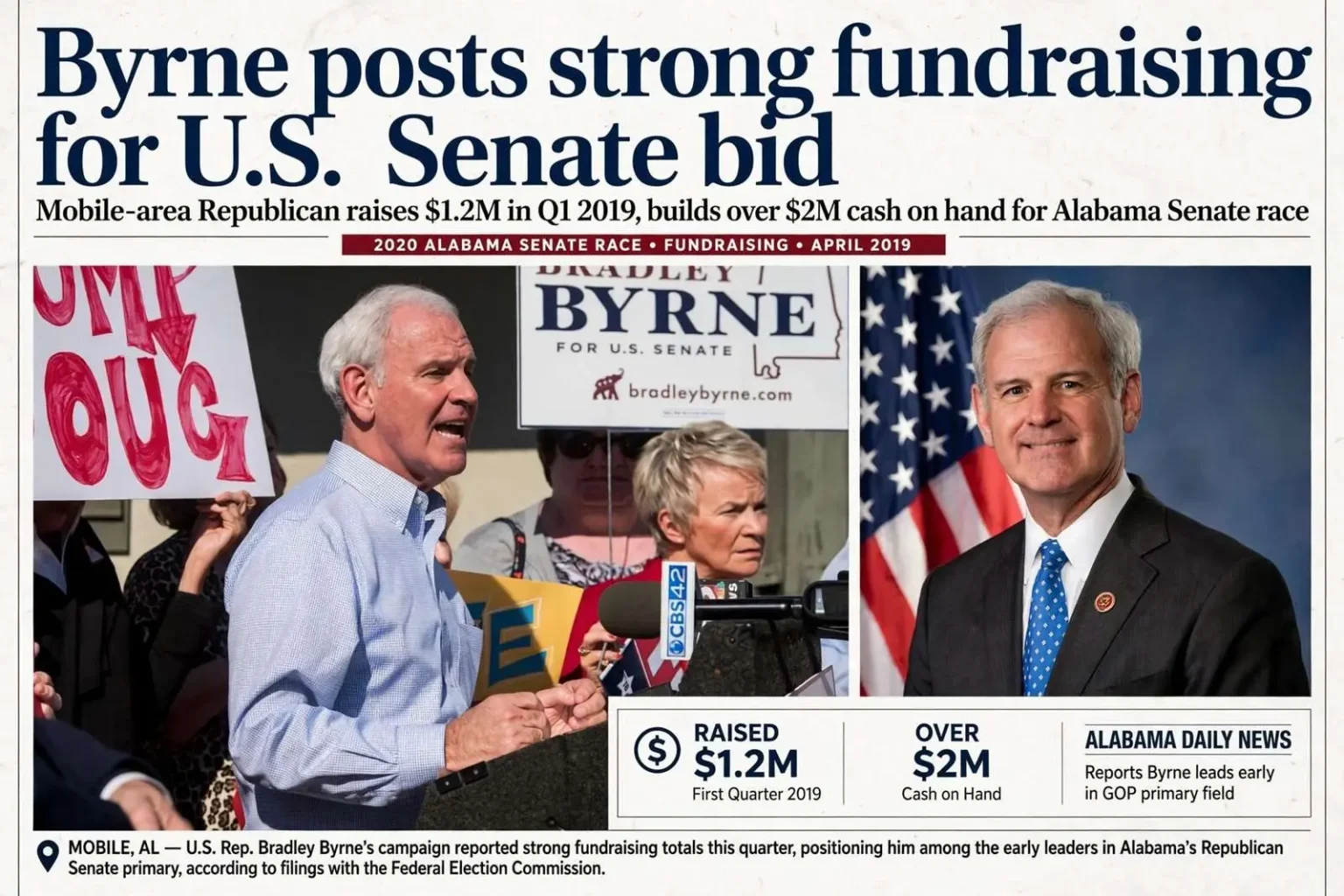
U.S. Rep. Bradley Byrne has gotten a financial boost in his campaign for the Senate, and the numbers place his 2020 bid among the early fundraising leaders in Alabama’s Republican primary. The Mobile-area Republican raised $1.2 million in the first quarter of 2019, according to the Alabama Daily News, leaving him with more than $2 million cash on hand as he seeks to unseat Democratic Sen. Doug Jones in 2020.
Fundraising totals at this stage of a Senate cycle function as both resource and message. A $1.2 million quarter more than a year before the election gives Byrne the means to build a statewide operation — travel, staff, advertising, and the ground game that Alabama’s 67 counties demand — while the total itself sends a signal to potential donors, endorsers, and primary opponents that the campaign is a serious one. The more than $2 million in cash on hand matters just as much: it represents money banked before the primary fight fully arrives, when spending accelerates and the ability to sustain advertising through the final weeks often decides close races.
Byrne’s political base
Byrne’s fundraising strength rests on the district he has represented since 2014. Alabama’s First Congressional District runs across the southern tier of the state, taking in Mobile, Baldwin County, and the southwestern counties along the Mississippi and Florida lines, and it is among the most reliably Republican districts in Alabama. Byrne himself came to the seat with deep roots in the area: he chaired the Alabama State Board of Education, served as chancellor of the state’s two-year college system during its post-scandal reorganization, and ran for governor in 2010 before winning the congressional seat in a special election.
In the House, Byrne built a profile as a reliable conservative vote with particular attention to coastal and Gulf issues, federal workforce and military matters affecting the region, and education policy. Mobile’s economy — anchored by the port, shipbuilding at Austal, aerospace employers, and the state’s growing manufacturing base — gave him a steady stream of local concerns to carry to Washington, and Baldwin County’s rapid growth made him a frequent presence in one of the fastest-growing counties in the state. That established name recognition across south Alabama is the intangible asset behind a fundraising quarter of this size; donors give early to candidates they already know.
The Senate seat he is pursuing became available, in effect, in December 2017, when Doug Jones won a special election over Roy Moore in a race that became a national story. Jones’s victory — the first Democratic Senate win in Alabama in a quarter century — came amid extraordinary circumstances surrounding his opponent, and Republicans made reclaiming the seat their top Senate priority for 2020. Jones himself was candid that his election was not a mandate that reflected Alabama’s normal electorate, and both parties treated the 2020 race as a likely Republican pickup opportunity from the day it was scheduled.
The 2020 Alabama Senate race
The Republican primary field in early 2019 was already drawing national attention, and Byrne’s first-quarter numbers positioned him within it. The primary field grew to include Jeff Sessions, the state’s former senator whose resignation to serve as attorney general had triggered the special election, along with Tommy Tuberville, the former Auburn football coach, and Secretary of State John Merrill, among others. With a crowded field, primary strategy in Alabama’s system becomes arithmetic: a candidate must clear fifty percent to win outright, and a runoff between the top two follows if no one does. Fundraising shapes which campaigns can survive that gauntlet.
Money in Alabama politics buys specific things. Statewide campaigns need television buys in the Birmingham, Huntsville, Mobile, and Montgomery markets, radio in the rural black belt and north Alabama, and the staff and travel to campaign across a state where distance is the perennial obstacle. A candidate with $2 million banked in the spring of 2019 can fund early advertising to introduce himself to voters outside his congressional district — the essential task for a south Alabama congressman running statewide — while opponents with thinner reserves must rely on earned media and free exposure to close the name-recognition gap.
The Alabama Daily News, the Montgomery-based outlet that reported Byrne’s totals, has become a standard source for Alabama political coverage, and first-quarter reports in an off-year are scrutinized by political professionals precisely because they measure an operation’s durability rather than a single moment’s enthusiasm. Byrne’s $1.2 million quarter, reported in that context, was read as evidence that the Mobile-area congressman could fund a genuine statewide campaign — the question his rivals would spend the next year trying to answer differently.
What the numbers mean for Alabama
For Alabama voters, the early fundraising race is the visible edge of a campaign that will eventually reach every county. Byrne’s cash position allows him to run a patient primary — to spend on organizing and introductions while preserving reserves for the final stretch — and it pressures opponents to raise comparably or find alternative advantages: name identification, free media, or outside support. Political action committees and national Republican groups watched the primary closely, since the party’s path to a Senate majority ran through Alabama, and the prospect of an expensive, divisive primary was the scenario national Republicans hoped to avoid after the 2017 experience.
Jones, for his part, entered the cycle with his own fundraising operation and the incumbent’s advantage of time, but also with the structural reality of a state that had voted Republican in every recent statewide race. The general election dynamics were predictable from the start: the Republican primary winner would begin as the favorite, and Jones’s path required either a Republican nominee who struggled to unify the party or a campaign that changed the usual arithmetic. Byrne’s quarter was an early contribution to the race’s central question — which Republican would emerge to make that general election case.
The first quarter of 2019 ended with Byrne holding a war chest of more than $2 million and a fundraising pace of $1.2 million per quarter, numbers that established the Mobile-area congressman as a serious contender for the Republican Senate nomination. The totals came from the Alabama Daily News’s reporting, and they set the benchmark his primary rivals would be measured against through the rest of the year — the early financial story of a Senate race that Alabama, and Washington, would follow closely through 2020.
How campaign finance reports work
The numbers behind a story like Byrne’s come from the quarterly reports every federal campaign files with the Federal Election Commission. Candidates must disclose their receipts, expenditures, and cash position each quarter, and political reporters in Alabama and Washington parse those filings the day they post. First-quarter reports of an election year or the year before it are treated as a health check: they show whether a campaign’s fundraising is accelerating, whether its donor base is broad or concentrated among a few large checks, and whether the burn rate — spending relative to intake — suggests discipline or strain. The $1.2 million figure and the $2 million cash position that the Alabama Daily News reported came from that disclosure system.
Individual contribution limits in federal races constrain where that money comes from. Donors can give a candidate a few thousand dollars per election under federal law, so a quarter of this size implies a large number of donors plus support from political action committees, which are subject to their own limits. Campaign finance watchers look at the composition — how much is itemized individual giving, how much comes from PACs, how much arrives from donors outside Alabama — because each pattern tells a different story about a campaign’s strength. A home-district congressman typically shows strong Gulf Coast giving with substantial PAC support from industries with business before the federal government.
Cash on hand is the number professionals weight most heavily in the year before a primary. A campaign can raise a large quarter and spend it just as fast; banked money, by contrast, represents flexibility and endurance. Byrne’s more-than-$2 million position entering mid-2019 meant he could weather the crowded primary’s later stages — when advertising saturation in Alabama’s media markets becomes expensive — without the mid-campaign fundraising scramble that hobbles underfunded challengers.
South Alabama’s political landscape
Byrne’s fundraising geography reflects his district’s character. South Alabama’s First District blends the port city of Mobile — with its business, legal, and medical establishments — and Baldwin County’s booming suburban communities of Fairhope, Daphne, Gulf Shores, and Spanish Fort, along with the smaller industrial and agricultural counties to the west and north. Political money in the region flows from real estate, shipping, banking, healthcare, and the defense-related employers clustered around Mobile’s port and shipyards. A congressman who has chaired committees and subcommittees touching those industries builds the relationships that translate into early campaign checks.
The senatorial district’s political history also frames the race. Alabama’s Senate seats have been held by Republicans since the mid-1990s, and the state’s voters have delivered Republican majorities in every presidential election of the modern era. Doug Jones’s 2017 win was a singular event — decided by a historically narrow margin in a special election defined by extraordinary circumstances — and both parties entered 2020 treating the seat as the Republican Party’s most winnable pickup opportunity in the country. That national attention brought outside money and media to every Republican primary event, Byrne’s quarterly totals included.
The primary calendar gave the field more than a year to develop. Alabama’s primary would come in the spring of 2020, with a runoff following weeks later if needed, and the general election in November 2020. Candidates used 2019 for the unglamorous work that money enables: hiring staff, opening headquarters, traveling to county party meetings and fish fries from Huntsville to Dothan, and building the donor networks that sustain a year-long campaign. Byrne’s first-quarter report showed that work already funded at scale.
The stakes for the Senate
Alabama’s seat mattered beyond the state’s borders. The Senate map for 2020 put Democratic incumbents on defense in several states Donald Trump had carried, and Alabama was the mirror image — a Republican-leaning state with a Democratic incumbent defending a seat won in a special election. National Republicans, through the Senate Leadership Fund and allied groups, signaled they would spend in Alabama, and national Democrats faced the choice of defending Jones heavily or conceding the seat. Every Republican primary development, including fundraising quarters like Byrne’s, was read in Washington as part of that map.
For the candidates, the logic of a strong early quarter is defensive as well as offensive. In a field that eventually grew crowded, each campaign had to demonstrate viability to keep donors, endorsers, and media attention from consolidating behind a rival. Byrne’s $1.2 million quarter served that function — evidence that the congressman from Mobile could compete financially with any rival, including opponents with higher national name recognition. Whether that financial strength converted into votes would be decided over the following year, but the benchmark was now on the record.
The quarter, reported by the Alabama Daily News, stands as the opening financial chapter of the 2020 Senate race: Bradley Byrne, the Mobile-area Republican, raised $1.2 million and banked more than $2 million against Doug Jones, the Democrat he hoped to unseat. The numbers gave the Byrne campaign the resources and the credibility to wage a statewide campaign, and they set the standard every other Republican in the field would have to meet.


