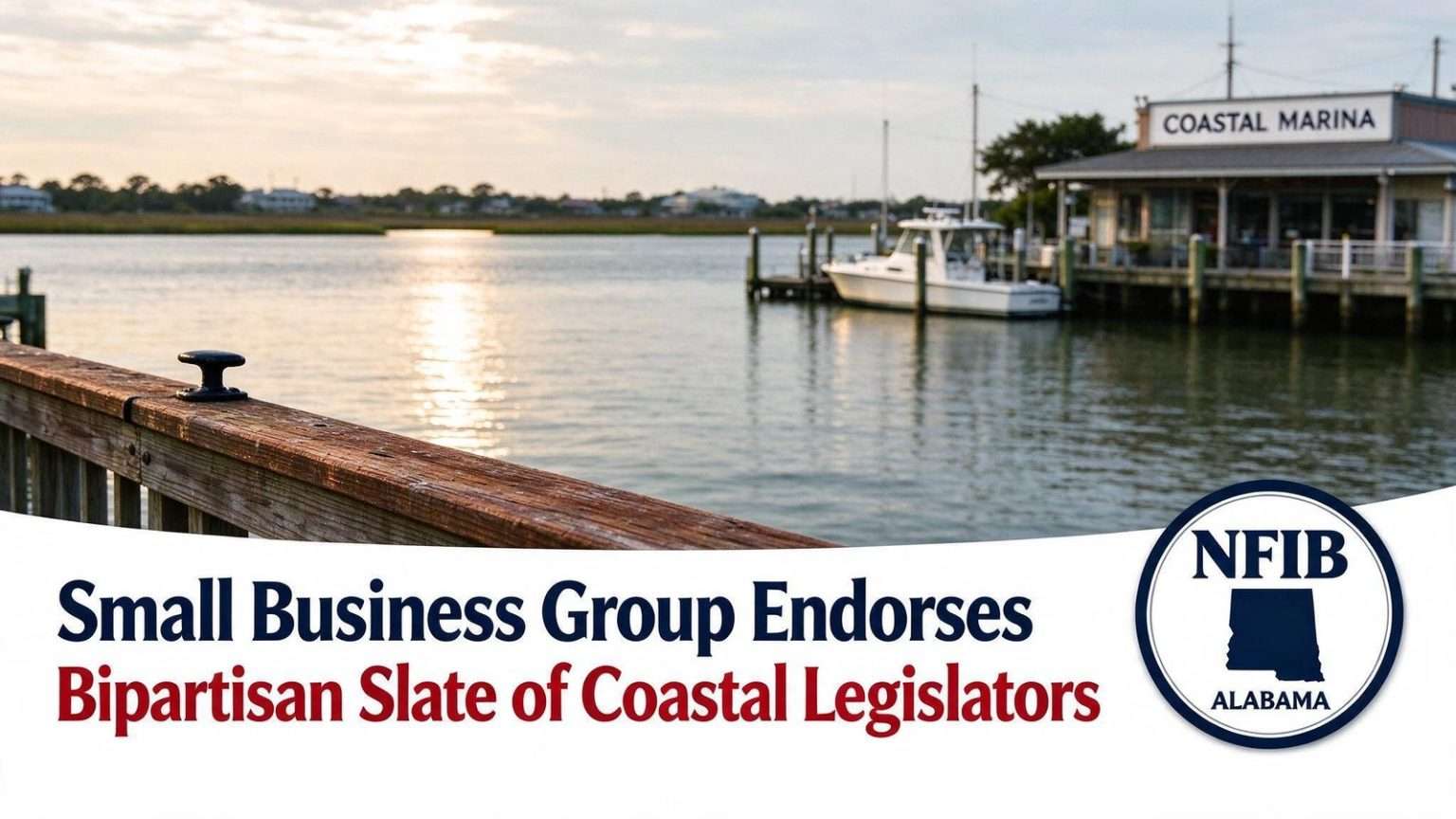
The National Federation of Independent Business, Alabama’s leading small business association, announced its endorsements in 80 state legislative races ahead of the Nov. 2 election, backing a bipartisan slate that included a group of incumbent lawmakers from the coastal counties.
The NFIB is the nation’s largest small business advocacy organization, and its Alabama chapter functions as one of the most closely watched interest groups in state politics. The federation tracks how every sitting legislator votes on tax policy, regulation, workers’ compensation, health insurance mandates and a range of other issues that land hardest on companies with a handful of employees rather than a human resources department. Its endorsement process for a general election leans heavily on those voting records, which is why the group’s lists so often cross party lines in the same cycle.
For Alabama’s small employers — the restaurants, contractors, hardware stores, marinas, medical practices and family firms that anchor Main Streets from Bay Minette to Gulf Shores — the state Legislature’s decisions on business taxes, unemployment costs and regulatory oversight translate directly into hiring and expansion decisions. Groups like the NFIB argue that a Legislature’s composition matters more to a two-employee shop than to a large corporation, because small businesses lack the in-house counsel and lobbying presence that shield bigger firms from policy shifts.
Coastal Names on the List
Among the local endorsements were three incumbent state senators: Trip Pittman of Montrose, Rusty Glover of Semmes and Ben Brooks of Mobile. The group also endorsed a slate of incumbent state representatives from across the region, including Harry Shiver of Bay Minette, Alan Baker of Brewton, Joe Faust of Fairhope, Steve McMillan of Gulf Shores, Randy Davis of Daphne, Victor Gaston of Mobile, Jamie Ison of Mobile, Chad Fincher of Semmes, Jim Barton of Mobile and Spencer Collier of Irvington.
The coastal delegation collectively represents one of the fastest-growing regions in the state. Baldwin County’s communities along Mobile Bay — Daphne, Fairhope, Montrose and the beach towns — had spent the decade absorbing rapid residential growth, while Mobile County’s legislative districts cover a mix of port-centered industry, suburban development and rural stretches to the north and west. The named incumbents span that entire geography, from Shiver’s district around Bay Minette to McMillan’s along the Gulf beaches.
The roster spanned both parties, reflecting the organization’s stated approach of measuring candidates by their records on business issues rather than by party label. In a region where legislative districts do not sort neatly along ideological lines — and where tourism, construction, seafood and manufacturing interests often align across the aisle — that record-based method produced a list that drew from both caucuses in the State House and Senate.
For the coastal delegation, the endorsements amounted to a vote of confidence from a constituency of small employers heading into the final weeks of the campaign. An NFIB endorsement arrives with tangible practical benefits: the federation’s political arm can direct member communications, and its seal carries weight in a campaign mailbox where voters are sorting through a stack of mailers from competing interests.
Business Over Party
“Our members support candidates who support small business, regardless of party affiliation,” said Rosemary Elebash, state director of NFIB/Alabama. “Small business is the backbone of Alabama’s economy, and it’s critically important to have a Legislature that supports free enterprise.”
That framing captured the group’s pitch to voters and lawmakers alike. By emphasizing a bipartisan approach, the federation positioned itself as a validator of pro-business records across the political spectrum, a stance that carried particular resonance in a region where economic development and job growth dominated the civic agenda.
Elebash’s description of small business as the backbone of the state’s economy reflects the numbers that drive the argument. The overwhelming majority of Alabama businesses are classified as small businesses, and they account for a substantial share of private-sector employment across the state. In the coastal counties, the proportion is even more pronounced, because the regional economy is built substantially on tourism, retail, food service, construction and trades — sectors dominated by independently owned firms rather than national chains.
The endorsement announcements also served a signal function within the Legislature itself. Incumbents who earn the federation’s backing know their voting records on business legislation are being scored and published, and challengers pay attention to which interest groups are lining up behind their opponents. Over successive election cycles, that dynamic shapes how legislators approach bills affecting unemployment insurance taxes, lawsuit limits, licensing requirements and the host of other measures the federation monitors.
What the Endorsements Signaled
Endorsements from a well-known business organization can carry practical weight in legislative races, offering candidates a credential to tout with employers and helping to shape the perception of a race’s stakes. In legislative districts where name recognition is low and turnout is modest, a third-party validation from an organization with an established brand can move the small slice of persuadable voters who actually decide down-ballot contests.
The coastal incumbents on the list shared a set of policy concerns familiar to any Gulf Coast legislator. Insurance affordability, hurricane recovery, coastal economic development and the ongoing competition for industry sit at the top of the region’s agenda, and each of those issues intersects directly with the business community’s priorities. Small coastal employers have a particular stake in property insurance costs, which affect both their commercial coverage and the disposable income of their customers.
With the Nov. 2 election approaching, the endorsed incumbents entered the closing stretch of the campaign with an organizational advantage that challengers found difficult to match. The federation’s members were encouraged to support the list at the ballot box, and the group’s messaging in the campaign’s final weeks reinforced the theme that a Legislature friendly to free enterprise was the surest path to job creation in the region.
The broader context for the announcement was an election season in which economic anxiety ranked at or near the top of voter concerns statewide. Campaigns for legislative seats that year emphasized job creation, government spending and the state’s business climate, giving a small business organization’s endorsements unusual prominence. Candidates across Alabama competed to demonstrate their pro-business credentials, and groups that could credibly certify those credentials found their seals in demand.
The Region’s Economic Stakes
Along the Gulf Coast, the stakes behind the endorsements were concrete. Baldwin County’s growth had made it one of the state’s economic engines, with new rooftops bringing new retail centers, medical offices and service businesses to the Eastern Shore and the beach corridor. Mobile County’s economy leaned on the port, shipbuilding and aerospace, alongside the small contractors and suppliers that orbit those anchor industries. In both counties, the health of independently owned businesses determined whether growth translated into local prosperity or simply passed through to outside firms.
The makeup of the endorsed slate reflected the region’s political geography. Baldwin County districts have long leaned heavily Republican, while Mobile County’s delegation historically blended the two parties, with urban Mobile districts and suburban ones voting differently than rural stretches of the county. A list that included lawmakers from both parties was therefore less a calculation than a natural byproduct of scoring records across a genuinely mixed delegation — and it allowed the federation to present itself locally as an interested party in results rather than in parties.
Small business owners in the coastal counties also carried concerns specific to their location. Seasonal tourism swings complicate cash flow and hiring along the beaches, seafood and marine trades face their own regulatory pressures, and the concentration of construction firms along the growth corridors means land-use and infrastructure decisions land on Main Street as directly as any tax bill. Legislators who had built records addressing those sector-specific concerns had effectively been campaigning for the federation’s endorsement for years, whether or not they thought of it that way.
Legislative decisions with direct business consequences loomed over the session that would follow the election. Road and bridge funding, incentives for industrial recruitment, insurance reform and coastal restoration spending all sat on the agenda, and each touched the coastal delegation’s districts directly. The endorsed incumbents had, by virtue of their records, already taken positions on many of those questions — which was precisely the point the federation was making with its list.
For voters in the coastal counties, the endorsements offered a shorthand summary of how a decade of legislative service had been viewed by one of the state’s most engaged interest groups. Whether that validation proved decisive in individual races would depend on turnout, campaign funding and the local dynamics of each district. But for the thirteen coastal lawmakers whose names appeared on the list, the message from Alabama’s small business community was unambiguous: the records they had built on business issues had earned them the backing of the constituency that claims to speak for the state’s employers.