Shelby Presses Senate to Restore Funding for Tanker That Could Be Built in Mobile
Alabama's senior senator warned a Senate defense panel in July 2006 that cutting $203.9 million from the KC-135 tanker replacement program would delay a contract that could bring aircraft work to Mobile.
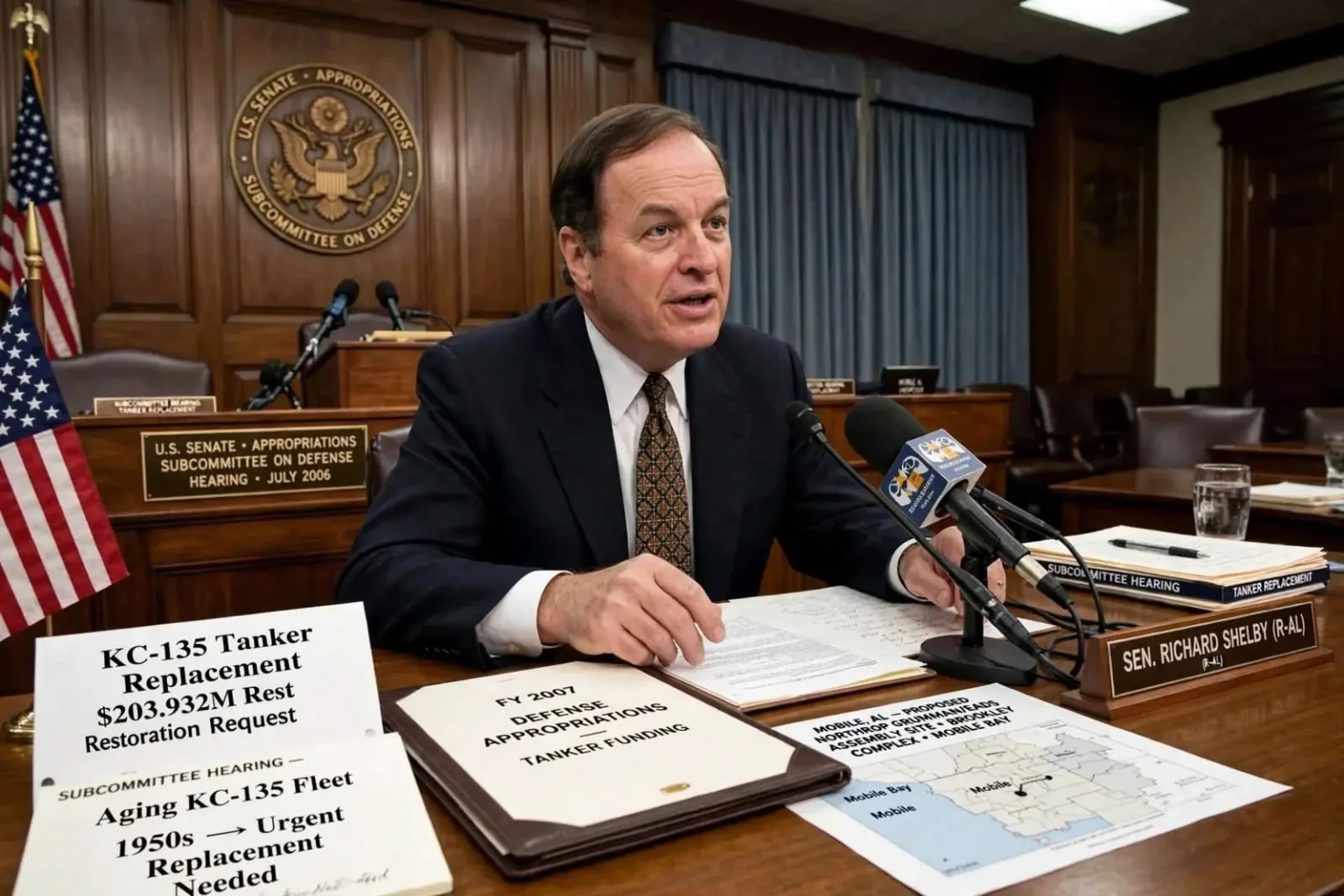
U.S. Sen. Richard Shelby went before the Senate Appropriations Subcommittee on Defense in July 2006 to protest the omission of $203.932 million for the replacement of the Air Force’s aging KC-135 aerial refueling tankers, a program that carried extraordinary stakes for Mobile. The Alabama Republican called the effort “critical to our nation’s efforts in the War on Terror” and pressed the panel to restore the money before the bill advanced. For a city watching a single line in a federal budget, the hearing was the season’s most consequential local event.
Why Mobile was watching
The tanker competition was, at that moment, the single largest economic development prospect in South Alabama. A team pairing Northrop Grumman with EADS had proposed an aircraft that would be assembled in Mobile, at a site on the Brookley complex beside Mobile Bay. The proposal would put a final assembly operation — not a parts plant, not a distribution center, but the line where finished military aircraft are built — on ground that the Air Force itself had abandoned when Brookley Field closed in the late 1960s. If the team won, the region stood to gain an aerospace manufacturing base of a kind it had never had, with the workforce, supplier network and national visibility that come with it.
Shelby made the connection plainly. “I continue to believe that if the Northrop Grumman/EADS team is able to participate in a fair and open competition, their proposal would win,” he said. “Such success will mean significant jobs and investment in Alabama, particularly South Alabama.” His confidence rested on the proposal’s economics: the team was offering a wide-body aircraft derived from a modern commercial airliner, with greater fuel capacity and lower operating cost than any competitor built on a smaller airframe. “But none of that could happen if the Air Force lacked the money to run the competition and award a contract.”
“It is imperative that this program be adequately funded in fiscal year 2007 so that the Air Force can award the contract in a timely manner,” Shelby said. The sequencing was the point. A competition without money is a competition that keeps being rescheduled, and every delay pushed the award — and the factory — further into the future.
The statement to the subcommittee
Addressing the chairman, Shelby acknowledged the difficulty of assembling a defense appropriations bill under tight constraints, noting the subcommittee had been allocated $9 billion less than the president’s budget request. Every defense bill in a tight year is a chain of such decisions, each one shifting a few hundred million from one account to protect another. He said he nonetheless believed the tanker replacement was vital to national security and to service members fighting abroad.
His core argument was about the age of the fleet. “Our Air Force has a fleet of aging refueling tankers that are currently experiencing problems,” Shelby told the panel. “I do not believe we can wait 35 years to replace them.” The KC-135 first entered service in the 1950s, and by 2006 the aircraft keeping American fighters and bombers airborne over Iraq and Afghanistan were, in many cases, older than the crews flying them. Tankers are the unglamorous backbone of American airpower: without them, combat aircraft cannot reach distant theaters, stay on station or come home.
The Air Force had studied replacing the fleet for years, and successive administrations had deferred the decision because of the program’s size — one of the largest aircraft purchases in Pentagon history. Shelby’s argument that year was that deferral had itself become the expensive option: every additional year of service for a half-century-old airframe multiplied maintenance costs and risk.
A dispute over leftover money
The subcommittee had justified its reduction by pointing to unspent balances. According to the Air Force, the tanker replacement program still held $119.8 million in unobligated funding from fiscal years 2005 and 2006, and the panel concluded that this was sufficient to support systems development and demonstration. In appropriations practice, unobligated balances are a standing temptation: money already appropriated but not yet committed can be borrowed against to fund something else, with the assumption that the underlying need is not urgent.
Shelby disputed the reasoning. He told the subcommittee that the Air Force had stated it would need at least $70 million in fiscal year 2007 to move forward and award a contract that year. Leftover balances from prior years, in other words, were not the same as authority to proceed — the Air Force could not launch a competition, evaluate bids and sign a contract on money appropriated for other purposes in earlier budget cycles. The distinction between cash on hand and legal authority is one of the least visible and most consequential facts in federal budgeting, and the tanker line was living proof.
A bill that kept getting cut
The tanker line item had been treated very differently by each body that touched it, a pattern Shelby laid out for the record. The president’s FY 2007 budget request included $203.932 million for the KC-135 tanker replacement program. The House Armed Services Committee cut $87 million from the program. The House defense appropriations subcommittee fully funded the tanker at the president’s request of $203.932 million. The Senate Armed Services Committee reduced funding for the program by $199 million.
The pattern showed how a single program can be valued differently depending on which committee holds it: the authorization committees decide what the military may buy, the appropriations subcommittees decide what may actually be paid for, and the two branches of the House and Senate do not always reach the same answer. For a program like the tanker — long-horizon, expensive and easy to defer one more year — the division of labor created a standing risk that everyone would agree the fleet needed replacing while nobody supplied the money to start.
Shelby said he planned to work to restore the money during conference negotiations on the bill, the last stage at which House and Senate versions are reconciled. Conference committees are where restored line items most often survive, because the negotiators must produce a single bill both chambers can pass and the president can sign — and a senior appropriator with a home-state stake brings leverage to that table that no outside advocate can match.
The long road ahead
The 2006 skirmish over a few hundred million dollars was an early episode in what became one of the longest and most contentious procurement fights in modern Pentagon history. The tanker competition would be awarded, protested, cancelled and rerun over the years that followed, with Mobile’s hopes rising and falling along with each decision in Washington. What never changed was the geography: whoever won the tanker would build it somewhere, and Mobile had put itself forward as the place with the land, the deepwater port, the workforce pipeline and the political backing to make the factory real.
For readers looking back, the significance of Shelby’s statement lies less in the specific dollar figure than in what it revealed: that the industrial future of a Gulf Coast city had become tethered to the line-by-line arithmetic of a defense appropriations subcommittee, and that Alabama’s senior senator understood exactly how much depended on keeping that line alive. The KC-135 fleet flew on for years after 2006, repaired, re-engined and re-winged past every birthday its designers imagined, while the contest to replace it ground through protests and revotes. The lesson of the summer of 2006 was that in Washington, even a fleet built in the Eisenhower years can wait for its successor — unless a senator keeps the money in the bill.
The hearing also fit a pattern in Shelby’s career that Mobile residents had learned to read. As a senior member of the Appropriations Committee, he had spent years steering federal projects toward the state — research dollars, NASA work in Huntsville, Army and Navy installations across the state — and the tanker bid represented the largest single prize ever put within reach of south Alabama. His argument before the subcommittee was therefore both national and local at once: the Air Force needed new tankers, and Alabama had assembled the case to build them.
The Brookley site itself was central to that case. The former air base, closed by the Pentagon decades earlier, left Mobile with waterfront industrial land, runway-adjacent acreage and a labor pool with aerospace experience — assets most competing cities could not assemble in a single package. State and local officials had spent years preparing the site for exactly the kind of announcement a tanker win would bring, and the funding fight in Washington was the one obstacle no local preparation could overcome.
What the summer’s funding fight also demonstrated was the peculiar fragility of a competition that has not yet been run. Until a contract is signed, every dollar is an invitation to defer, and every deferral invites the next one. Shelby’s position was that the only way to break that cycle was to put the money in the bill and force the Air Force to move — a argument he would repeat, with variations, through the years of protests and revotes that followed.