Asked to Name a Statesman, Alabama Lawmakers Crossed Party Lines
Coastal legislators were asked which colleagues outside their own delegations deserved to be called statesmen. The answers, from Republicans and Democrats alike, revealed who commanded respect in Montgomery.
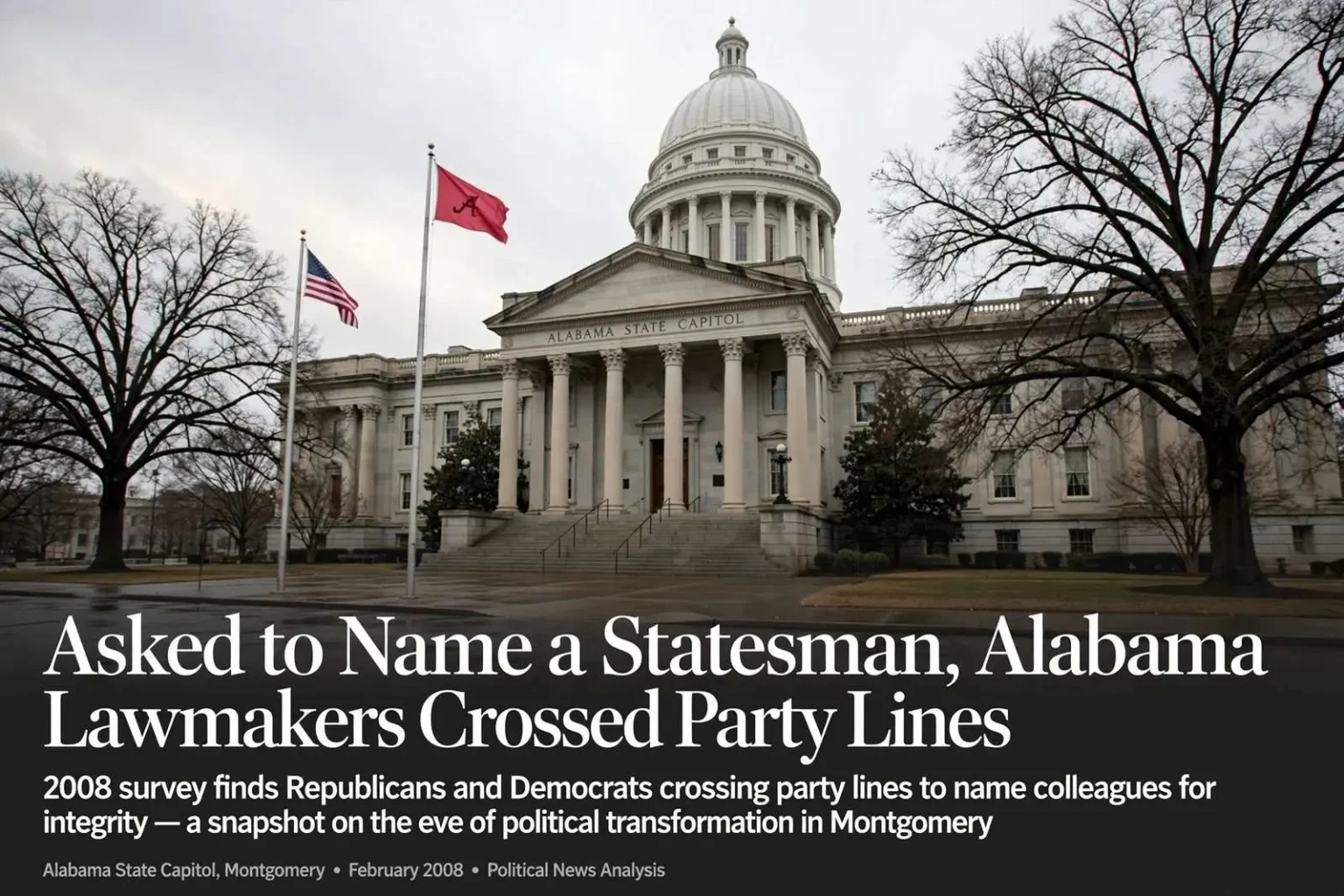
Politicians are rarely asked to praise one another on the record. In February 2008, a group of south Alabama legislators was asked to do exactly that: name a colleague — from outside their own delegation — whom they regarded as a statesman or stateswoman rather than a dealmaker working the hallways. The response was middling, as such requests usually are. But the answers that came back were instructive, both for who was named and for what the naming revealed about how the Alabama Legislature saw itself.
The exercise carries its own etiquette. A legislator asked to single out a colleague for praise risks slighting everyone else in the chamber, and many members decline or offer carefully hedged answers. Those who responded with names were, in effect, spending a little of their political capital to honor someone else — which is what made the replies worth collecting.
The names
State Rep. Jamie Ison, a Mobile Republican, named Reps. Paul DeMarco, House Minority Leader Mike Hubbard and Mary Sue McClurkin. State Rep. Spencer Collier of Bayou La Batre reframed the question. “If by statesman, you mean least political or self-serving,” he said, “then it’s a tie between Jeff McLaughlin, a liberal, and Robert Bentley, an evangelical social conservative.” It was a pointed answer from a Republican — naming a Democrat first, and defining statesmanship as the absence of self-interest rather than the presence of ideology.
State Sen. Trip Pittman of Montrose named Arthur Orr. State Rep. Jim Barton of Mobile said he had been most impressed with Mike Hubbard and Steve Clouse. State Sen. Rusty Glover of Semmes named Scott Beason of Gardendale, calling him a conservative leader he hoped one day to call governor. State Rep. Joe Faust of Fairhope named Rep. H. Mac Gipson Jr. State Rep. Jay Love of Montgomery split his answer between the parties, naming Republican Victor Gaston of Mobile and Democrat Marcel Black. State Rep. Steve McMillan of Bay Minette named Hubbard, House Speaker Seth Hammett and DeMarco.
Read as a list, the answers reached across both parties and every corner of the chamber’s leadership. They included a Democratic speaker, a Republican minority leader, two of the chamber’s most respected budget writers, and backbench members from both sides of the aisle — a distribution that says something about what legislators actually observe from their desks during long session days.
What the answers showed
Two patterns stand out. The first is Hubbard’s dominance. The Auburn Republican, then House minority leader and chairman of the state GOP, was named more often than anyone else — a measure of the standing he had built while assembling the campaign operation that would deliver Republicans control of the Legislature in 2010 and make him speaker of the House. Colleagues across the aisle may have opposed Hubbard’s politics, but enough of them credited his discipline and competence to make him the survey’s runaway leader.
The second is the willingness of Republicans to name Democrats. Collier’s pairing of a liberal and an evangelical conservative, and Love’s balanced ticket of Gaston and Black, reflected a chamber where cross-party respect still functioned as currency. Hammett, the Democratic speaker, drew praise from a Republican member of the Baldwin County delegation — an acknowledgment that the speaker’s even-handed management of the House transcended party lines, at least in the eyes of one opposition member.
Glover’s answer was the most openly partisan — naming Beason, a firebrand conservative, and framing him as a future governor — and it served as a reminder that the survey captured ideology as well as character. Statesmanship, whatever the question intended, is partly in the eye of the beholder.
The Legislature they described
The Alabama Legislature of 2008 was in its final years of unbroken Democratic control, a run stretching back to Reconstruction. Republicans were the minority, but a rising one, and the corruption investigations then circulating through Montgomery — particularly around the two-year college system — were about to reshape the terrain. The two-year college scandal had already claimed legislators and community college presidents, and its fallout weakened the Democratic establishment’s grip in exactly the places Republicans were targeting.
Against that backdrop, the survey’s emphasis on personal integrity reads differently than it might have a decade earlier. Members were naming colleagues they trusted at a moment when trust in the institution itself was eroding — a quiet acknowledgment that the chamber’s reputation was in the hands of individuals, not parties.
The careers named in that survey went in strikingly different directions. Robert Bentley was elected governor in 2010 and resigned in 2017 amid the scandal that grew from an affair and the effort to conceal it. Mike Hubbard became speaker and was later convicted on ethics charges and imprisoned — the same leadership skills colleagues praised in 2008 deployed, prosecutors argued, for personal benefit. Spencer Collier became state law enforcement secretary, was fired, and became a central figure in the events that ended Bentley’s governorship. Arthur Orr and Steve Clouse became two of the most influential budget writers in the state, chairing the Senate and House General Fund committees and shaping Alabama’s finances through years of shortfall and reform.
Seth Hammett left the speakership to run the state’s industrial development arm, extending the economic-development legacy he had built in the House. Victor Gaston rose to the Senate and its presidency pro tem. Jay Love became House Ways and Means chairman before departing for higher education leadership. The list reads, in hindsight, like a catalog of what became of the 2008 Legislature’s leadership class.
How the exercise reads today
Read now, the exercise is a reminder of how much of a legislative reputation is provisional. The colleagues who commanded respect in 2008 were, in several cases, the same men whose falls would define Alabama politics a decade later — and the ones who quietly kept their heads down were the ones still writing the budgets. Statesmanship, as the survey defined it, turned out to be a poor predictor of the future; workmanlike reliability was a better one.
It is also a document of a chamber on the eve of transformation. Within two years of the survey, the Republican wave of 2010 ended 136 years of Democratic control, Hubbard moved from minority leader to speaker with the gavel his colleagues had already seemed to sense was coming, and the Democratic members named in the survey — McLaughlin, Black — became part of a diminished minority. The personal bonds the answers revealed did not survive the realignment unchanged, but they were real at the time, and they mattered in a body where even a permanent majority still needs votes from across the aisle.
The final lesson belongs to the question itself. Asked to name a statesman, Alabama’s legislators mostly named competent, self-effacing workhorses — an answer that is both deflating and, in its way, reassuring. The chamber knew the difference between a show horse and a plow horse. It just could not know which plow horses would end up in the history books, and which in the headlines, for the wrong reasons.
Who the named legislators were in 2008
A closer look at the names on the list explains why each drew praise from the colleagues who offered it. Paul DeMarco, a Homewood Republican, was already one of the minority party’s most active members, and his name appearing on lists from both McMillan and Ison — legislators from opposite ends of the state and opposite benches of experience — showed how quickly he had built a reputation for responsiveness. Mary Sue McClurkin, a Shelby County Republican, chaired the House Education Committee and was regarded as one of the more studious members of her caucus.
Arthur Orr, a Decatur Republican and attorney, had come to the Senate with a background in international finance and a habit of mastering budget documents in detail; his reputation for preparedness crossed party lines even then. Steve Clouse of Ozark, like Orr, was known as a numbers legislator — a member who actually read the General Fund and Education Trust Fund budgets line by line — which is why his name surfaced from Barton across the state in Mobile. H. Mac Gipson Jr., the House minority whip, was valued by colleagues for his institutional knowledge and his fairness in floor maneuvering.
Jeff McLaughlin, the Guntersville Democrat Collier named first, was known as one of the chamber’s most independent voices, a member who voted his district rather than the leadership’s instructions. Victor Gaston and Marcel Black, the two men Love split his answer between, represented the same quality from opposite parties — Gaston the Mobile Republican’s steadiness, Black the north Alabama Democrat’s long service on the Transportation Committee.
Glover’s choice of Scott Beason fit a different template. Beason, a Gardendale Republican, was building a profile as an aggressive conservative on immigration and social issues, and Glover’s hope to one day “call him governor” was a statement of ideological alignment as much as personal admiration — the survey’s only answer that pointed toward a future statewide campaign.
The survey and its limits
The middling response rate was itself informative. Many members declined to answer, and their refusals tell the other half of the story: in a part-time Legislature where colleagues meet as adversaries on the floor and as friends in the hallway, few members want on the record a ranking that necessarily elevates some and demotes the rest. The answers that did come back came disproportionately from members secure enough in their own standing to spend credibility on a compliment.
There is also a sampling bias worth noting: the respondents were drawn from south Alabama’s delegation, and their answers favored colleagues from the greater Birmingham and Montgomery corridors — the members they encountered most often in conference committees and statewide party work. A Mobile or Baldwin legislator’s candid acquaintanceship rarely extends deep into north Alabama’s House membership, so the list maps the geography of interaction as much as the geography of virtue.
For all those caveats, the exercise captured a moment when the chamber’s informal rankings still mattered more than its formal ones. Committee chairs and party leaders held the institutional power in 2008, but the members doing the naming reached past the title-holders to the colleagues they trusted in the room — and in the decade of upheaval that followed, that was the judgment Alabama’s political world would test against events.