Alabama’s Census Response Leads Region but Still Trails Nation as a Congressional Seat Hangs in the Balance
Alabama's 2020 Census self-response rate is outpacing its regional neighbors but still lags the national average, with Mobile and Baldwin counties among the areas officials say need to improve before the count ends.
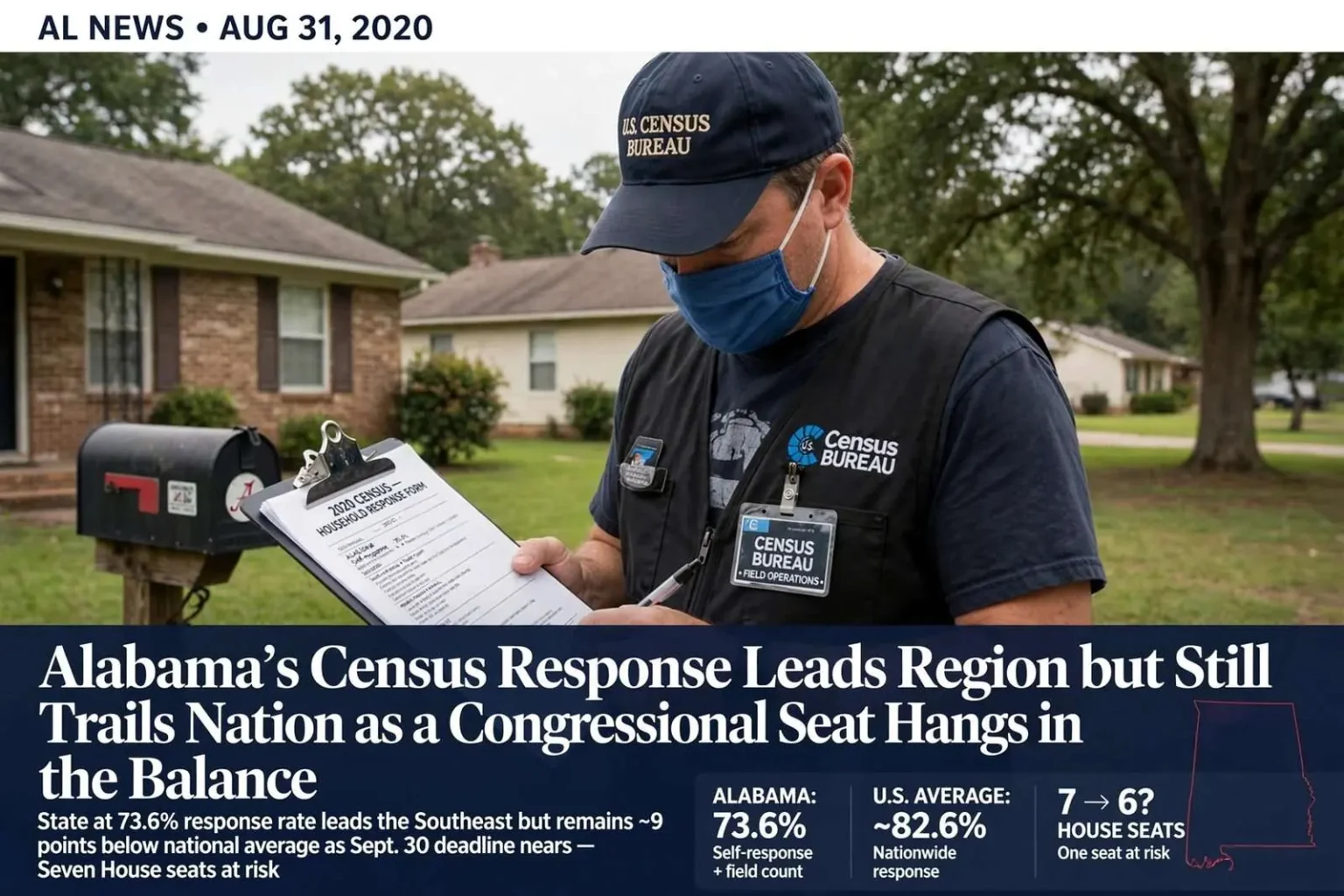
With the 2020 Census entering its final month of data collection, Alabama has posted a stronger self-response rate than most of its neighbors in the Southeast, but state officials say the numbers still aren’t high enough to guarantee the state keeps all seven of its seats in Congress.
As of Aug. 30, 73.6 percent of Alabama households had been counted, either through self-response or through follow-up visits from census workers, according to state officials tracking the count. That figure already tops the 72.5 percent response rate recorded a decade ago, but it remains roughly nine percentage points behind the national average, a gap that has state leaders worried heading into the Sept. 30 deadline for field operations.
“We have been told if we don’t get this up substantially, we will lose a congressional seat,” said Kenneth Boswell, director of the Alabama Department of Economic and Community Affairs and chairman of the Alabama Counts! 2020 Census Committee. “Seventy-three percent is not substantial, so we’re still on the verge that if we don’t get these numbers up substantially, we will lose a congressional seat and federal funding that goes along with that.”
The response rate varies dramatically from county to county. Shelby County leads the state at 76.2 percent, while Coosa County trails at just 36.6 percent. Along the Gulf Coast, Mobile County’s self-response rate stands at 60.3 percent, while Baldwin County lags further behind at 56 percent, putting both coastal counties below the statewide mark with only weeks left to close the gap.
“Right now, Mobile and Baldwin counties really need to work hard to get those numbers up,” Boswell said. “As far as where we need to be, my response has always been consistent: as close to 100 percent as we can get it, and we’ve got a month. Do I think it’s feasible to get to 100 percent? Absolutely not. I’m a realist, not a daydreamer. But can we get it to 80 percent and above? Absolutely.”
Marilyn Stephens, assistant regional census manager for the seven-state Southeast Region of the U.S. Census Bureau, said Alabama currently leads that region in response rate, and she expects the number to keep climbing before field operations wrap up at the end of the month.
“We are on target,” Stephens said. “We have daily production goals and we are enumerating them in Alabama. People are cooperating by filling out their census forms either by phone or going online.”
Households that haven’t yet responded are now being targeted directly by field workers, either through phone calls or in-person visits. Stephens acknowledged the coronavirus pandemic pushed the process back roughly three months, but noted this census marked the first time in the Bureau’s history that residents could respond by phone, mail or online, making it “more of an automated census” than in years past.
Even with summer staffing adjustments prompted by the pandemic, Stephens described the nationwide count as “the largest peacetime civilian mobilization in the country.” Between March 1 and Aug. 9, the Bureau hired more than 47,000 temporary workers across the Southeast Region, which spans Louisiana, Mississippi, Alabama, Florida, Georgia and the Carolinas. Many of those workers, she said, have picked up additional hours beyond the two to four hours per week typically offered for the part-time role, since the pandemic left more people out of work and looking for income.
“We are tasked with the responsibility of ensuring we have enumerated all 100 percent of households,” Stephens said, adding that the Bureau has leaned more heavily than in past decades on partnerships with state and local governments to encourage residents to self-respond before field workers ever knock on a door.
U.S. Rep. Bradley Byrne, whose district includes much of coastal Alabama, credited Gov. Kay Ivey with “taken a strong leadership role” in pushing for an accurate count, but noted his own district’s response rate sits at just 58 percent. Byrne said the possibility of Alabama losing one of its seven congressional seats is a real threat, one that could force Mobile and Baldwin counties into separate congressional districts during the next round of redistricting.
“It’s the ultimate game of political musical chairs as to who should be included and who will be left out, and that’s not fun,” Byrne said. “I’ve seen maps that would split the First Congressional District, with Baldwin County going in one direction and Mobile in another. It’s like a Rubik’s Cube, and there is an assumption we have to obtain a majority-minority district, which is Congresswoman Terri Sewell’s, and her district is going to have to get much larger geographically. I think there will be a major effort to push her district into my present district.”
Byrne said any redistricting effort in the state is likely to be contentious no matter how lawmakers approach it, and he expects the state to face legal challenges from civil rights organizations regardless of the final map. Still, he said he remains hopeful residents who haven’t yet responded will do so before time runs out.
“I think the census can be successful,” Byrne said. “I’m hoping anyone who hasn’t responded will realize they need to do this. It’s going to take a very concerted effort, and governments are pushing very hard on their local operations around the state, but we have to wake people up and get people to participate.”
U.S. Sen. Doug Jones said he shares those concerns about a potential lost seat and the federal funding tied to accurate population counts. Jones also criticized the Trump administration for shortening the timeline for field operations and for declining to extend the Dec. 31 deadline for reporting final numbers to the president.
“The House has already passed a bill to extend the Sept. 30 field operations deadline and to extend the Dec. 31 reporting to the president,” Jones said. “I hope the Senate will do the same, but it depends on the amount of pushback we get from the administration. Alabama is behind the curve, and we’re way behind where we should be to maintain seven congressional seats. For whatever reason, it seems the administration does not want to count all the folks. I don’t know why, but it’s going to hurt states like Alabama, which supported this president.”
With roughly a month remaining before field operations are scheduled to end, state and federal officials alike are urging Alabama households, particularly in Mobile and Baldwin counties, to complete their census forms online, by phone or by mail before workers show up at the door. The final tally will determine not only how federal dollars are distributed across the state for the next decade, but whether Alabama keeps all seven of its seats in the U.S. House of Representatives.
How Apportionment Works
The U.S. Constitution requires a census every 10 years, and the results are used to divide the 435 seats in the U.S. House among the states. Under federal law, the Census Bureau delivers state population totals to the president by Dec. 31 of the census year, and the new apportionment takes effect with the congressional elections two years later. Alabama has had seven House seats since the 1970 census, when it lost its eighth.