Second Annual Care Carnival Returns to Benefit Woody’s Song
Second Annual Care Carnival Returns to Benefit Woody's Song — a South Alabama News report on Mobile, Mobile County, Care Carnival, Woody's Song.
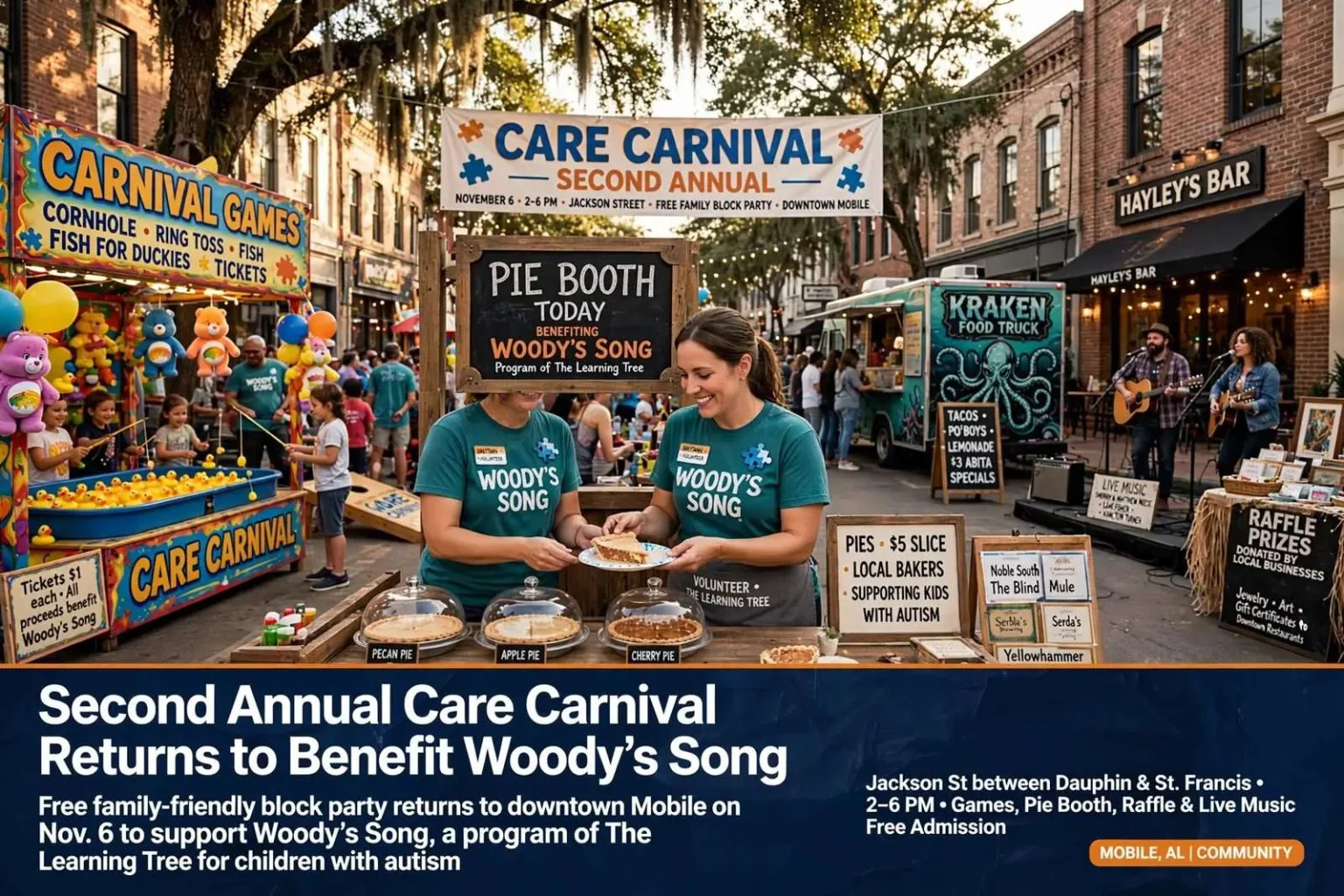
The second annual Care Carnival returns to downtown Mobile on Nov. 6, a free, family-friendly block party on Jackson Street between Dauphin and St. Francis, near Hayley’s Bar. The fundraiser benefits Woody’s Song, a program of The Learning Tree that serves children with autism, and the event has quickly established itself as one of the downtown calendar’s most distinctive afternoons, part carnival, part concert, part neighborhood fair.
From 2 to 6 p.m., guests can play carnival games — cornhole, ring toss, fish for duckies and more — with tickets, plus a pie booth featuring locals like advocate Darwin Singleton and Hayley’s owner Delane Bond. The pie booth has the flavor of a classic church or school fundraiser, with familiar Mobile faces serving slices and taking good-natured ribbing, while the game booths give children a reason to work the street from end to end.
Raffle prizes include jewelry, art and gift certificates from Abita, Yellowhammer Tattoos and restaurants such as Noble South, The Blind Mule and Serda’s. The prize list reads like a tour of downtown Mobile’s dining and retail scene, and the breadth of donated goods reflects how far the event’s reach extends through the neighborhood businesses that surround Jackson Street.
Live music comes from Sherry and Matthew Neese, Lane Fisher and Karlton Turner, with the Kraken food truck and Hayley’s $3 Abita specials on hand. The lineup of local performers gives the block party a soundtrack across the whole afternoon, while the food truck and drink specials give guests reasons to stay long after their game tickets run out.
The Program Behind the Party
Woody’s Song employee Brittany Mistich created the event to sustain the year-round program, which builds language, social and cognitive skills for elementary-age children on the spectrum. “This is something I can do,” she said of giving back to her community. Her framing captures the spirit of the carnival: a fundraiser built not by a professional event company but by a staff member who works with the children the program serves and wanted a way to keep that work funded.
Woody’s Song operates as a program of The Learning Tree, the Alabama organization with a long history of serving children and adults with developmental disabilities, including autism, across facilities and programs in the state. The program takes its approach from the belief that children on the spectrum benefit most from consistent, individualized support that treats communication and social growth as skills to be built deliberately over time. For elementary-age children, that work happens during years that shape everything that follows in school and in life.
The name Woody’s Song carries its own meaning within that mission, a reminder that each child the program serves has a voice worth developing. Programs serving children with autism focus heavily on the areas the carnival supports: language skills that let children express needs and ideas, social skills that open friendships and classroom participation, and cognitive skills that underpin learning across every subject. Sustaining that work year-round, as Mistich said the event is meant to do, requires funding that outlasts any single grant cycle or school year.
The Learning Tree’s presence in Alabama special education stretches back decades, and its programs have served families who often struggle to find services close to home. For Mobile families, a program that builds skills for children on the spectrum within the community means less travel, more consistency and a network of parents and staff who know each other well. Fundraisers like the Care Carnival keep such programs rooted in the neighborhoods where the families live.
A Downtown Block Party With a Purpose
Jackson Street between Dauphin and St. Francis sits in the heart of downtown’s entertainment district, steps from Hayley’s Bar and the cluster of restaurants and venues that define the blocks around Dauphin Street. Closing the street for an afternoon block party transforms a corridor better known for nightlife into a family venue, with game booths, music and the pie booth lining the route. The free admission keeps the event open to everyone, with ticket sales for games and the raffle doing the fundraising work.
The involvement of downtown businesses shows how the event’s second year built on the first. Hayley’s Bar hosting the block party’s home base and offering $3 Abita specials makes the venue a sponsor in substance, while donations from Noble South, The Blind Mule and Serda’s put some of Mobile’s most talked-about restaurants into the raffle. Yellowhammer Tattoos contributed gift certificates alongside jewelry and art donations, giving the prize table a range that appeals to every age and taste in a family crowd.
Local personalities anchor the fundraising too. Darwin Singleton, a longtime Mobile television figure and advocate whose community work is well known to local audiences, taking a turn at the pie booth gives guests a reason to buy a slice, and Delane Bond’s presence as Hayley’s owner ties the party directly to the bar that hosts it. The result is an event where the people running the booths are the same people guests see around downtown all year, which is part of why the carnival has felt less like a charity function and more like a neighborhood gathering with a purpose.
The music lineup of Sherry and Matthew Neese, Lane Fisher and Karlton Turner draws from the same local well. Gulf Coast singer-songwriters and performers have long anchored benefits across Mobile, and their willingness to donate an afternoon to Woody’s Song reflects the close ties between the city’s musicians and its community causes. Afternoon sets from local acts also give families with young children a comfortable window to attend, since the event runs from 2 to 6 p.m. and wraps before the street’s usual evening crowds arrive.
What the Funds Support
Money raised through game tickets, pie sales and the raffle goes toward the program’s year-round operation, the staffing, materials and consistency that skill-building for children with autism requires. Families who rely on programs like Woody’s Song often describe them as lifelines, the place where a child’s progress in language or social confidence is celebrated week by week. A single afternoon carnival cannot fund a program alone, but an annual tradition that grows each year provides the sustained support that Mistich envisioned when she created the event.
The carnival games themselves are chosen with young attendees in mind. Cornhole tournaments give older kids and adults a competitive outlet, while ring toss and the fish-for-duckies booth serve the youngest guests, the classic midway experience scaled to a single city block. Ticket systems like the one used at the Care Carnival keep the games moving and give children a small ritual of trading tickets for turns, the kind of detail that makes a block party feel like a real fair. Volunteers staff the booths through the afternoon, and the event’s organizers rely on that volunteer corps, drawn from the program’s supporters and downtown regulars, to keep the whole street running smoothly.
Autism services in Alabama have expanded over the past two decades, but demand still outpaces availability, particularly for programs that serve children during the elementary years when intervention matters most. The Learning Tree’s approach emphasizes dignity and possibility, building on each child’s strengths rather than working from a deficit model, and Woody’s Song applies that philosophy to the specific needs of children on the spectrum as they learn to navigate language, friendships and the classroom. Parents involved with the program describe the difference in concrete terms, a child who can ask for help, join a game, or tell a parent about their day.
That is the work the Care Carnival underwrites, and it is why the event’s creators have kept the format so deliberately local. Every cornhole board, raffle ticket and slice of pie sold on Jackson Street converts downtown’s goodwill into program hours for children. The second year of a fundraiser is typically the test of whether it becomes a tradition, and the Care Carnival’s return on Nov. 6, with a growing list of business sponsors, returning local personalities and an afternoon of music on a closed downtown block, suggested that Mobile was ready to make it one.
Organizers welcomed anyone interested in supporting Woody’s Song to come out between 2 and 6 p.m., buy tickets for the games, take a chance on the raffle and enjoy the music, with the knowledge that a free afternoon of carnival games and local bands on Jackson Street was doing quiet, important work for children across the city.
For families attending with children on the spectrum, the event also models the kind of community inclusion that programs like Woody’s Song work toward: a public space where sensory-friendly accommodation and patient neighbors are simply part of the plan, and where the children the fundraiser supports can see a whole downtown block gathered around their success.