University of South Alabama Mobile
USA Campus Officer Cleared in Civil Suit Over 2012 Fatal Shooting
A federal judge ruled that a University of South Alabama campus police officer owes no damages in the 2012 shooting death of an 18-year-old student.
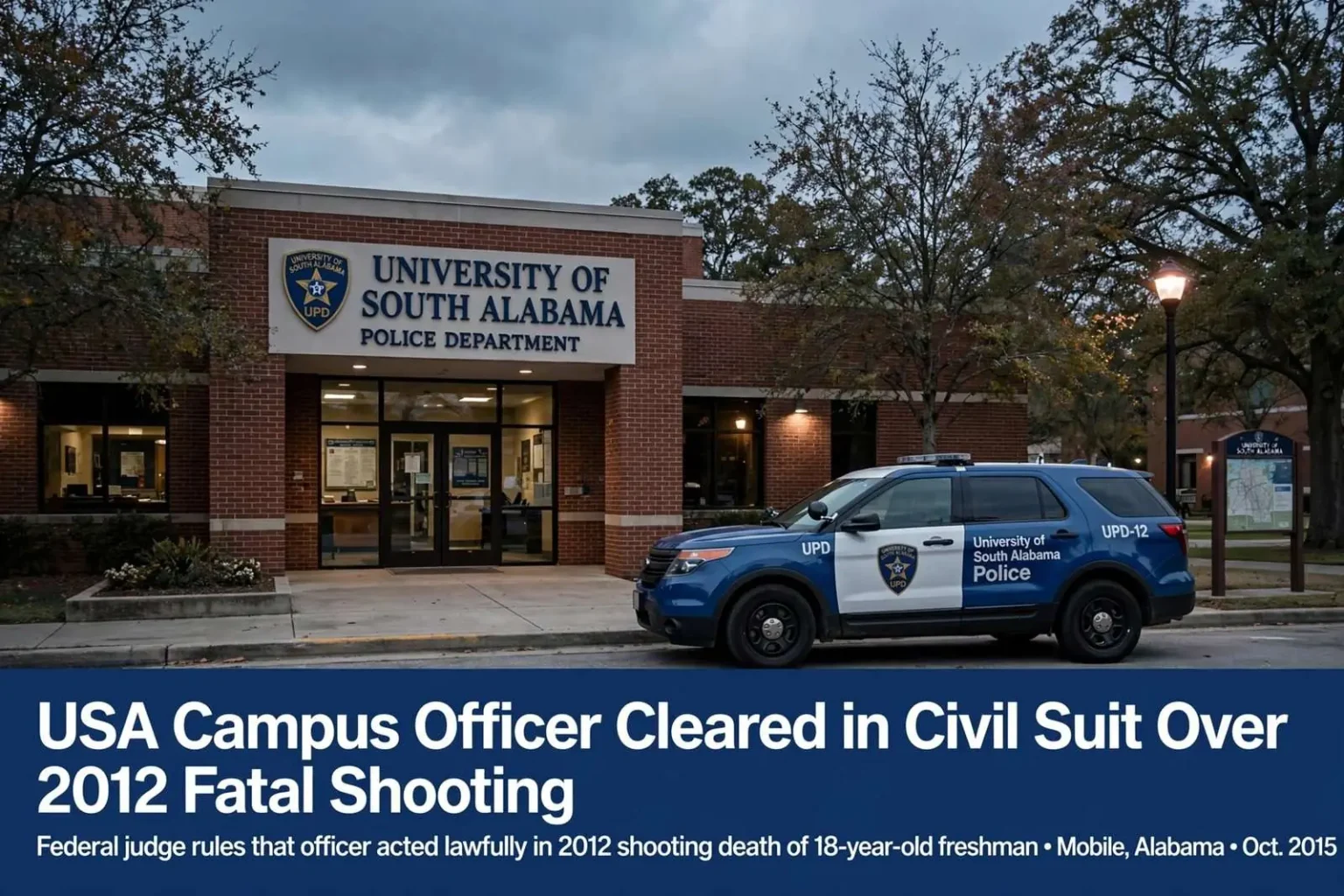
A federal judge has ruled that a University of South Alabama campus police officer will not be held financially liable in the 2012 shooting death of an 18-year-old freshman, closing out a civil case that had loomed over the department for nearly three years. U.S. District Court Judge William Steele determined that Officer Trevis Austin, who remains employed by the university’s police department, does not owe damages to the parents of Gilbert Collar, a Wetumpka native who was shot and killed outside USA police headquarters in October 2012.
The ruling capped a lengthy legal process that began almost immediately after the shooting and unfolded on two separate tracks — the university’s internal review and, later, the Collar family’s civil action. The university and its police chief at the time were cleared of wrongdoing early on, and Austin himself faced no criminal charges over the shooting. The Collar family filed the civil suit in 2014, arguing the shooting was unjustified, and had said any money awarded would fund a scholarship in their son’s name after legal costs.
In his ruling, Judge Steele emphasized that the case had to be evaluated based on what a reasonable officer would have perceived in the moment, not with the benefit of hindsight. That standard — the controlling test in use-of-force cases across the federal courts — asks whether a reasonable officer facing the same circumstances would have acted similarly, deliberately excluding everything learned afterward, including laboratory results that explained the decedent’s behavior. Applying it, the judge found the officer’s actions legally justified.
The Night Outside Police Headquarters
According to the judge’s findings, Austin was alone without backup when Collar, who had unknowingly ingested a synthetic drug, approached the police headquarters and began knocking on the glass windows. Austin came outside with his weapon drawn, and after several tense minutes of erratic behavior from Collar, the officer fired, killing him steps from the department’s front door. The sequence, reconstructed from witness statements and physical evidence, formed the factual core of the case.
Court testimony included details from the university’s police chief at the time, who said photographic evidence showed stippling consistent with Collar being shot at close range, within about two feet of the officer. Stippling — the pattern of unburned powder particles embedded in skin — anchors the distance between firearm and target, and at that range it corroborated an account of an immediate, close-quarters confrontation.
Both the former chief and another officer who was on the force during the incident and has since become a police chief in the region testified that they believed they would have made the same decision under the same circumstances. That testimony — from officers with no personal stake in the case other than professional solidarity — addressed the reasonableness standard directly, offering the court the judgment of experienced law enforcement peers evaluating the same split-second scenario.
What the Court Weighed
The synthetic drug element of the case explained what had otherwise seemed inexplicable to Collar’s family and the Wetumpka community: an 18-year-old freshman with no record of violence behaving in a manner that a trained officer perceived as a lethal threat. Toxicology findings later established that Collar had ingested a substance whose effects include extreme agitation, delirium and erratic strength and behavior — effects he did not know he was experiencing and could not control.
The judge’s task was to fold those facts into the legal framework without letting hindsight do the work. Knowing afterward that Collar was not an attacker but a student in a drug-induced crisis cannot retroactively change what the officer facing him could have known at the time. Steele’s ruling turned on that distinction, concluding that the officer’s perception of a threat was reasonable even though the underlying cause of Collar’s behavior was a tragedy rather than an attack.
That reasoning is consistent with how federal courts have resolved use-of-force cases for decades, but it rarely makes the loss easier for families, who must absorb the legal conclusion that no one will pay for a death that no one intended. The Collar family’s stated plan for any award — a scholarship in their son’s name — reflected the same impulse that drove the suit: a desire that something constructive come from an irreversible loss.
Three Years of Scrutiny
The university’s police department spent the three years between the shooting and the ruling under a level of scrutiny that few campus agencies ever face. The case drew sustained attention in Mobile and in Collar’s hometown of Wetumpka, and it became part of a broader national conversation about campus police forces — their training, their authority and the situations in which young students and armed officers intersect. Every stage of the process, from the internal review to the federal ruling, was followed closely.
The structure of the legal outcome was typical of such cases. The university itself and its police chief were cleared early, leaving Austin as the individual defendant in the civil action, and prosecutors declined to bring criminal charges — a decision that reflected the same reasonableness analysis the civil court later applied. That left the family’s 2014 suit as the final avenue, and Steele’s ruling ended it without the case ever reaching a jury.
For the university, the conclusion closes both a financial and an institutional question. Civil judgments against campus departments can run into millions of dollars, but the longer cost is reputational: a pending suit keeps a shooting case in the news for years and complicates recruitment of both students and officers. With the ruling, USA’s department has a definitive legal answer to the central question raised in October 2012.
The Broader Questions the Case Raised
The case remains a reference point in discussions about how campus police handle encounters involving students in crisis. Collar was not a criminal suspect; he was a freshman whose behavior had been altered by a substance he did not know he had taken, and he walked toward the one building on campus where an armed officer was stationed. The encounter lasted minutes from knock to gunshot, leaving no time for the crisis-intervention approaches that agencies have since worked to build into training.
Departments across the country have responded to cases like this one with expanded training in recognizing excited delirium and drug-induced crises, in de-escalation, and in the use of less-lethal tools — all aimed at creating options short of gunfire when a subject’s behavior is erratic but not necessarily lethal. Whether such tools would have changed the outcome outside USA police headquarters is unknowable, but the case illustrates why agencies invest in them: officers increasingly encounter people whose dangerous behavior has medical causes rather than criminal intent.
For students and parents, the ruling also clarified the legal standard that governs such encounters. Courts judge officers on reasonable perception in the moment, not on what investigation later reveals — a standard that protects officers acting in good faith under pressure, and that families often find cold when the person lost was their child. Both realities coexist in the record of this case, and both were visible in Steele’s ruling.
An Unresolved Grief
Legal resolution is not emotional resolution. Collar’s family waited nearly three years for an answer, pursued it through a federal lawsuit, and received a ruling that the officer owes nothing — while their son remains an 18-year-old from Wetumpka whose death had a medical explanation but a police outcome. Their scholarship plan, announced early in the case, stands as the family’s own answer to how his memory should live on.
The university, for its part, retains Austin as an employed officer, and the department continues the work of policing a campus of more than 15,000 students. The shooting outside its headquarters in October 2012, the review that followed, and the federal judgment now entered will remain part of the institution’s history — a case studied not only for its legal standard but for everything it revealed about the thin line between a crisis and a confrontation.
Inside the Reasonableness Standard
The legal doctrine Judge Steele applied deserves explanation, because it decides nearly every contested shooting case in federal court. The Supreme Court settled the framework decades ago: the question is not whether, looking back, the officer could have done something different, but whether a reasonable officer on the scene, in the same circumstances, with the same information and the same seconds to decide, would have perceived a threat requiring deadly force. Courts apply the standard “from the perspective of a reasonable officer on the scene, rather than with the 20/20 vision of hindsight.”
That framework exists for a practical reason. Officers make decisions in seconds with incomplete information; investigators and judges examine them for years with complete information. A standard that second-guessed every decision with perfect knowledge would leave no officer able to act decisively, while a standard that excused everything would leave the public unprotected. The reasonableness test is the compromise between those poles, and Steele’s finding that the officer’s perception was reasonable placed this case on the settled side of it.
The testimony of the two veteran officers — the former USA chief and the officer who later led another department in the region — functioned as the professional community’s application of that test. When experienced commanders state under oath that they would have made the same call in the same spot, courts give that judgment substantial weight, because it comes from people who have carried the responsibility the defendant carried that night.
How the Case Moved Through the System
The timeline shows how deliberately the process ran. The shooting occurred in October 2012; the university and its then-chief were cleared in the early stages; criminal charging decisions came next, with no charges filed against Austin; the family filed the civil suit in 2014; and the ruling on liability arrived in 2015, nearly three years after the events themselves. Each stage involved separate decision-makers examining the same facts under different legal standards, and each reached the same conclusion.
The absence of criminal charges reflected the same core finding: prosecutors concluded the evidence did not establish that the officer acted unlawfully. Civil liability requires a lower threshold than criminal guilt, but even that lower threshold was not met, according to the court’s ruling. For the family, that layered unanimity — university review, prosecutors, and now a federal judge — narrowed every remaining avenue, and the ruling closed the case without trial.
The case’s resolution also spared the university the risks and publicity of a jury trial, where the graphic details of the encounter would have been relitigated in public. Instead, the record now consists of the court’s findings: an officer alone, a student altered by a synthetic drug, minutes of escalating erratic behavior at close quarters, and a decision the law treats as reasonable even as everyone involved mourns its result.
Synthetic Drugs and Campus Safety
One underexamined thread of the case is the substance involved. Synthetic drugs circulated widely among young people in the early 2010s, marketed as legal alternatives and sold under names that concealed their contents. Their effects — agitation, delirium, superhuman strength, indifference to pain — produced a wave of emergency room cases and, in encounters with police, a pattern of tragedies in which the subject’s behavior was misread as aggression. Collar’s death fit that pattern: a student who took a substance, experienced a crisis, and encountered an officer who had seconds to interpret it.
Universities have since woven that lesson into prevention and response: education campaigns about synthetic substances, training for campus officers in recognizing medical crises, and protocols that route behavior possibly rooted in drugs toward medical response where time allows. None of those measures can reconstruct the moments outside USA police headquarters in October 2012, but they are the practical legacy of cases like this one.
With Judge Steele’s ruling entered, the legal record of Gilbert Collar’s death is complete. What remains is the human one: a family in Wetumpka planning a scholarship, a campus that remembers the case, and an officer and department that continue their work carrying the weight of a night that ended a young life steps from their own front door.