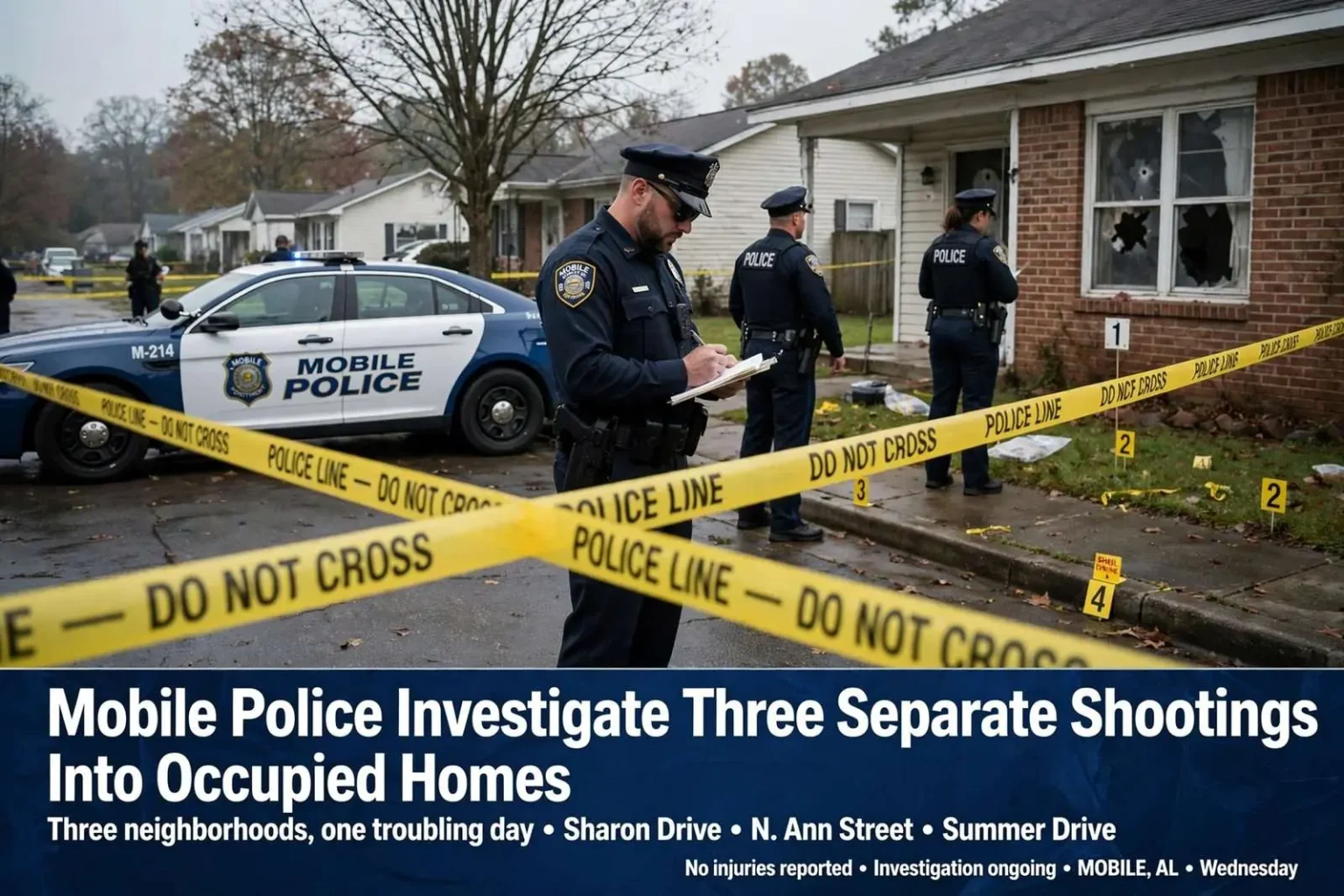
Mobile police are investigating three separate shootings that occurred within a matter of hours on the same day, all involving gunfire directed into homes that were occupied by families at the time.
The first incident was reported before dawn on Sharon Drive, where a resident told officers that an unknown person fired several shots into the home while her family was inside. Officers who responded found evidence of the gunfire but, remarkably, no injuries among the people inside.
Less than five hours later, officers responded to a similar report on N. Ann Street, where a woman said someone fired a round into her apartment, which was also occupied by her family at the time. Detectives noted the timing and similarity of the report as they began comparing notes between the two scenes.
A third shooting was reported shortly afterward on Summer Drive, where another resident said several shots were fired into her home while her family was present. Three occupied homes struck in a single day placed the day’s calls among the more unusual the department has handled in recent memory, even in a city where gunfire calls are a routine part of police work.
Mobile police spokesman Terence Perkins said investigators do not currently believe the three shootings are connected, though the department has not ruled out the possibility as the investigation continues. Detectives will look at the locations, the timing and any patterns in how the shots were fired before reaching a conclusion about whether the cases share a source.
No injuries were reported in any of the three incidents, but the shootings have raised concern among residents in the affected neighborhoods, given that all three targeted occupied homes rather than empty properties or vehicles. A bullet that passes through a wall or window in a home where a family is sleeping can strike anyone inside, and police treat each such call as a near-miss with potentially fatal consequences.
Three neighborhoods, one troubling day
The three streets where the shootings occurred sit in different parts of the city, and each scene presented its own geography for investigators to work. Sharon Drive, N. Ann Street and Summer Drive are residential streets of the kind where families have lived for years, and where the sound of gunfire, once rare enough to be dismissed, now prompts immediate calls to police.
At each location, officers documented where rounds struck the homes, searched yards and streets for shell casings, and spoke with neighbors who may have seen or heard vehicles or people moving through the area around the times of the shootings. Even fragments of casing evidence can be compared across cases and against other investigations in the city’s records.
Residents described the kind of fear that comes with shots fired into a home at night: children on the floor, families taking cover in interior rooms, and questions afterward about whether the home was targeted or simply in the path of careless gunfire. Police have not said whether any of the homes were struck deliberately.
Why gunfire into homes is treated so seriously
Random or targeted gunfire into occupied residences remains one of the more serious categories of property and violent crime that Mobile police track closely, since the potential for injury or death is high even when shots don’t immediately strike a person. Bullets penetrate exterior walls, windows and doors far more easily than many residents realize, and interior walls offer little protection.
Prosecutors likewise treat shootings into occupied dwellings as among the most serious charges available for gunfire cases, because the law recognizes that firing into a home where people live carries a substantial risk of killing someone, whether or not a specific person was the target.
Officers routinely urge residents who hear gunfire near their homes, even briefly, to report it promptly rather than assume it was fireworks or another disturbance, since early reports can help investigators establish patterns across incidents. A call made minutes after shots are heard can give police a time window tight enough to pull useful camera footage and locate physical evidence before it is disturbed.
Dispatch records from a day like Wednesday’s also matter. When multiple shooting calls arrive in a compressed period, supervisors can cross-reference the times, descriptions of any vehicles and the direction shots appeared to come from, building a picture that no single scene provides on its own.
The canvass begins
Mobile police have not released information about a motive or suspects in any of the three cases. Investigators are continuing to canvass the areas around each shooting scene for surveillance footage, shell casings and witnesses who may have seen or heard something useful to the investigation.
That canvass typically involves door-to-door visits, requests to businesses and residents for camera access, and a re-walk of each block to catch details that may have been missed in the initial response. Detectives also check whether any of the homes or nearby addresses had prior calls for service that could bear on the cases.
Shell casings recovered from the scenes will be processed and, where possible, compared with evidence from other shootings in the area. That kind of comparison has repeatedly allowed investigators in cities across the country to link otherwise separate incidents to the same weapon, and it is one of the first analytical steps in cases like these.
The timing of the three shootings, spread across the morning hours, means investigators are working three separate windows of potential witnesses: early risers, morning commuters and neighbors already out for the day. Each window offers a different set of eyes, and police say even partial descriptions of vehicles or directions of travel are worth reporting.
How residents can help
Anyone with information about any of the three shootings is asked to contact the Mobile Police Department. Investigators say tips can be provided anonymously, and any details about vehicles, people or activity near Sharon Drive, N. Ann Street or Summer Drive around the time of the shootings could help move the investigations forward.
Details that may seem minor to the person who noticed them, such as a car that was parked unusually, headlights that swept through the neighborhood at an odd hour or the sound of a door slamming just after shots were heard, are exactly the kind of information detectives ask neighbors to share. In shooting cases with no injured victim, witness accounts are often the primary path toward identifying who fired the shots.
Police also encourage residents to preserve any potential evidence they may have captured inadvertently, including doorbell camera clips or vehicle dashcam footage from the hours in question. Recording devices that automatically overwrite footage within days make prompt contact especially important.
Life on the affected streets afterward
In the days after shootings into homes, families on the affected blocks are often left to patch walls and replace windows while wondering whether it will happen again. Community policing officers and neighborhood association leaders in Mobile have long worked to maintain lines of communication in such situations, encouraging residents to keep reporting and to look out for one another in the weeks that follow.
The department’s investigators, for their part, continue to treat the three cases as open and active. Detectives will follow the evidence wherever it leads, whether that points to a single shooter responsible for more than one scene, or to three unrelated incidents that happened to unfold on the same day in different corners of the city.
Until that question is answered, the working assumption on all three streets is the same one officers delivered to residents at each scene: report anything unusual, keep cameras running and trust that a prompt call, even about something that seems small, can make the difference in a case with no injured victim to speak for itself.
Updates will be provided as investigators identify suspects or make arrests in any of the three shootings.
Citywide, gunfire into homes has been a recurring concern for Mobile police, and the department’s patrol commanders have emphasized that each call is documented, geotagged and reviewed for patterns. That data-driven approach is what allows investigators to spot a cluster like Wednesday’s quickly and assign detectives before trails go cold.
Safety experts who work with neighborhood groups also recommend practical steps for homeowners in the aftermath of such incidents: repairing damaged walls and windows promptly, improving exterior lighting around entries, and keeping a record of anything unusual on the block, including dates and descriptions. None of those steps prevents a bullet, but together they shorten the distance between an incident and a report police can act on.
For now, the three investigations continue in parallel, with detectives coordinating through the department’s gunshot violence units and sharing findings as they develop. Anyone who believes they have information relevant to any of the scenes is urged not to wait for a detective to come to them first.
Police said additional information will be released as it becomes available, and residents of the three neighborhoods will be watching for the kind of update that brings an arrest, and with it, some measure of peace to streets where families were reminded how quickly a normal morning can turn dangerous.