An Alabama Original: How a Merchant Marine’s Cayman Islands Lunch Became Mobile’s West Indies Salad
Bill Bayley Sr. adapted a Caribbean lobster salad to Gulf blue crab in 1947. The recipe stayed secret until 1964, when the Junior League of Mobile published it in Recipe Jubilee.
Alabama has a deep culinary history, but few dishes are as uniquely treasured on the Gulf Coast as West Indies Salad — a cold, marinated blue crab dish that has functioned as a regional delicacy for nearly eight decades.
It was invented in 1947 by restaurateur William “Bill” Bayley Sr. at Bayley’s Steak House, located south of Mobile on Dauphin Island Parkway.
It Started in the Caribbean
The story begins far from Mobile Bay. Before opening his restaurant, Bayley served as a steward in the Merchant Marine.
While his ship was docked in the Cayman Islands, Bayley was inspired by local culinary practices. He began preparing a simple, refreshing salad using boiled lobster, finely chopped onions, oil and vinegar to feed himself and his crewmates.
The bright acidity of the marinade against sweet seafood is the essential idea he carried home — and it is what still defines the dish.
Adapting to Alabama
Bayley opened Bayley’s Steak House in 1947. Eager to serve his Caribbean-inspired creation but without easy access to lobster, he adapted the recipe to the bounty of local waters: fresh, sweet lump blue crab meat.
He named the dish “West Indies Salad” as a tribute to the islands that sparked it.
The substitution turned out to be an improvement rather than a compromise. Blue crab is sweeter and more delicate than lobster, and it absorbs a vinegar marinade more readily — which is why a dish born as a shipboard improvisation became a regional standard.
Not Actually a Salad
Despite the name, the dish contains no lettuce or leafy greens. It relies instead on a spare combination of crabmeat, sweet onions, oil and vinegar.
It became an instant success. Bayley’s Steak House eventually evolved into Bayley’s Seafood Restaurant, a 500-seat destination where seafood lovers from across Alabama gathered for the original.
A Guarded Recipe, Finally Published
For years, the exact proportions of Bayley’s recipe remained closely guarded. The recipe was finally published in 1964 in the Junior League of Mobile’s cookbook, “Recipe Jubilee.”
That publication is a significant moment in Alabama food history. A regional community cookbook is often the only place a locally important recipe is ever recorded in a fixed form, and it is why the dish exists today as a defined preparation rather than as a dozen competing family versions.
The Ingredients
The dish’s appeal lies in its simplicity and its strict method.
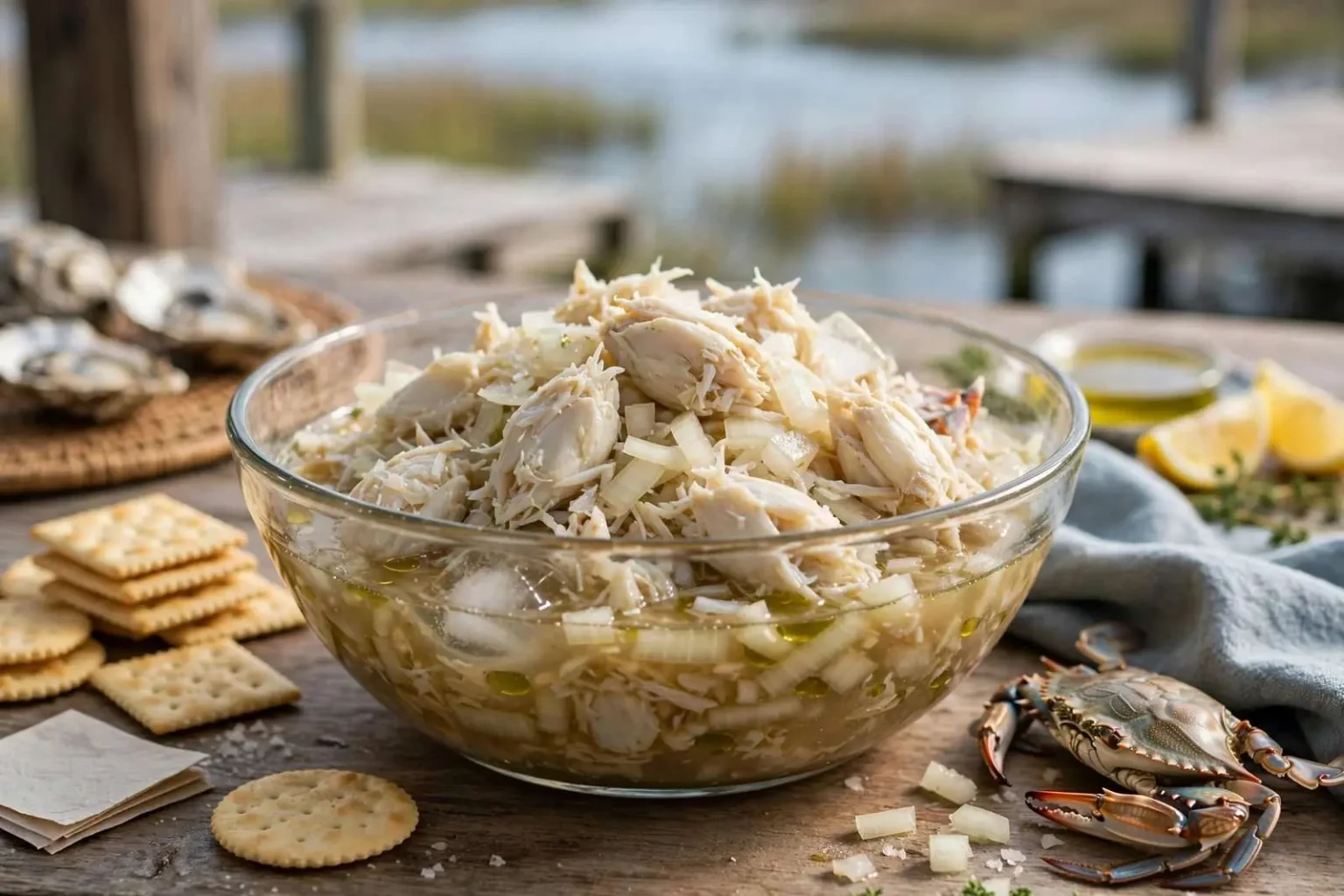
It calls for one pound of fresh lump blue crab meat, meticulously picked over for shells and cartilage; finely chopped sweet onion; vegetable oil; apple cider vinegar; and four ounces of ice-cold water, which balances the acidity and keeps the salad cold.
The ice water is the detail most home cooks skip and the one that matters most. Without it, the vinegar dominates and the crab reads as sharp rather than sweet.
The Method: Layer, Don’t Stir
To achieve the authentic result, the ingredients must be layered rather than tossed together.
Spread half of the finely chopped onion across the bottom of a large glass bowl. Cover the onion completely with the separated lump crab meat, then top with the remaining chopped onion.
Pour the vegetable oil, apple cider vinegar and ice-cold water directly over the layers.
Cover the bowl and refrigerate to marinate for a minimum of two hours, though chilling up to 12 hours produces the best results.
Toss the mixture lightly just before serving to distribute the marinade.
The reason for layering rather than stirring is structural. Lump crab meat is fragile, and repeated mixing breaks the lumps into shreds. Layering lets the marinade work its way down through the bowl by gravity while leaving the crab intact — which is why a properly made West Indies Salad still shows whole pieces of crab when it reaches the table.
How to Serve It
West Indies Salad is served ice-cold, either presented on a bed of lettuce or alongside a sleeve of saltine crackers. The crackers supply a salty crunch against the sweet, acidic, savory crab.
Modern chefs across Alabama and the wider Gulf Coast occasionally add their own touches — mint, lemon, seasoning blends — but Bayley’s original remains the standard against which the variations are measured.
Buying Crab for It
Because the dish has so few components, the crab determines the outcome entirely. Fresh lump blue crab meat, picked carefully for shell fragments, is not interchangeable with claw meat or with pasteurized product, either of which will produce something noticeably different.
For Gulf Coast cooks, that generally means buying from a local seafood market during blue crab season and making the dish the same day.