Rain Did Not Stop Mobile Mardi Gras Parades in 2018
Rain did not stop three downtown Mobile Mardi Gras parades, including the Joe Cain Procession, on Feb. 11, 2018.
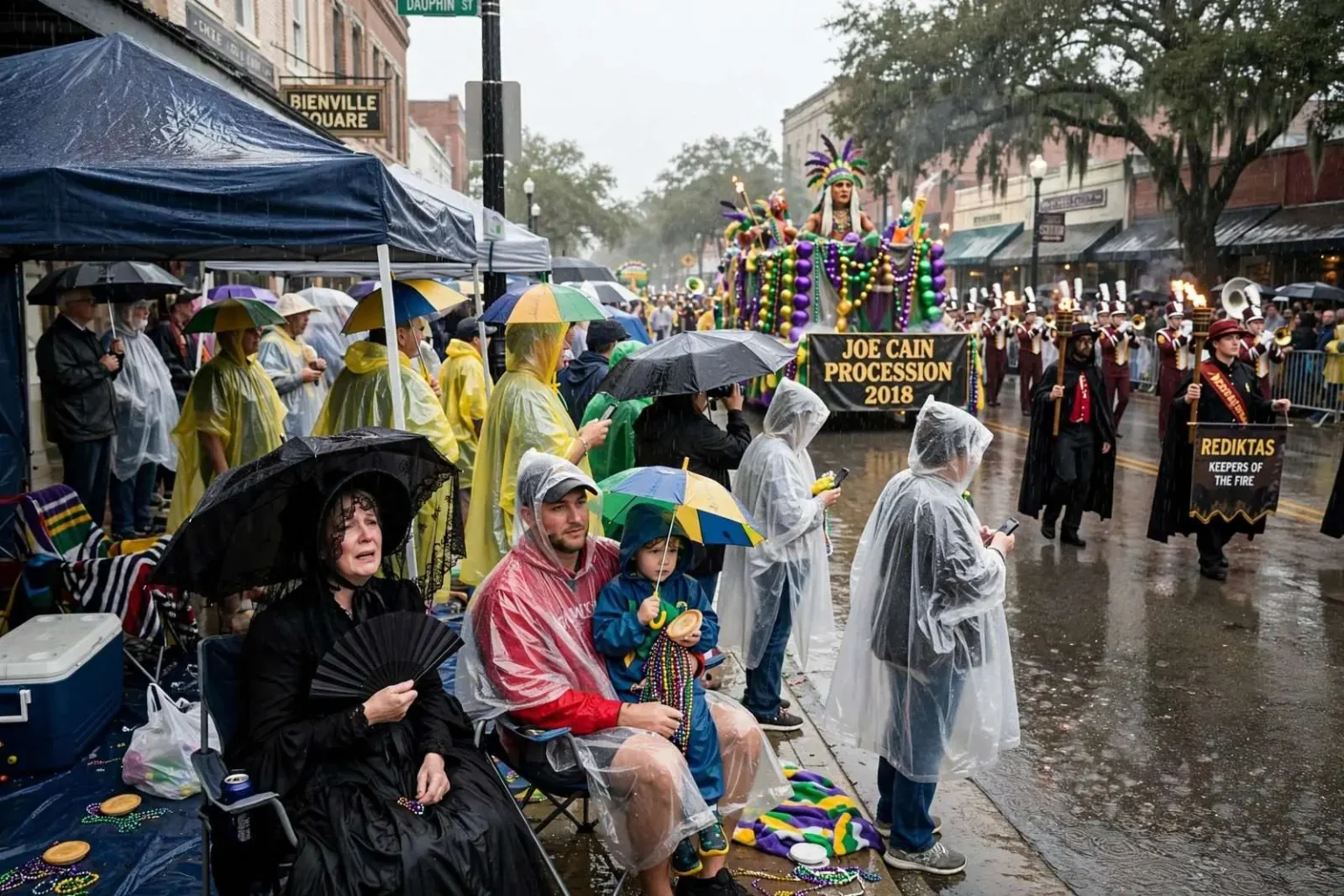
Originally reported February 11, 2018. Rain did not stop three Mardi Gras parades in downtown Mobile on Feb. 11, 2018, including the historic Joe Cain Procession, as dedicated parade-goers turned out in ponchos, under tents, and in umbrella hats to keep one of the city’s oldest traditions on schedule. The show of persistence came after another parade had been canceled, making the decision to roll all the more meaningful to the societies and crowds who refused to let a gray Sunday wash out the season.
Residents who attended said the celebration was an important part of being a Mobilian, a sentiment echoed along the parade routes where families claimed their usual stretches of sidewalk with tarps and folding chairs. The report also noted visitors from Houston who contrasted Mobile’s family-oriented parade experience with New Orleans, pointing to the more relaxed atmosphere that has long distinguished Mobile’s celebration as the birthplace of Mardi Gras in the United States.
A Sunday of Defiance Against the Weather
The parades that rolled on Feb. 11, 2018, did so against a forecast that would have convinced less devoted organizations to stay home. Mobile’s Mardi Gras season spans weeks, and weather is one of the few forces that can disrupt it — rain dampens throws, soaks the floats’ décor, and keeps the casual crowds home. But the core of the celebration has always been its regulars: the members who ride and walk the routes, the families who mark out territory downtown, and the school-age riders and marching bands who make up so much of each procession.
The cancellation of one parade earlier in the run gave added weight to the three that did roll. Mobile’s celebration is a layered affair, with dozens of societies scheduled across the season, and a single cancellation rearranges the rhythm of the calendar. When the Joe Cain Procession went forward despite the rain, crowds treated it as something of a statement — that the city’s signature Sunday, whatever the sky was doing, belonged to the celebration.
Joe Cain Day: Mobile’s Most Colorful Tradition
The Joe Cain Procession is unlike any other parade in Mobile. It honors Joseph Stillwell Cain, the local man credited with reviving Mardi Gras in Mobile after the Civil War, when he paraded through the city in 1866 dressed as a fictional Chickasaw chief — “Slacabamorinico” — in an irreverent act of defiance that lifted the city’s spirits during Reconstruction. His revival of the celebration is why Mobile lays claim to the oldest Mardi Gras tradition in the country, one that predates the Crescent City’s first mystic societies.
Joe Cain Day, observed on the Sunday before Fat Tuesday, has grown into one of the most beloved days of the season. The procession that bears his name is famously informal and comedic, famously led by the Merry Widows of Joe Cain — women dressed in Victorian mourning attire who wail dramatically for the city’s favorite son — and by the Rediktas, Keepers of the Fire, who honor Cain’s resting place each year. Thousands of participants walk the route rather than ride, and the parade’s irreverent, homemade character stands in contrast to the more formal mystic society parades earlier in the season.
Mobilians, Tents, and Umbrella Hats
The scene downtown on that rainy Sunday was quintessentially Mobile. Families arrived with tents pitched along the route and coolers stocked for a full day, wearing rain ponchos and, in at least a few memorable cases, umbrella hats that became the day’s improvised fashion statement. Longtime parade-goers will tell you that bad weather separates the casual spectators from the true faithful, and the crowds that lined the route on Feb. 11, 2018, made their commitment clear.
Those who attended said the celebration was an important part of being a Mobilian — a phrase that captures how deeply Mardi Gras is woven into the city’s identity. In Mobile, the season is not a single night of partying but weeks of parades, balls, and school holidays, with participation passed down through families and mystic societies whose memberships span generations. Skipping a rainy Sunday was, for many, never really an option.
For the riders and walkers in the three parades, the weather added its own challenges. Float riders tossed their throws to smaller, damper crowds; marching bands played through wet uniforms; and the crews who drive and accompany the floats worked harder in the rain than they would on a clear night. That the processions rolled at all reflected the work of the societies and city crews who prepare the routes, clean the streets, and keep the season moving regardless of conditions.
Visitors From Houston Take Note
Among the umbrellas downtown that day were visitors from Houston, who told the local station that they were struck by how Mobile’s parade experience differs from New Orleans. Their contrast — Mobile’s family-oriented celebration versus the Crescent City’s bigger, rowdier reputation — is one that Gulf Coast residents hear often, and it has become part of how Mobile markets itself: all of the tradition, history, and pageantry, with an atmosphere where children catch throws from curbs their grandparents once stood on.
That reputation matters practically as well as culturally. Mardi Gras season fills downtown hotels and restaurants during what would otherwise be a slow stretch of winter, drawing visitors from across the Gulf Coast who come for a weekend of parades without the crowds and costs of New Orleans. Families from Houston, Baton Rouge, Pensacola, and beyond have increasingly made Mobile part of their Carnival circuit, and the 2018 season — rain and all — was part of that growing recognition.
Mobile’s Claim as Mardi Gras Birthplace
The devotion on display in 2018 makes more sense with the longer history in view. Mobile’s celebration traces its roots to 1703, when French colonists at the original settlement of Mobile held the first recorded Mardi Gras observance on the Gulf Coast — years before New Orleans existed. The modern mystic society tradition began in 1831 with the Cowbellion de Rakin Society, whose members paraded with rakes and cowbells after a New Year’s Eve celebration. That society’s traditions traveled to New Orleans with a group of Mobilians in the 1850s, helping seed the celebrations there, but the original rootstock remained in Mobile.
Today the city’s Carnival season features dozens of societies, roughly a month of parades, and a calendar that builds steadily toward Fat Tuesday. Downtown routes on Government Street and around Bienville Square carry much of the parade traffic, drawing crowds that number in the hundreds of thousands across the season. The celebration is a major economic engine for the city and a source of civic pride that Mobilians defend enthusiastically whenever the “birthplace” question arises.
What the Rainy Sunday Meant
The Feb. 11, 2018 parades became one of those small stories that residents retell precisely because they capture the character of the celebration. Three parades rolled, including the historic Joe Cain Procession; families sat under tents in the rain; a Houston visitor went home with a story about Mobile’s family atmosphere; and the season rolled on toward Fat Tuesday. This article records that 2018 Mardi Gras event and is not a current parade schedule — but as a snapshot of how Mobile treats its oldest tradition, it remains a good one: rain or shine, the parades roll, and the city shows up.
The Throws, the Floats, and the People Behind Them
Every parade that rolls in Mobile represents months of preparation that spectators rarely see. Mystic societies begin designing floats and ordering throws — moon pies, beads, cups, stuffed animals, and doubloons — well before the season, and members spend evenings building and decorating the floats that carry them down the route. School bands practice their march music in the fall for performances that come amid exam schedules, and dance groups, scout troops, and civic organizations sign up for walking positions in processions like the Joe Cain Procession months in advance.
A rainy Sunday adds work to every one of those roles. Float riders dash through drizzle between throws; papier-mâché and fabric décor absorb water and lose their bright edges; and the tractor drivers and float captains have to account for slick streets and slower crowds. That the three processions completed their routes on Feb. 11, 2018, says something about the professionalism of the societies and city staff behind them, and about the tolerance for discomfort among Mobilians who consider the season the high point of the year.
It is also worth noting what the crowds endured the rain for. The Joe Cain Procession is not the biggest parade of Mobile’s season by attendance, but it may be the most affectionately regarded, precisely because it belongs to the whole city rather than to any single society. Anyone who signs up can walk it, which means the route fills with neighborhood groups, families, and characters who have no formal connection to Carnival beyond a costume and a commitment to keeping Joe Cain’s memory — and his mischief — alive. On a Sunday when the weather gave everyone an excuse to stay home, that commitment carried the day, as it has for decades of Joe Cain Days before it.