Long before cruise ships became a familiar sight along Mobile’s waterfront, the city’s relationship with the industry began as something of an experiment — one that ultimately reshaped the local tourism economy. In late 2001, Carnival Cruise Lines announced it would send its ship Holiday to Mobile for a handful of test voyages to Mexico and Belize the following spring. Company spokeswoman Jennifer De La Cruz described the plan at the time as a way to gauge whether the Port City could support regular cruise traffic.
The arrangement called for the Holiday, a ship that had spent years sailing from other homeports, to operate a short season of sailings from Mobile while the company measured demand. Carnival had watched other mid-sized Gulf and Atlantic ports cultivate cruising business and wanted to know whether travelers in the central Gulf Coast region would drive to Mobile rather than New Orleans or Florida to board a ship.
The response surprised everyone
The response was immediate: within two weeks, the initial sailings sold out, prompting Carnival to schedule additional voyages almost right away. Travel agents soon reported overbooking headaches as demand outpaced expectations, with local tourism officials calling the sellouts among the fastest in the company’s history.
The sales surge came from a market Carnival had barely begun to tap. Mobile sits within a day’s drive of a broad swath of the Southeast — from New Orleans across the Gulf Coast to Montgomery, Birmingham and the Florida Panhandle — and local travel agents found customers eager to avoid long drives to the nearest cruise terminals. Families, church groups and convention visitors alike booked the test sailings, and the pace of bookings only accelerated as word of the new homeport spread through the region.
City leaders took notice. Then-Mayor Mike Dow pushed for Mobile to develop permanent cruise terminal infrastructure along the waterfront, citing early estimates that cruise passengers had already spent millions of dollars in the local economy during just a month of test sailings. The Mobile City Council followed up by approving funding for engineering work near the Arthur R. Outlaw Mobile Convention Center, as city officials began courting multiple cruise lines, including Royal Caribbean and Holland America, in hopes of establishing Mobile as a homeport.
The courtship of multiple lines reflected a deliberate strategy. City officials did not want Mobile’s fortunes tied to a single carrier, and they presented the port’s advantages to every major cruise operator willing to look: a sheltered riverfront berth minutes from downtown, proximity to Interstate 10 and the region’s highways, an airport within a short drive, and a proven base of customers hungry for departures close to home.
The test sailings also gave the city data it had never had before. Officials tracked passenger spending at restaurants, hotels and shops during the trial season, and the numbers became the backbone of the argument for a permanent terminal. What had been anecdote — full restaurants on sailing nights, packed parking lots near the waterfront — became a documented case that cruising could anchor the kind of visitor traffic Mobile had long tried to attract downtown.
A permanent homeport
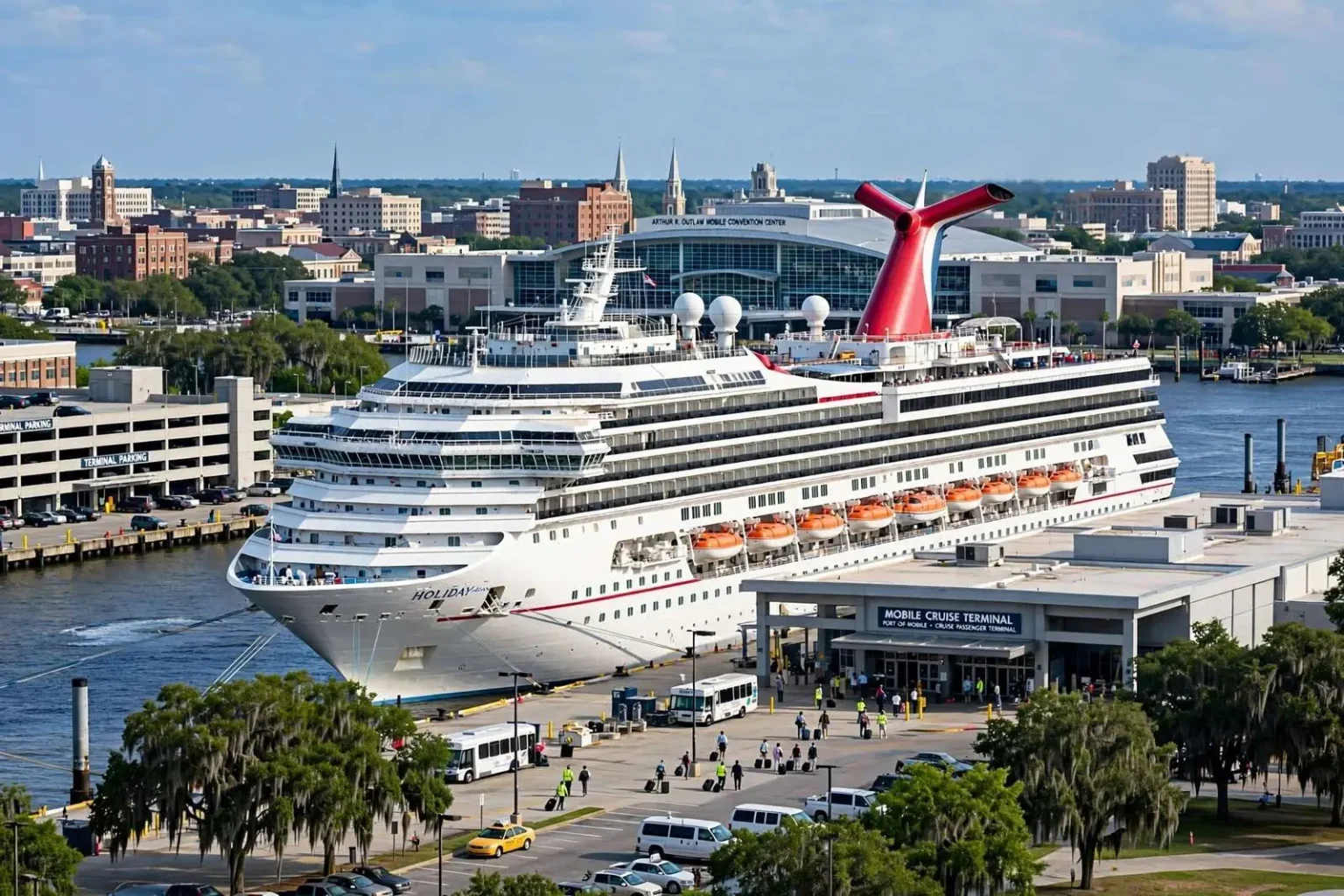
By the end of 2003, Carnival committed to basing the Holiday permanently in Mobile, and the city moved forward with plans for a multimillion-dollar terminal complete with parking and retail space along the Mobile River. The commitment transformed what had been a temporary arrangement into a cornerstone of the city’s downtown revitalization plans, and the terminal project gave the waterfront its first purpose-built passenger facility in the port’s modern history.
The terminal opened in October 2004 with a dedication ceremony that drew state and local officials, including U.S. Sen. Richard Shelby, who called Mobile a “sleeping giant” for tourism. Carnival’s chief executive at the time praised the reception the city gave the ship, ranking it among the best welcomes he’d witnessed anywhere in the company’s history.
The Holiday’s first voyage out of its new Mobile home a day later carried more than 1,400 passengers bound for Mexico, and the ship went on to extend its Mobile contract the following year, citing strong sales that stretched bookings well into the future. The 2,000-mile round trip to Mexico had proven so popular that Carnival kept adding capacity, and travel agents across the Gulf Coast began building their winter booking seasons around the Mobile departures.
For downtown Mobile, the terminal changed the rhythm of the waterfront. Cruise weeks brought thousands of visitors through the streets around the convention center, filling hotels before sailings and restaurants afterward. Parking garages that had emptied on weekends filled with passengers’ cars, and the city began marketing itself to convention planners as a destination that could pair meetings with a pre- or post-cruise stay. The terminal also gave cruise passengers a reason to arrive early and explore — the historic district, the museums and the riverfront all sit within walking distance of the berth, a geography few homeports can claim.
The economic footprint reached beyond downtown as well. Passengers driving in from across the Southeast spent on gasoline, lodging and groceries, while the ship’s provisioning created steady orders for local food suppliers, stevedores and service companies. Local officials described cruising as a new pillar for a tourism economy that had previously leaned on conventions, hunting and fishing, and the beaches across the bay.
Ups and downs over fourteen years
The 14-year relationship between Mobile and Carnival has had its ups and downs since those early years, including a period when the cruise line pulled out of the market entirely before eventually returning. The departures and returns tracked the industry’s broader cycles — shifting ship deployments, hurricane seasons that disrupted Gulf itineraries and changing company strategies — and each withdrawal prompted questions about whether Mobile could sustain regular cruising.
Each time Carnival stepped back, city officials worked to lure the line back, pointing to the same fundamentals that had made the 2002 test run such a success: a captive regional customer base and a terminal purpose-built for the trade. When the ships returned, bookings recovered quickly, echoing the pattern set a decade and a half earlier. The pattern demonstrated something important about the Gulf Coast cruising market — demand did not disappear when the ships did, it simply waited for the next departure, and it came back faster each time the route resumed.
But the partnership’s roots trace directly back to that initial 2001 test run — a bet on Mobile’s tourism potential that paid off far faster than anyone at Carnival originally expected. What began as a handful of exploratory sailings became a permanent homeport, a multimillion-dollar terminal and a tourism engine that reshaped Mobile’s downtown waterfront, and it all started with a company asking a simple question about whether the Port City could fill a ship. The answer, repeated across fourteen years of sailings, has been yes.
The Holiday itself became a familiar fixture in the years that followed. The ship, one of Carnival’s older and smaller vessels, offered shorter itineraries that suited first-time cruisers and budget-minded families, and its size made it a good fit for a river terminal that larger modern ships would eventually outgrow. Over its years in Mobile, the ship carried hundreds of thousands of passengers and introduced a generation of Gulf Coast travelers to cruising.
Terminal operations also created year-round employment at the waterfront — longshore crews handling supplies, security staff, parking attendants, taxi and shuttle operators, and the port personnel who manage the comings and goings of a passenger vessel alongside the cargo ships that share the Mobile River. Tourism officials counted the cruise business among the anchors of the downtown visitor economy, alongside the convention center and the museums that line the historic district. The jobs supported by a single homeported ship ripple through the local service economy every week the vessel sails.
The experiment’s legacy extends to the region’s broader tourism marketing as well. Mobile entered the 2000s competing for visitors with Gulf Shores, New Orleans and Pensacola, and the cruise terminal gave the city a distinguishing attraction none of its neighbors could match. Advertising campaigns built around “cruise from your backyard” messaging targeted the drive market, reinforcing the same insight that filled Carnival’s test sailings in a matter of weeks: that a large share of the Southeast’s cruising public preferred to start its vacation close to home.
Two decades on, the story of how Mobile became a cruise homeport is told as a case study in regional economic development — a city that tested an idea, saw it succeed beyond expectations in a single season, and committed public investment to lock in the opportunity. The gamble that began with the Holiday’s test voyages in 2002 continues to shape the Port City’s waterfront and its visitor economy today.