Prosecutors Signal More Charges Possible in Mobile Pill Mill Case
Federal prosecutors asked to delay the trial of two Mobile doctors accused of running a massive pill mill, citing the likelihood of new charges and defendants.
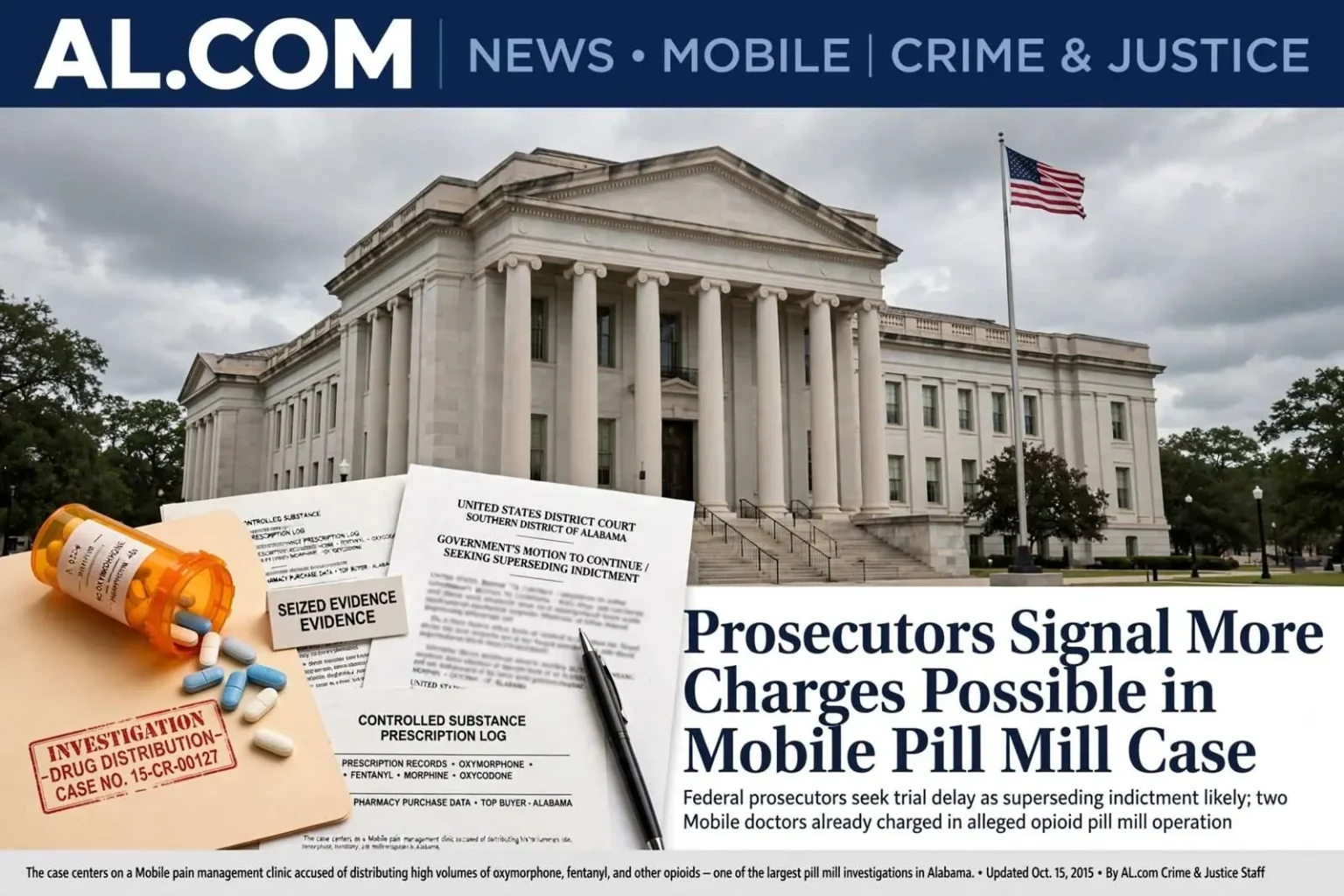
Federal prosecutors are signaling that additional defendants and charges could be added to the case against two Mobile doctors accused of running one of the nation’s largest pill mills, according to a court filing seeking to push the trial back to mid-2016. The development indicates the prosecution, already among the most closely watched prescription-drug cases in the country, may be growing rather than narrowing as investigators continue to work through the evidence gathered during a years-long federal probe.
The filing, submitted this week in U.S. District Court in Mobile, asked a judge to delay the trial due to what prosecutors described as the likelihood of a superseding indictment that would include additional criminal charges and possibly new co-defendants tried alongside the case’s original two physicians. Superseding indictments are a routine prosecutorial tool for expanding a case, but the government’s advance notice that one is likely — rather than merely possible — tells the court and the defense to expect a substantially broader proceeding.
The doctors, co-owners of a Mobile pain management practice, were indicted in May on charges of conspiracy to distribute controlled substances outside the usual course of professional medical practice and conspiracy to commit healthcare fraud. Those statutes are the federal government’s standard weapons against so-called pill mills — clinics that dispense powerful opioid prescriptions without legitimate medical purpose — and convictions can carry decades in prison, along with forfeiture of the proceeds allegedly earned through the scheme.
Prosecutors allege the clinic operated as one of the most prolific prescribers of opioid painkillers in the country, distributing the kind of prescription volume that drew the attention of federal drug investigators years before the indictment was returned. The case has become a focal point in the broader national reckoning over opioid prescribing, and its outcome in Mobile is being watched by clinics, regulators and prosecutors far beyond the Gulf Coast.
Prescription Records That Stunned Investigators
According to figures cited in court filings, the clinic’s pharmacy was the top buyer of oxymorphone and fentanyl in Alabama in a recent year, the second-largest buyer of morphine and oxycodone, and the seventh-largest buyer of methadone statewide. Those rankings, drawn from distribution data reported to federal authorities, placed a single pain clinic at or near the top of the state’s consumption of some of the most potent opioids available by prescription.
In one year, the pharmacy’s oxymorphone and fentanyl purchases outpaced the state’s next-largest buyer by wide margins, and patients reportedly traveled from 18 different states to obtain prescriptions at the clinics. The out-of-state traffic — patients crossing state lines to reach a single Mobile practice — is a hallmark that investigators have long cited in distinguishing pill mills from legitimate pain treatment, since genuine patients typically seek care near where they live.
Court records show one of the physicians wrote nearly 35,000 prescriptions for controlled substances in a single year, a pace investigators calculated at roughly one prescription every three and a half minutes for a standard 40-hour work week, based on an FBI affidavit filed in the case. The arithmetic, laid out in an agent’s sworn statement, became one of the most striking details of the government’s case, illustrating a prescribing volume that left little time for examination, diagnosis or individualized treatment decisions.
Pain management, when practiced within professional standards, involves careful patient screening, treatment agreements, prescription monitoring and periodic review — processes that take time investigators say this clinic’s output made impossible. Experts cited in similar cases have testified that prescribing at such volume typically requires preprinted or standardized prescriptions that vary little from patient to patient.
A Third Doctor Steps Away From Practice
A third doctor who worked at the practice was not charged but voluntarily surrendered his controlled-substance prescribing license to the U.S. Drug Enforcement Administration in May, around the time of the indictment. The surrender strips a physician of the DEA registration required to prescribe narcotics, effectively ending any involvement with controlled substances while the case and any related investigation continue.
Records show he later applied to have that license reinstated, a request that remains pending and that federal authorities are likely to contest given his former association with the clinic. DEA registration proceedings run on a separate track from criminal prosecution, but the agency routinely considers pending criminal matters and professional conduct when weighing whether a physician may resume prescribing controlled substances.
Investigators say the case has been complicated by the sheer volume of evidence collected during the federal probe. The FBI copied thousands of pages of medical records from the clinic, but attorneys on both sides have been unable to review the material because they lack compatible software to analyze it — a logistical failure that has stalled the kind of detailed medical review that pill mill prosecutions turn on, since the government must prove each prescriber acted outside the bounds of medicine.
A federal magistrate judge ordered the electronic medical records vendor used by the clinic to produce software capable of processing the records, a step prosecutors say is necessary before the case can move forward. Until the records can be opened and searched, neither side can assess what the documentation shows about patient visits, examinations and the medical rationale behind the prescriptions at the heart of the case.
The delay request underscores the scope and complexity of a prosecution that has drawn national attention to prescribing practices at Mobile-area pain clinics. Cases built on conspiracy charges require the government to connect prescribing patterns, financial records and patient outcomes across hundreds of patients, and the electronic records at issue are the evidentiary backbone for all of it.
Why the Case Is Being Watched Nationally
The prosecution arrives amid a broader federal push against opioid overprescribing, which has enlisted prosecutors, DEA diversion investigators and health agencies in a campaign against clinics viewed as supply sources for addiction and diversion. Pill mill cases typically pair criminal charges with civil actions seeking forfeiture of clinic assets, and Mobile’s case is expected to test how courts weigh pharmacy distribution data — the ranking statistics cited in the filings — as proof of illegitimate prescribing.
For patients and legitimate pain physicians in the region, the case has already changed the landscape. Pharmacies and prescribers across South Alabama report heightened scrutiny of high-volume opioid prescriptions, and the state’s prescription drug monitoring program has given regulators a real-time window into prescribing that did not exist when the clinic’s practice patterns first developed. The era in which a single clinic could rank among a state’s top buyers of fentanyl and oxymorphone without triggering alarms has given way to continuous surveillance of exactly those patterns.
Defense attorneys for the two doctors are expected to argue that pain management is a legitimate specialty and that aggressive prescribing, however unusual, does not by itself establish criminal intent. Courts handling similar prosecutions have grappled with where that line falls, and the trial — whatever form it takes after a possible superseding indictment — will turn on granular evidence about individual patient encounters rather than the headline statistics alone.
Federal authorities have not said how many additional defendants, if any, might ultimately be named in a superseding indictment, and the case remains pending as both sides continue reviewing evidence ahead of a revised trial date. What began as an indictment of two physicians may grow into a sprawling prosecution involving the clinic’s staff, operators and financial beneficiaries — or it may proceed largely as charged, with the new charges prosecutors foreshadowed aimed at rounding out the case they have already built.
Either way, the message from the government’s filing is clear: the investigation that produced the May indictment remains active, the evidence remains under review, and prosecutors intend to present Mobile’s federal court with the fullest account they can assemble of how one pain clinic came to preside over some of the largest opioid distribution volumes in Alabama’s history. Residents can expect the case to remain a fixture of the federal docket well into 2016 and beyond, as one of the nation’s largest pill mill prosecutions moves toward trial in Mobile.
The stakes extend beyond the courtroom. Prosecutors who win pill mill convictions typically seek restitution and forfeiture running into millions of dollars, along with sentences intended to deter other high-volume prescribers, and regulators use such cases to justify tighter oversight of pain clinics statewide. Alabama, which has ranked among the states with the highest per-capita opioid prescribing, has been under sustained pressure to confront the supply side of its addiction crisis, and a successful prosecution in Mobile would give state and local officials a prominent precedent as they tighten their own rules for pain management practices.
For now, both sides await the software needed to open the clinic’s records, and the judge in the case will decide how long the government’s expansion may take. When the trial finally begins, it will stand as one of the largest tests yet of how federal law reaches prescribing that crosses the line from aggressive medicine into trafficking.