Mobile Residents to Question Arc Terminals Officials on Waterfront Storage Tanks
Mobile's City Council delayed a decision on waterfront storage tank appeals until residents could question Arc Terminals officials at a community meeting.
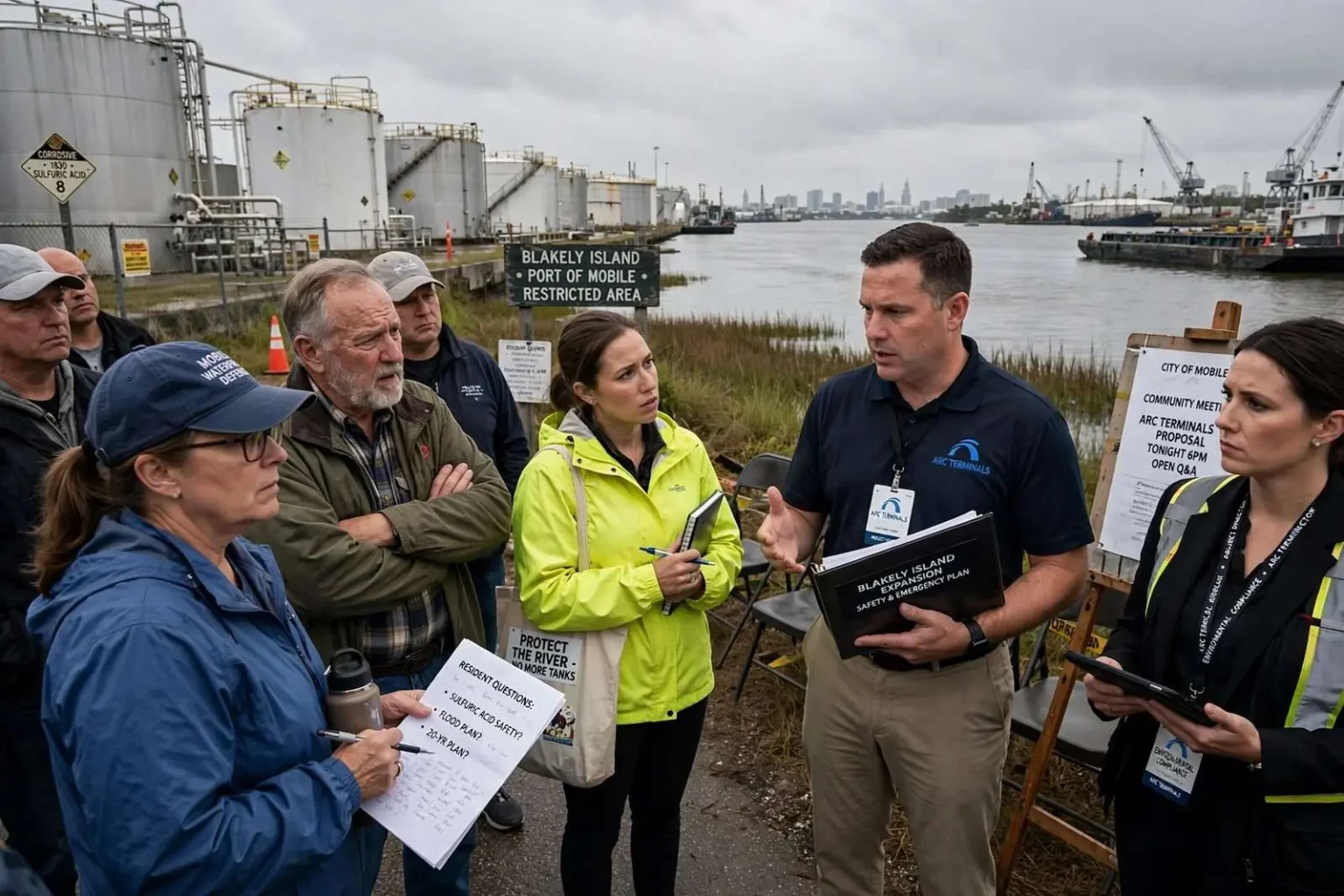
Mobile residents opposed to a wave of new storage tanks on the city’s waterfront are set to get a rare chance to question company officials directly, after the City Council delayed a decision on the project pending a community meeting. At the center of the debate is Arc Terminals, which has proposed expanding its bulk storage facility and adding tanks to hold sulfuric acid on Blakely Island. The plan has drawn a skeptical response from nearby residents, who have voiced concerns to local lawmakers about what more industrial storage along the Mobile River could mean for the surrounding community.
The Mobile City Council put off ruling on two appeals that could reverse decisions already made by the Planning Commission, opting instead to wait until after a community meeting where top Arc Terminals officials are expected to field questions directly from residents. The procedural pause is an unusual step, and it signals that the council understands the project has become a referendum on the waterfront’s future rather than a routine land-use matter.
Residents say they have a long list of unanswered questions heading into the meeting. Chief among them: whether storing sulfuric acid so close to the Mobile River poses a safety risk, what the company’s long-term plans for its Mobile operations look like, and whether there is an adequate emergency plan in place for the tanks in the event of major flooding or a hurricane. Those concerns carry extra force in a port city that remembers what hurricanes do to industrial facilities along the water.
The Setting: Blakely Island and the Working River
Blakely Island sits in the Mobile River just north of downtown, an industrial pocket in the middle of the harbor where bulk liquid storage has long been part of the landscape. The island’s location puts proposed facilities close to established neighborhoods across the water, including communities whose residents have watched industrial development creep toward their doorsteps for generations. It is precisely that proximity — industry on the river, homes within sight of it — that gives the sulfuric acid question its urgency.
Sulfuric acid is one of the most widely used industrial chemicals in the world, a workhorse of fertilizer manufacturing, refining and metal processing. It is also corrosive and hazardous in concentrated form, and bulk storage of it demands engineered containment, leak detection and spill response planning. Supporters of the project note that such chemicals move through American ports constantly under established safety rules; critics respond that established rules did not prevent every industrial accident along the Gulf Coast, and that the burden of proof belongs on the company proposing to site the tanks.
The appeals before the council grew out of the Planning Commission’s earlier decisions on the project, and the council’s authority to reverse those decisions is the leverage residents have been counting on. By delaying, the council turned the community meeting into a de facto evidentiary hearing, with company officials on the record and residents expected to press for specifics rather than assurances.
A Waterfront at a Crossroads
The tension reflects a broader debate playing out along Mobile’s waterfront over how the city balances industrial growth with its ambitions to build up tourism and public access to the river. Above-ground storage tanks have become a flashpoint in that debate, with critics arguing that expanded industrial storage could limit future waterfront development while raising environmental and safety concerns for nearby neighborhoods. Every new tank row that rises along the river changes what the waterfront can be a decade from now, and both sides know it.
Supporters of continued industrial investment counter that companies like Arc Terminals provide jobs and tax revenue that help anchor Mobile’s working waterfront, which has long served as a hub for petroleum, chemical and bulk cargo storage tied to the city’s port activity. The Port of Mobile is one of the driving engines of the regional economy, and the bulk storage terminals along its rivers are part of the infrastructure that keeps cargo moving. From that perspective, a tank is not an eyesore but a warehouse, and a warehouse is a payroll.
The community meeting gives residents their first structured opportunity to test those competing claims against the company’s own answers.
The community meeting gives residents their first structured opportunity to test those competing claims against the company’s own answers, and both sides have reasons to treat it seriously. For opponents, it is a chance to put the safety questions on the record in front of the elected officials who will vote on the appeals. For the company, it is a chance to demonstrate transparency and address misconceptions before the council rules — or to expose gaps in its own planning that could cost it the vote.
The Questions Residents Plan to Ask
The three headline questions residents have framed — safety near the river, long-term plans, and emergency preparedness — each open onto deeper lines of inquiry. On safety, residents can be expected to ask how sulfuric acid would arrive and depart the island, by barge or ship, and what safeguards govern that transfer, which is historically where bulk chemical incidents begin. They will want to know the tank design standards, the secondary containment that would hold a leak, and whether the facility’s plans account for the storm surge that a Gulf hurricane can push up Mobile Bay.
On long-term plans, the concern is about scope creep. A permit for a handful of tanks can become the anchor for a much larger complex, and residents who have watched other port cities cede their waterfronts to tank farms one approval at a time want commitments, not impressions. The question of what Arc Terminals intends Mobile to look like in twenty years is really a question about what the city will be able to build — or not build — along the river once the storage footprint expands.
On emergency planning, the hurricane scenario dominates. Mobile sits at the head of Mobile Bay in a region where major storms have repeatedly tested industrial facilities, and flooding along the river can reach the low-lying ground where tank farms sit. Residents want to know who responds if a tank is compromised during a storm, what notification would reach nearby neighborhoods, and whether the company’s emergency plan has been coordinated with city and county responders rather than written only for regulators.
What the Council’s Delay Means
The council’s decision to postpone its ruling on the two appeals is procedural but not neutral. A vote taken before the community meeting would have rendered the meeting moot; by waiting, the council guaranteed that whatever is said at the meeting becomes part of the record the members weigh. It also puts pressure on the company to perform, since officials who cannot answer the residents’ questions directly will face the same questions in chambers.
For the Planning Commission, whose earlier decisions are under appeal, the delay is a reminder that its rulings on industrial proposals are political acts as well as technical ones. The commission weighs zoning and land-use standards, but the council’s appellate role means the final word on Mobile’s waterfront belongs to elected officials who hear from voters.
Residents organizing for the meeting have been encouraged to submit questions in advance and to press for written answers, a tactic that turns vague assurances into documents that can be cited later. Whatever the outcome, the meeting stands as a test of how Mobile handles the collision between its industrial present and its aspirations for a more accessible waterfront — and of whether a company seeking to expand on Blakely Island can persuade its neighbors that the two futures can coexist.
The Working Waterfront’s Track Record and Its Risks
Mobile’s harbor has hosted bulk liquid storage for more than a century, and the companies that operate along the river point to that history as evidence the arrangement works. Terminals storing petroleum, chemicals and other bulk cargoes move products that feed refineries, farms and factories across the region, and the port’s cargo volumes have made it one of the most important deepwater harbors on the Gulf. The jobs tied to that activity — terminal operators, tug crews, stevedores, inspectors — pay wages that support families across the metro area, and city tax collections from industrial waterfront property fund services well beyond the districts where the facilities sit.
The counterweight to that record is the list of incidents that have shaped environmental regulation along the Gulf Coast over the decades. Accidents at industrial facilities, spills into waterways and catastrophic storm damage have all left their mark on public expectations, and communities near industrial sites have learned that the benefits of industry are regional while its risks are local. That asymmetry — everyone gains from the port, but one neighborhood lives with the tanks — is the underlying grievance the community meeting will surface.
Blakely Island’s particular geography sharpens the point. Land close to downtown Mobile is limited, and the island represents some of the last industrial parcels within sight of the city skyline. Every acre devoted to tank farms is an acre unavailable for the riverfront promenades, parks and mixed-use development that waterfront cities across the country have pursued, and that Mobile’s own planning documents have floated for areas closer to downtown.
How the Appeals Process Works
The two appeals now pending before the council arrived through the standard municipal pathway: the Planning Commission made decisions on the project, and opponents exercised their right to appeal those decisions to the elected council. Appeals of this kind typically hinge on questions of whether the commission applied the city’s zoning and land-use rules correctly, whether the project meets the standards for its district, and whether conditions attached to an approval are adequate to protect neighboring properties.
The council’s options when it takes the matter up range from upholding the commission’s decisions to reversing them, with the possibility of conditions in between. A reversal would force the company back to the drawing board; an approval with conditions could impose requirements on containment, setbacks, monitoring or emergency planning. Either way, the community meeting is expected to inform how the members vote and what conditions, if any, they attach.
What Residents Are Watching For
By the end of the meeting, residents say they want three things from Arc Terminals: straight answers on the sulfuric acid question, a concrete account of the company’s long-term intentions, and an emergency plan they can read rather than imagine. Anything less, they argue, and the council would be voting on faith — faith in a company’s goodwill, in federal and state oversight, and in the assumption that nothing will go wrong on a riverbank in a hurricane.
The outcome will be watched well beyond the neighborhoods nearest Blakely Island. Developers, port interests, environmental groups and downtown boosters all see the case as a marker for Mobile’s direction: whether the city’s riverfront continues its century-long role as a wall of industrial infrastructure, or whether the balance begins to shift toward the public access and tourism economy the city has talked about for years. The residents who fill the meeting room will not decide that alone, but they will make sure the council cannot say it decided without hearing them.