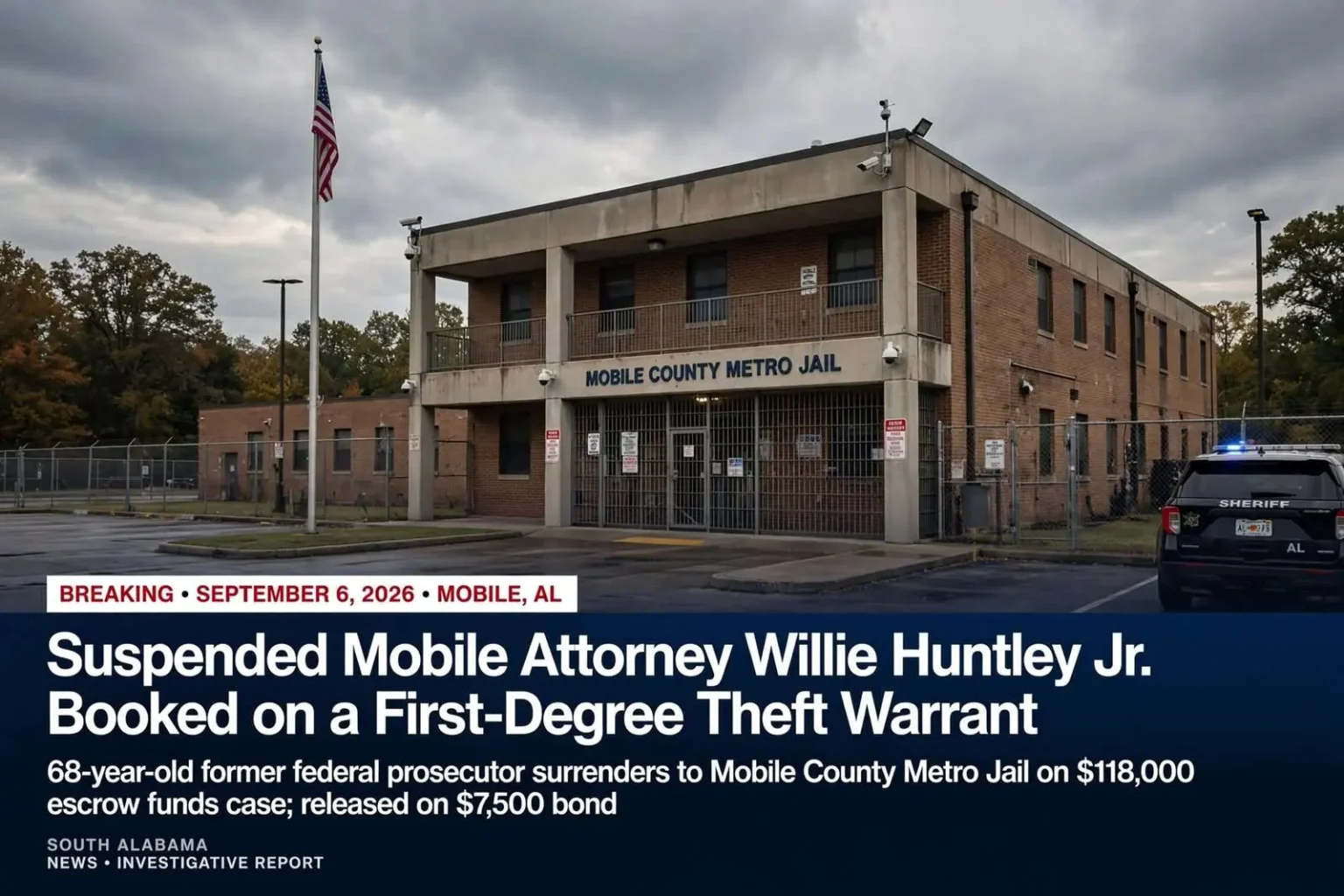
Suspended Mobile Attorney Willie Huntley Jr. Booked on a First-Degree Theft Warrant
Willie Julius Huntley Jr., 68, a Mobile attorney suspended from practice since January, surrendered Saturday on a first-degree theft of property warrant as he faces a civil suit over $118,000 in escrow funds from a collapsed Hale County timber deal.
A longtime Mobile attorney and former federal prosecutor was booked Saturday on a first-degree theft of property warrant, months after he was suspended from practicing law and sued over $118,000 in escrow funds from a collapsed timber-cutting agreement.
Willie Julius Huntley Jr., 68, turned himself in to Mobile County Metro Jail at 10:40 a.m. Sept. 5 on a warrant for first-degree theft of property, according to Mobile County Sheriff’s Office jail records. He was released at 12:22 p.m. on a $7,500 bond.
A Four-Decade Legal Career
Huntley has practiced law in Alabama for more than four decades. An Auburn University graduate and former Tigers running back, he earned his law degree from Cumberland School of Law in 1984 before clerking for a federal judge and serving as both a state and a federal prosecutor.
He later entered private practice in Mobile, where his work included criminal defense, civil rights and personal injury cases. Over the years he has also served as a Mobile Municipal Court judge and as the attorney for the Prichard Water Works and Sewer Board, and he was Prichard’s city attorney as of 2008.
He has represented clients in a number of high-profile criminal matters. Most recently, he served as the lawyer for a contractor charged with participating in a conspiracy to embezzle funds from the Prichard utility.
In 2017, Huntley testified before the U.S. Senate Judiciary Committee during former Alabama Sen. Jeff Sessions’ confirmation hearing for U.S. attorney general — an appearance that put a Mobile practitioner in front of a national audience at a moment of considerable political attention.
Suspended Since January
State bar records show Huntley was suspended from practicing law in Alabama effective Jan. 5, 2026.
The suspension was ordered by the Alabama Supreme Court under Rule 20(a) of the state’s Rules of Disciplinary Procedure — a provision used when attorneys fail to properly handle client funds held in trust.
According to the disciplinary record, the suspension was based on an order from the Alabama State Bar Disciplinary Commission after Huntley failed to respond to requests for information and failed to act as directed regarding client funds held in trust in a pending disciplinary matter.
Records show the bar acted after determining that Huntley repeatedly failed to respond to requests for information concerning a disciplinary matter. The organization also prohibited him from maintaining an attorney trust account.
That description points to one of the most serious categories in attorney discipline. Lawyers are required to hold client and third-party funds in separate trust accounts — commonly called IOLTA accounts in Alabama and most other states — entirely apart from the firm’s operating money. Trust account obligations are close to absolute: the money is not the lawyer’s, it must be accounted for at all times, and it must be delivered promptly when the client or a third party is entitled to it.
Bar authorities treat trust account irregularities with particular urgency because client funds are at immediate risk. A failure to respond to bar inquiries compounds the problem, since the disciplinary system depends on lawyers cooperating with investigations into their own conduct.
Rule 20(a) exists to let the court act quickly. Where the ordinary disciplinary process can run for months through investigation, formal charges and a hearing, an interim suspension is designed to remove a lawyer’s access to client money while that process plays out, on the theory that the risk of further loss outweighs the lawyer’s interest in continuing to practice in the meantime.
A Related Civil Complaint
Criminal charging documents were not available as of Saturday. A recent civil complaint filed in Mobile County, however, accuses Huntley and his law firm of conversion over $118,000.
The lawsuit, filed July 29 in Mobile County Circuit Court, names Huntley and his firm, Huntley, Jordan & Ross, L.L.C., as defendants. The plaintiffs are C. James Fields, James Fields Trucking and Logging LLC, and Isaiah Walton, on behalf of J.A. Walton heirs.
The complaint alleges the plaintiffs paid $118,000 into escrow under a timber-cutting contract involving property owned by the heirs of J.A. Walton in Hale County, and that Huntley and his firm managed that escrow.
According to the complaint, neither Huntley nor the firm has returned the money. The plaintiffs seek damages on claims of conversion and unjust enrichment.
“By retaining Plaintiffs’ payments … Defendants have been unjustly enriched at Plaintiffs’ expense,” the civil complaint states.
The allegations in a civil complaint are unproven allegations. The complaint has not been adjudicated, and no connection between the civil case and the criminal warrant has been confirmed by authorities.
How the Timber Deal Collapsed
The dispute traces to a Dec. 26, 2023, agreement between Walton, acting on behalf of the estate’s heirs, and Fields and his Greensboro-based company to cut timber from property in Hale County.
Fields and his company paid $118,000 into an escrow account managed by Huntley and his firm. Huntley was representing the logging company in litigation over the property.
In 2024, one of the Walton heirs, Calvin Jackson, filed a motion in Greene County Circuit Court seeking to halt all timber cutting. The disagreement among the heirs stalled the arrangement the escrow money had been paid to support.
Huntley moved to intervene in the Greene County case on Oct. 1, 2025, asking the court to “determine the validity of the contract, and the amount of payment to the above listed heirs” and to “order the funds paid into court.”
That motion was never ruled on, and the case “has failed to proceed in a meaningful fashion,” the Mobile County complaint states.
The plaintiffs allege that since being barred from practice, Huntley has not returned the escrow funds, transferred them to a licensed attorney, or filed an interpleader action to allow a court to determine their proper distribution.
Those three options describe the standard exits available to a lawyer holding disputed money. An interpleader in particular is the conventional remedy: the stakeholder deposits the contested funds with the court, names the competing claimants, and steps out of the dispute, leaving a judge to decide who is entitled to what. It is designed precisely for a situation in which a lawyer holds money that more than one party claims.
The plaintiffs are seeking $118,000 in compensatory damages and $39,333.33 in attorneys’ fees, plus interest and court costs. Their attorney is Garrett H. Chambless of the Montgomery firm Chambless Math & Carr.
Efforts to reach Huntley for comment were not immediately successful.
Former Partners Ask to Be Dismissed
Two of Huntley’s former law partners, Joe Carl “Buzz” Jordan and Jay Ross, filed a motion Aug. 20 to dismiss themselves and the firm from the case.
The motion argues that Huntley, Jordan & Ross, L.L.C., has not operated as a law firm since 1999, and that Jordan and Ross have had no association with Huntley since that year.
“Defendants have never had any legal representation or any involvement with Plaintiffs regarding any facts alleged in this case,” the motion states.
It also says that Jordan and Ross “have not received any monies from anyone regarding the facts alleged in this case.”
Naming a dissolved partnership as a defendant is common in cases like this one, because escrow accounts, letterhead and account signatures often continue to carry a firm name long after the partnership behind it has ended. Whether the former partners remain in the case is a question the court will resolve separately from the claims against Huntley himself.
A Disciplinary Record Going Back Two Decades
Huntley has faced disciplinary issues before.
The Alabama State Bar publicly reprimanded him in 2006 for mishandling $30,000 in insurance money intended for the children of a man who had died. Records show that Huntley’s client, the dead man’s sister, endorsed the check and that Huntley deposited it into his trust account.
Huntley forwarded the money almost a year and a half after the attorney representing the children had asked for it, and only after deducting a $6,000 legal fee for himself. He ultimately refunded the $6,000 in January 2006 after the state bar threatened to suspend him.
The State Bar also reprimanded Huntley for using client funds to pay firm expenses during his law partnership with Ross and Jordan. He received another reprimand for filing a form in a Mississippi court in October 2003 falsely stating that he had not been subject to disciplinary action by the bar or the courts.
In 2008, the Internal Revenue Service asked a federal judge in Mobile to order Huntley — then Prichard’s city attorney — to “fully obey” a summons directing him to turn over his personal income tax records for 2005 and 2006. The IRS maintained that Huntley turned over documents but did not provide all of the required information. The agency ultimately voluntarily dismissed the case.
A public reprimand is a middle sanction in Alabama’s disciplinary scheme, more serious than a private reprimand and short of suspension or disbarment. Prior discipline is relevant chiefly to what comes next: bar authorities weigh a lawyer’s record when deciding the sanction for any new violation, and repeated findings involving client money weigh heavily.
What a First-Degree Theft Charge Carries
Theft of property in the first degree is a Class B felony in Alabama, punishable by not less than two and not more than 20 years.
Alabama grades theft by the value of the property involved, with first-degree theft reserved for the highest value tier. The threshold has been adjusted by the Legislature over time; the charge signals that prosecutors allege a substantial sum.
Alabama’s theft statute expressly includes obtaining or exerting unauthorized control over the property of another with intent to deprive the owner of it. That formulation encompasses situations in which property was lawfully received but then not returned or accounted for — which is why escrow and trust fund disputes can produce criminal exposure rather than only civil liability.
Bond and Process
The $7,500 bond and the roughly hour-and-45-minute stay at Metro Jail reflect a routine booking on a warrant for a defendant who surrendered voluntarily. Bond amounts turn on the charge, criminal history and flight risk, and a defendant with deep local roots who arranges his own surrender ordinarily receives a bond he can post.
From here, the case would follow a standard Alabama felony track: a preliminary hearing in district court to determine probable cause, or direct presentation to a Mobile County grand jury. An indictment would move the matter to circuit court for arraignment.
Presumption of Innocence
The warrant is an accusation. Huntley has not been convicted of anything, and he is entitled to the presumption of innocence unless and until the State proves the charge beyond a reasonable doubt.
That principle is worth stating plainly in a case involving a defendant who spent much of his career invoking it on behalf of others.
Parallel Tracks
Cases like this often proceed on three separate tracks at once, each with its own standard and its own consequences.
The criminal case requires proof beyond a reasonable doubt and carries the possibility of incarceration. The civil case requires only a preponderance of the evidence and seeks money. The bar disciplinary proceeding is neither criminal nor civil but a licensing matter, governed by the Alabama Rules of Professional Conduct, with sanctions ranging from private reprimand to disbarment.
The three can reach different outcomes on the same underlying facts. A lawyer can be disciplined on conduct that never produces a criminal conviction; a criminal acquittal does not restore a suspended license; and a civil judgment can follow either result.
South Alabama News will update this report as charging documents become available and the case proceeds.