Driver Hurt After Medical Episode Sends Vehicle Into a Power Pole at Cottage Hill and Sollie Roads
A driver experiencing a medical episode crashed into a power pole at Cottage Hill and Sollie roads Saturday evening, flipping his vehicle and snapping the pole. He was hospitalized with non-life-threatening injuries.
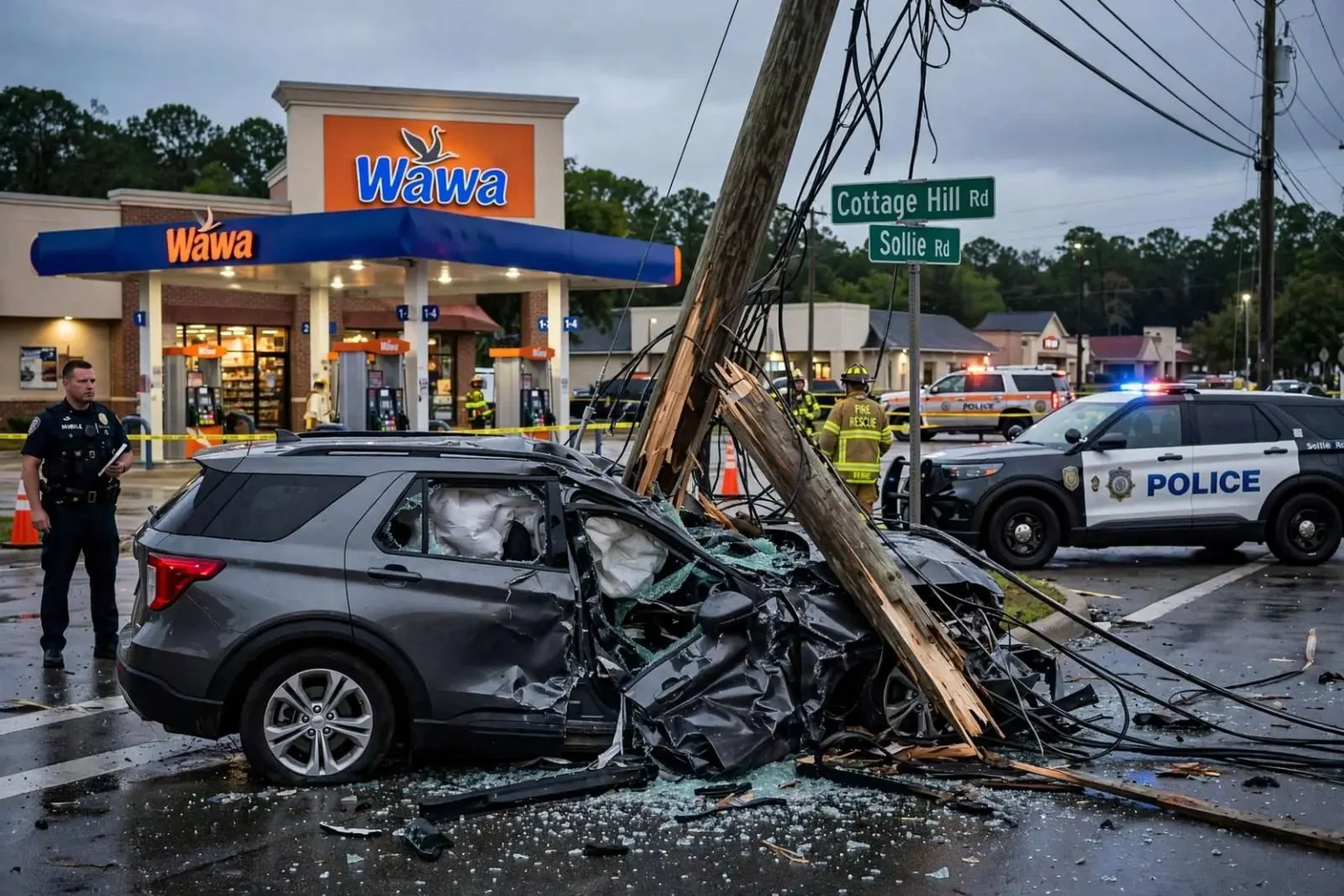
MOBILE COUNTY — A man was injured Saturday evening after experiencing a medical emergency and crashing into a power pole in west Mobile, according to the Mobile Police Department.
The crash happened in front of the Wawa at the intersection of Cottage Hill Road and Sollie Road.
News crews on scene observed one vehicle flipped onto its side and a power pole snapped.
A spokesperson with Mobile Police said officers responded to the area in reference to a man experiencing a medical episode. He was taken to a hospital for non-life-threatening injuries.
A Crash That Began Before the Impact
Collisions caused by a driver’s sudden medical event occupy a distinct category in traffic safety, and they are more common than most drivers assume.
The defining characteristic is that the driver is incapacitated before the vehicle leaves its lane. Cardiac events, seizures, strokes, syncope and severe hypoglycemic episodes can all produce loss of consciousness or loss of control without warning. Once the driver is incapacitated, the vehicle continues under its own momentum until it strikes something — which is why such crashes frequently involve fixed objects such as poles, trees, buildings or barriers rather than other vehicles.
That pattern matches what was observed at Cottage Hill and Sollie: a single vehicle, a struck pole and no reported involvement of other traffic.
The physics of a fixed-object impact are also distinct. A collision between two vehicles distributes energy across both and involves crumple zones designed for the purpose. A vehicle striking a utility pole concentrates force into a narrow area of the structure, which is a large part of why such crashes commonly produce rollovers — the vehicle rotates around the point of impact.
Downed Poles Are Their Own Emergency
A snapped power pole converts a traffic collision into a utility incident with hazards that extend beyond the vehicle.
Downed conductors may remain energized even when they show no visible arcing, and current can travel through the ground around a fallen line, creating a voltage gradient that can injure someone simply walking nearby. Poles frequently carry telecommunications and cable lines alongside electrical distribution, and any of them may be entangled with the vehicle.
Standard emergency guidance is unambiguous: stay well back from a downed pole or line, assume every line is live, and do not attempt to move a vehicle in contact with wires. Occupants of a vehicle in contact with downed lines are generally safest remaining inside until utility crews confirm the lines are de-energized, unless fire or another immediate threat makes exiting necessary.
Utility crews are typically dispatched to isolate the circuit and replace the pole, work that can require lane closures and, depending on the circuit configuration, may interrupt service to nearby customers.
The Intersection
Cottage Hill Road and Sollie Road sit in a heavily developed section of west Mobile. Cottage Hill is a principal east-west arterial through a corridor lined with retail, restaurants, offices and residential subdivisions, and it carries substantial daily volume.
The presence of a convenience store and fuel station at the corner means the location sees frequent turning movements and pedestrian activity in the parking areas — conditions that raise the potential consequences of any loss-of-control event.
Medical Events Behind the Wheel
Alabama, like every state, requires drivers to be medically fit to operate a vehicle, and physicians commonly counsel patients with conditions that carry a risk of sudden incapacitation about driving restrictions. Seizure disorders in particular are typically accompanied by specific guidance about seizure-free intervals before driving resumes.
In practice, however, a substantial share of medical-event crashes involve drivers whose condition had not previously been diagnosed. A first cardiac event or a first seizure gives no advance notice, and no licensing regime can screen for an event that has never happened.
Traffic safety researchers generally point to two mitigations. The first is prompt medical evaluation of unexplained symptoms — dizziness, fainting, unexplained fatigue, chest discomfort — particularly for people who drive regularly. The second is vehicle technology: automatic emergency braking, lane-keeping systems and, in newer vehicles, driver-monitoring features can in some circumstances reduce the severity of a crash after a driver stops responding.
Condition and Next Steps
The driver was transported for treatment of non-life-threatening injuries. Police have not released his identity, the nature of the medical episode, or whether any citations were issued.
Crashes attributed to sudden medical incapacitation typically do not result in criminal charges, since criminal liability generally requires a culpable mental state that an incapacitated driver cannot form. Investigators nonetheless document such incidents fully, both for the crash record and because civil liability and insurance determinations may turn on the findings.
No other injuries were reported.