Mobile Attorney Christine Hernandez Appeals Contempt Conviction Over Subpoena Dispute
Attorney Christine Hernandez is appealing a criminal contempt conviction to the Alabama Court of Criminal Appeals after a Mobile circuit judge found she orchestrated a subpoena delivery that disrupted a murder trial.
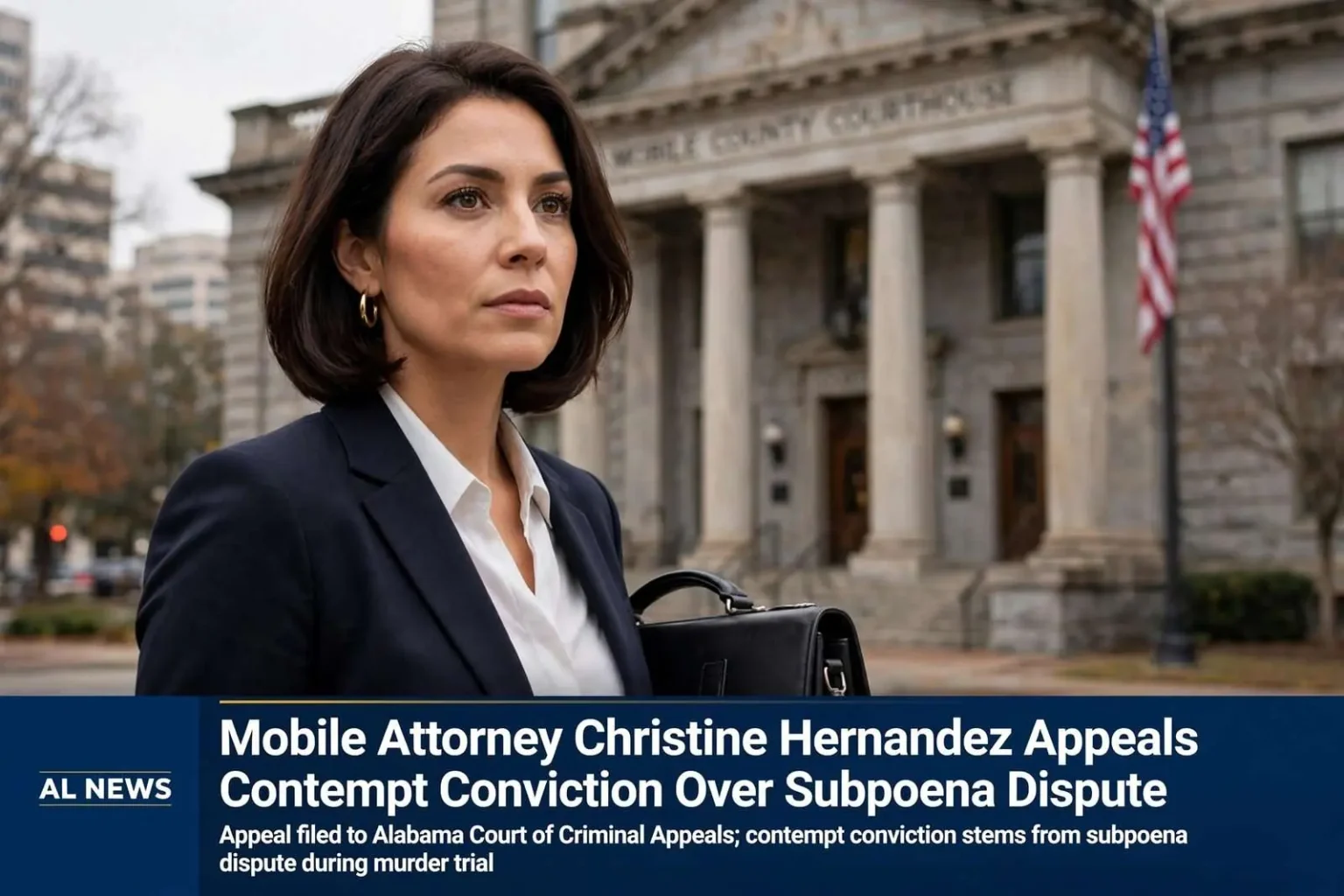
A prominent Mobile attorney is taking her contempt of court conviction to the state’s highest criminal appeals court, setting up a legal fight over what her lawyers describe as a routine courtroom dispute and what a Mobile County judge called deliberate gamesmanship.
Attorney Christine Hernandez filed a notice of appeal with the Mobile County Circuit Clerk’s Office on Dec. 27, ten days after Mobile Circuit Judge Wesley Pipes found her guilty of criminal contempt, a misdemeanor. The case now moves to the Alabama Court of Criminal Appeals, where a five-judge panel will review the ruling.
Pipes issued his ruling on Dec. 17, concluding that Hernandez intentionally arranged for a process server to deliver a subpoena to another attorney while that attorney was actively representing a defendant in a Mobile County murder trial in late November. In his written order, Pipes characterized the move as “gamesmanship” and an unrelated “squabble among lawyers” that had no place interrupting active court proceedings.
The dispute traces back to a show cause hearing held Dec. 15, during which Hernandez testified that she had instructed process server Edward Stokely to hold off on serving the subpoena inside the courtroom and to wait until the trial had concluded. Stokely offered a different account, telling the court he understood his instructions to mean the papers should be served before proceedings began at 9 a.m. on Nov. 18. Instead, he served the documents in open court in front of seated jurors, an act Pipes said threatened to derail a case that had already been in the pipeline for four and a half years.
In his findings, Pipes wrote that he found Stokely’s version of events more credible than Hernandez’s. As a result, both Hernandez and Stokely were held in contempt, though Stokely’s punishment was tied specifically to serving papers in view of identifiable jurors. Stokely was fined $25, while Hernandez was ordered to pay $100. Despite the disruption, the underlying murder trial ultimately resolved through a plea agreement rather than a mistrial.
Attorney James Rossler represented Hernandez during the contempt proceedings in Mobile County Circuit Court. For the appeal, Hernandez has retained Scott W. Hunter, an attorney based in Point Clear whose practice focuses on appellate advocacy.
Hernandez has built a reputation in south Alabama legal circles well beyond this dispute. She was co-counsel, alongside attorney David Kennedy, in Searcy v. Strange, the 2015 federal case that dismantled Alabama’s ban on same-sex marriage and helped pave the way for marriage equality across the state. She has also represented multiple plaintiffs in a lawsuit against St. Pius X Catholic School, alleging the school failed to protect students from bullying and covered up other incidents on campus.
In his order, Pipes emphasized the court’s authority to manage its own proceedings without interference, writing that the court “cannot and will not allow gamesmanship and unrelated squabbles among lawyers to interrupt, hinder and disturb its proceedings.”
Stokely’s attorney has indicated he does not intend to appeal the ruling against his client, leaving Hernandez’s challenge as the only one moving forward.
The Law on Contempt
Under Alabama law, a circuit court may punish contempt with a fine of up to $100 and up to five days in jail. The $100 fine ordered for Hernandez is the maximum fine the statute allows. Criminal contempt proceedings are governed by Rule 33 of the Alabama Rules of Criminal Procedure. That is why her appeal goes to the Court of Criminal Appeals rather than the civil appellate court.