
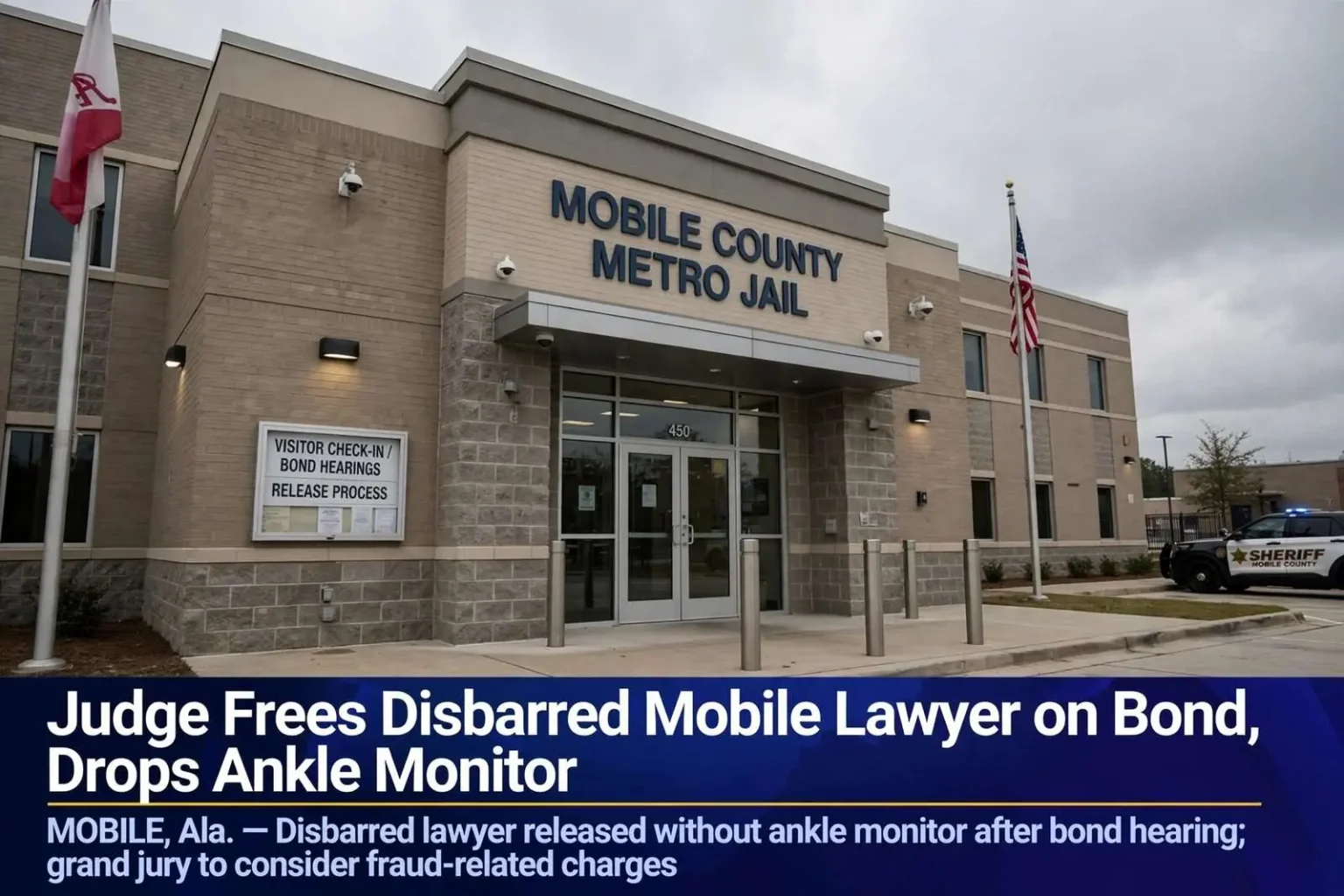
MOBILE, Ala. — A judge has allowed a disbarred lawyer from Mobile to remain free on bond without electronic monitoring, a decision that released Darryl Blackmon from the Mobile County Metro Jail this afternoon and removed the ankle tracking device that had been part of his release conditions. Prosecutors said Blackmon continued receiving payments and offering legal services after he was no longer authorized to do so. He has not yet been tried, and a grand jury will now decide whether to indict him on fraud-related charges — the next step in a case that began with allegations of practicing law without a license and has since moved through the county’s pretrial process.
The bond hearing turned on questions that judges weigh in every serious criminal case: whether a defendant poses a danger to the community, whether he is likely to appear for future proceedings, and whether the conditions of release are fair and feasible. Blackmon’s lawyer argued that his client is neither a threat nor a flight risk, and pointed to a practical problem that had kept him behind bars — he had been jailed since December because he could not afford the electronic monitoring fees. The judge agreed to remove the ankle monitoring requirement, and Blackmon walked out of the Metro Jail this afternoon on the revised bond conditions.
What prosecutors allege
The allegations at the center of the case involve the unauthorized practice of law. Prosecutors said Blackmon continued receiving payments and offering legal services after he was no longer authorized to do so — conduct that Alabama law treats seriously, because clients who hire a lawyer are entrusting them with their legal rights, their money, and sometimes the outcome of cases that shape the rest of their lives. When a person who cannot appear before the courts accepts fees for legal work, clients may not discover the deception until it has cost them dearly: missed deadlines, defaulted cases, and money paid for services that were never validly rendered.
According to the Alabama Bar Association, Blackmon was publicly reprimanded in 2023 for violating rules of professional conduct. A public reprimand is a formal disciplinary action — a published censure that falls short of disbarment but puts the attorney’s conduct on the public record. The eventual loss of his law license removed his authorization to practice entirely, which is what makes the subsequent allegations significant: prosecutors say the payments and legal services continued after that authorization ended. The grand jury will review the evidence and decide whether to formally indict him on fraud-related charges.
The bond decision
Bond conditions in Alabama felony cases are set to balance two commitments: the presumption of innocence, which favors release, and the community’s interest in ensuring defendants return to court and do not offend while awaiting trial. Electronic monitoring is one of the tools available — an ankle monitor tracks a defendant’s movements and enforces curfews — but it comes at a cost that is typically charged to the defendant. For defendants without income, those fees can create a de facto detention: technically released, but unable to pay for the device that makes release possible.
That was the situation Blackmon’s attorney described. Jailed since December, unable to afford the monitoring fees, Blackmon remained in custody despite a bond that nominally allowed his release. His lawyer argued that the arrangement exceeded what the circumstances required — that a client with no demonstrated danger to the community and no history suggesting flight should not sit in jail for inability to pay monitoring costs. The judge’s ruling removed the ankle monitoring requirement entirely, resolving the impasse and resulting in Blackmon’s release from the Mobile County Metro Jail this afternoon.
The disciplinary path: reprimand to disbarment
The case’s background runs through Alabama’s attorney discipline system, which operates under the Alabama State Bar and the state’s courts. The process begins with complaints, which are investigated by the bar’s Office of General Counsel. Findings can lead to a range of sanctions — private or public reprimand, suspension, or disbarment — depending on the severity of the misconduct. A public reprimand, like the one Blackmon received in 2023 for violating rules of professional conduct, is a published disciplinary action that serves both as punishment and as a warning to the public. Disbarment, the most severe sanction, strips an attorney’s license entirely and bars them from practicing law in the state.
The system exists to protect clients rather than to punish for its own sake. Rules of professional conduct govern how attorneys handle client funds, communicate with clients, maintain competence, and represent themselves to the public. Violations involving money — commingling funds, charging fees for work never performed, deceiving clients — are treated with particular gravity because they strike at the trust the entire profession depends on. When an attorney loses his license and then, according to prosecutors, continues taking payments for legal services, the conduct moves from the disciplinary realm to the criminal one: the unauthorized practice of law and, potentially, fraud.
What the grand jury will decide
The next procedural step belongs to a Mobile County grand jury. The panel will hear the prosecution’s evidence in closed session and vote on whether the fraud-related charges should proceed by indictment. The grand jury does not weigh defenses, hear from the accused, or determine guilt — it answers only whether probable cause supports formal charges. If an indictment is returned, the case moves to circuit court, where arraignment, pretrial motions, and potentially a trial would follow. If not, the charges end there.
Until that process plays out, the allegations remain allegations, and the presumption of innocence applies fully. The bond ruling itself reflects that principle: the judge’s decision to release Blackmon without electronic monitoring is not an assessment of guilt or innocence, but a judgment about the conditions needed to guarantee his appearance in court while the case advances.
The Metro Jail and the cost of pretrial detention
The Mobile County Metro Jail, where Blackmon had been held since December, houses thousands of defendants at any given time — most of them pretrial detainees who have been charged but not convicted. Cases like this one touch a policy debate playing out in courts across the country: whether financial conditions attached to release, including monitoring fees, function as detention by another name for defendants who cannot pay. Judges must weigh public safety against the principle that liberty before conviction should not depend on the size of a defendant’s bank account.
In this instance, the judge resolved the tension by removing the monitoring requirement altogether rather than leaving Blackmon in jail. The decision returned him to his community pending the grand jury’s review, under whatever remaining bond conditions apply. The fraud-related allegations, the 2023 public reprimand, and the loss of his law license all remain part of the record; what happens next — indictment or not, trial or not — will be decided in the courtroom, on the evidence, under the standard of proof the law requires.
Why unauthorized practice cases matter to clients
For the people prosecutors say paid Blackmon for legal services he was not authorized to provide, the harm operates on two levels. The first is financial: fees paid for representation that was never validly available. The second is legal — and often more damaging. Court proceedings run on deadlines. Statutes of limitation expire, response deadlines pass, hearings are missed. A client who believes a licensed attorney is handling a matter may not discover until too late that nothing was filed at all, and some losses cannot be undone by any later remedy. That asymmetry is why Alabama courts and the legislature treat the unauthorized practice of law as more than a technical violation, and why prosecutors pursued fraud-related charges rather than leaving the matter to the bar’s disciplinary process.
Consumers can protect themselves with a few simple checks. Alabama’s bar maintains records of every licensed attorney and every public disciplinary action, searchable by name. Before paying anyone for legal services, a client can verify active licensing in minutes. Red flags include requests for cash payments, guarantees of specific outcomes, and reluctance to provide a written fee agreement. When a disciplinary record shows a public reprimand or suspension, that history is public information precisely so that consumers can make informed choices before money changes hands.
How the case appears in the record so far
Setting aside what remains to be proven, the documented facts of the case to this point are limited and worth stating precisely. According to the Alabama Bar Association, Blackmon was publicly reprimanded in 2023 for violating rules of professional conduct. He has since been disbarred, removing his authorization to practice law. Prosecutors allege that he continued receiving payments and offering legal services after that authorization ended, and those allegations underlie the fraud-related charges awaiting the grand jury’s review. He has been held at the Mobile County Metro Jail since December, unable to afford electronic monitoring fees attached to his bond.
Today’s developments — the judge’s removal of the ankle monitoring requirement and Blackmon’s release from the Metro Jail this afternoon — change the conditions of his liberty, not the substance of the allegations. His attorney’s argument that he is neither a threat nor a flight risk prevailed at the hearing, and the state’s evidence against him has not yet been tested at trial. Both can be true at once, and the legal system’s structure is designed to keep them separate until a jury weighs the proof.
What happens next
The case now waits on the Mobile County grand jury. If the panel returns an indictment on the fraud-related charges, the case proceeds to circuit court, where Blackmon would be formally arraigned and a trial date eventually set. His defense would then have every opportunity to challenge the prosecution’s evidence, cross-examine witnesses, and present its own case. If the grand jury declines to indict, the criminal charges end without a trial.
Either way, the story so far offers Mobile readers a window into three interconnected systems: the bar’s disciplinary process that publicly reprimanded and then disbarred an attorney; the criminal process that converts allegations of fraud into formal charges through a grand jury; and the bond process that balances pretrial liberty, public safety, and the practical realities of monitoring costs. All three converged this afternoon at the Mobile County Metro Jail, where a disbarred lawyer walked out on revised conditions — presumed innocent, monitored no longer, and awaiting the grand jury’s decision on whether the charges against him will move forward.


