Mobile Fire Crews Battle Overnight Blaze at Vacant Home on Terrell Road
Mobile Fire-Rescue crews extinguished a fire at a vacant home on Terrell Road late Monday night, battling thick vegetation to reach the burning structure.
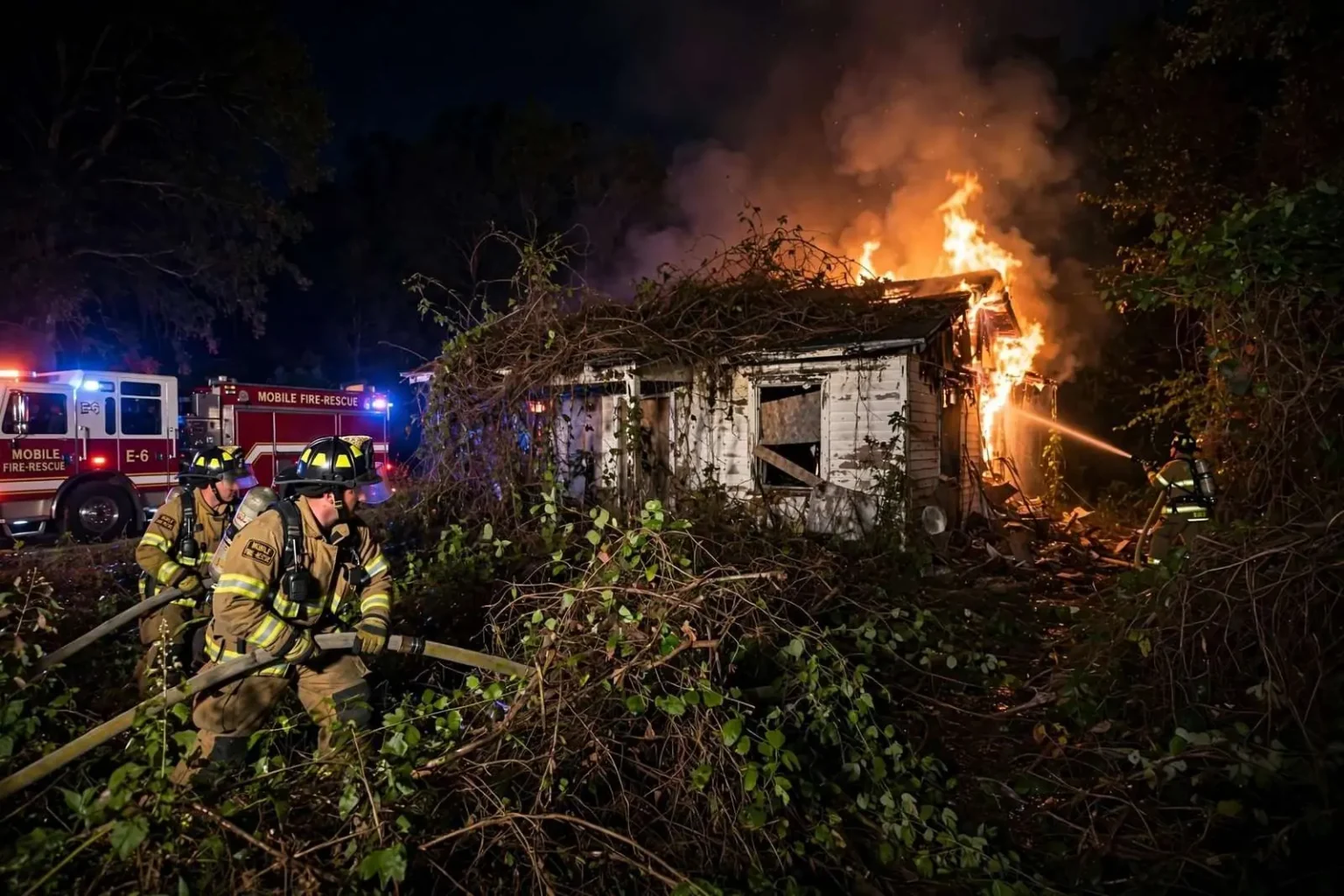
Mobile Fire-Rescue crews responded to a house fire late Monday night, July 20, at a vacant home on the 1300 block of Terrell Road, in a fight complicated by thick vegetation surrounding the property. According to a Mobile Fire-Rescue Department spokesperson, crews were dispatched to the scene around 9:50 p.m. Heavy vegetation on both sides of the property made it difficult for firefighters to reach the structure. The fire reportedly started at the right corner of the home, with flames later emerging from the back of the building. No one was living in the home at the time, though officials said snakes and turtles were found inside. Crews were able to extinguish the fire, and no injuries were reported. The cause of the fire remains under investigation.
A nighttime fire at a vacant house tests a fire department differently than a fire at an occupied home. There are no rescues to attempt, but there are hazards that occupied structures do not present: unknown building conditions, possible squatters or animals inside, delayed discovery that lets a fire grow before the first call comes in, and, as on Terrell Road, access problems created by overgrown land around an abandoned property.
The Dispatch and the Approach
The call came in around 9:50 p.m., hours after dark, when a fire in an unoccupied building can burn for some time before anyone notices or reports it. Mobile Fire-Rescue dispatchers sent crews to the 1300 block of Terrell Road, and when they arrived they found a structure that had already been burning, with fire showing at the right corner of the home before flames worked toward the rear of the building. Firefighters work from what they can see on arrival to decide how to attack a fire, where to position engines, and where the water supply will come from, and every delay in those early minutes allows the fire to extend deeper into the structure.
On this scene, the vegetation became the first obstacle. Heavy growth on both sides of the property narrowed and complicated the paths to the building, forcing crews to push equipment through or around brush while dragging hose lines. Firefighting is a logistics operation as much as anything else, and a hoseline can weigh well over a hundred pounds when charged with water. What would be a short pull across a mowed lawn becomes a slow, laborious advance through dense growth, all while the fire continues to spread inside.
The vegetation also concealed hazards underfoot. Overgrown vacant lots hide debris, holes, and abandoned fixtures, and firefighters advancing in the dark toward a working fire move by feel and flashlight. Incident commanders on such scenes balance the urgency of attacking the fire against the risk of injuring crew members, and access problems of the kind described on Terrell Road lengthen the time it takes to surround and extinguish a structure.
Fighting Fire in a Vacant Structure
Once crews reached the building, the fact that it was vacant changed the nature of the operation. With no one known to be inside, the priority shifts from search and rescue to fire containment, protecting nearby exposures, and preventing collapse injuries. Firefighters attack from the exterior until conditions are understood, because vacant buildings are more likely to have compromised floors, missing fixtures, and accumulated clutter that make interior operations dangerous.
The discovery of snakes and turtles inside the home came as no surprise to anyone familiar with vacant Gulf Coast properties. Abandoned structures in Mobile’s climate provide exactly what reptiles seek: cool, dark, undisturbed shelter close to water and food sources. Snakes and turtles take up residence in crawl spaces, wall voids, and debris piles, and firefighters entering such buildings encounter them regularly. The animals found at the Terrell Road house were a reminder that a vacant home is not empty, a point crews must keep in mind both for their own safety and when clearing a structure after the fire is out.
Where Vacant-Property Fires Start
The report that the fire started at the right corner of the home, with flames later emerging from the back, gave investigators a starting geography, but determining a cause requires more. Mobile Fire-Rescue investigators work backward from burn patterns, which trace how fire moved through a structure and where it burned longest and hottest. They look at the point of origin for ignition sources, from electrical wiring and appliances to candles, cooking materials, and debris that could have been set alight by discarded smoking materials. In vacant buildings, investigators also consider the possibility of intentional fires, unauthorized occupants, and children playing in the structure, weighing physical evidence against the building’s recent history.
Fires in vacant properties are a recognized category of risk in cities across the Gulf Coast. A building that no one lives in may retain utilities that are partially active, may contain furniture and debris left behind, and may attract trespassers. Without anyone present to call for help early or douse a small fire, an incipient blaze grows unchecked until it is visible from outside, which is why so many vacant-structure fires are reported late at night by neighbors or passersby, as the Terrell Road fire was. The delay in discovery means the fire is almost always larger on arrival than a comparable fire in an occupied home.
The aftermath creates costs beyond the burned building itself. A fire-damaged vacant house is a hazard for neighbors and a draw for children, and municipalities track dangerous structures through codes enforcement. Property owners in Mobile are responsible for maintaining vacant structures, and a fire often accelerates the process by which a city forces cleanup, securing, or demolition of a building that has become a hazard.
Vegetation, Access, and the Neighborhood
The heavy vegetation on both sides of the Terrell Road property was more than an inconvenience for this particular response. Overgrown lots increase fire risk in their own right: dry brush and unmowed growth carry flame from an exterior fire into a structure and can spread fire between buildings and across fences. Fire officials in wooded, humid cities like Mobile repeatedly emphasize maintenance of vacant lots, because growth that seems cosmetic in the rainy season becomes fuel during dry stretches. Clear access to a structure also matters for the next emergency, whether it is a fire, a medical call for someone living nearby, or a search of the property.
For the neighbors on the 1300 block, the night’s events were a disruption and, once the fire was out, a relief. Fires draw engine, ladder, and support apparatus that stage along residential streets, and a working fire after 10 p.m. means lights, hoses, and command activity for hours. The fact that no injuries were reported, to residents, firefighters, or anyone else, is the outcome every department hopes for from a night like this one, particularly given the difficult access and the unknowns inside the structure.
Mobile Fire-Rescue, the department that handled the call, protects a port city of nearly 200,000 residents with a network of stations spread across the city and a mix of engine, ladder, rescue, and specialty units. Vacant-structure fires, trash fires, and brush fires are routine parts of its workload, and the department’s spokespeople regularly share details of significant calls with local media to keep residents informed about incidents in their neighborhoods.
The Investigation Continues
With the fire extinguished and no injuries, the department’s remaining work on the Terrell Road house fell to investigators. Cause determinations in vacant-structure fires can take time, particularly when the building’s history is complicated, and the department said the cause of this fire remained under investigation. Until that work is complete, officials typically decline to speculate about whether the fire was accidental or intentional.
Investigators in cases like this one examine the scene methodically, photographing burn patterns, sifting debris at the point of origin, and interviewing the neighbors who reported the fire and anyone familiar with the property. Even in a vacant structure, the physical evidence usually tells a story: whether an electrical fault, an abandoned heating device, or an outside ignition started the blaze, and whether the fire smoldered or spread quickly. Findings in such cases sometimes lead to referrals for prosecution, and sometimes simply close the record on a building’s final chapter.
What can be said from the report is what happened: a fire was discovered late on Monday night, July 20, at a vacant home on the 1300 block of Terrell Road; crews dispatched around 9:50 p.m. found heavy vegetation complicating their approach; the fire began at the right corner of the home before showing from the rear; snakes and turtles were found inside the vacant structure; crews extinguished the fire with no injuries reported. For residents of the area, the episode stands as a practical illustration of why vacant properties and overgrown lots are worth reporting to the city, and of the work Mobile firefighters do, night after night, in buildings no one is watching.