Baldwin County Waives Battery Disposal Fees Sept. 12 for National Battery Take-Back Day
The Solid Waste Disposal Authority of Baldwin County will waive battery disposal fees from 7 a.m. to noon Saturday, Sept. 12, at CHaRM locations in Gulf Shores and Fairhope for National Battery Take-Back Day.
The batteries accumulating in kitchen drawers across Baldwin County have a free destination next Saturday.
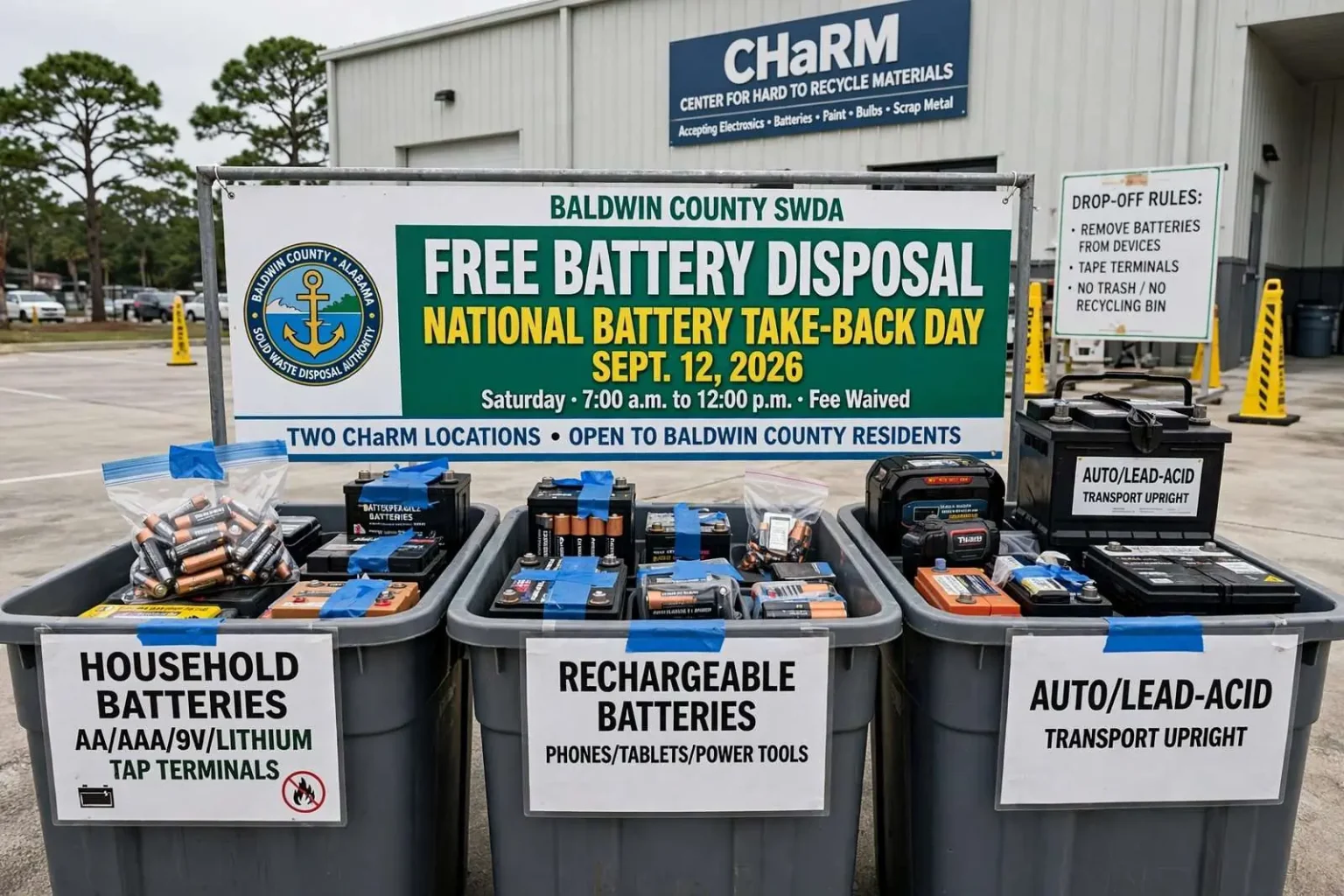
The Solid Waste Disposal Authority of Baldwin County will waive its usual battery disposal fees on Saturday, Sept. 12, 2026, from 7 a.m. to noon, as part of National Battery Take-Back Day. The event is open to Baldwin County residents.
Where to Go
Residents can bring batteries to either of two participating CHaRM locations:
- Orange Beach CHaRM — 22510 Russian Rd., Gulf Shores
- Fairhope CHaRM — 20609 Bishop Rd., Fairhope
Both locations participate in the fee waiver program. The waiver applies only at participating CHaRM sites during the scheduled hours — it will not be honored at SWDA landfills. Residents who take batteries to a landfill should not expect the National Battery Take-Back Day fee waiver to apply there.
What They Will Take
The collection covers batteries from a wide range of everyday items, including:
- Phones
- Watches
- Tablets
- Vacuums
- Power tools
- Cars
Residents are encouraged to check devices around their homes before heading to a CHaRM location. Most households substantially underestimate how many batteries they own, because the majority are sealed inside devices rather than sitting loose in a drawer.
SWDA asks residents to remove batteries from their devices before disposal. Doing so can help residents avoid additional fees, and the authority wants batteries handled separately from the electronics or other items they were used with.
Why Batteries Cannot Go in the Trash
Officials ask residents not to place batteries in household trash or recycling bins, and the reason is more urgent than general environmental good practice.
Lithium-ion batteries — the type in phones, tablets, laptops, cordless tools and an increasing share of household devices — can ignite when damaged, crushed or short-circuited. That is precisely what happens inside a garbage truck compactor or at a materials recovery facility, where mixed waste is compressed and sorted mechanically.
Waste and recycling operators across the country have reported a sharp rise in fires traced to improperly discarded lithium-ion batteries. These fires are difficult to extinguish because a battery in thermal runaway generates its own oxygen and can reignite after appearing to be out. They endanger collection crews and facility workers, damage expensive equipment, and in serious cases take a facility offline entirely.
Other chemistries carry their own concerns. Lead-acid automotive batteries contain lead and sulfuric acid. Older button cells may contain mercury. Nickel-cadmium batteries contain cadmium, a heavy metal. None belong in a landfill or a curbside recycling stream.
There is also a recovery argument. Batteries contain lithium, cobalt, nickel, lead and other materials that can be reclaimed through proper recycling — materials whose primary extraction carries substantial environmental cost.
Fees as a Barrier
The fee waiver addresses a specific, well-documented problem in household hazardous waste programs: even modest disposal charges suppress participation.
A resident weighing a small fee against the apparent zero cost of dropping a battery in the trash frequently chooses the trash, particularly when the harm is invisible and deferred. Removing the charge removes the deliberation.
Fee-waiver days also work as awareness campaigns. Many residents genuinely do not know batteries require separate handling, and a publicized event communicates both the requirement and the location that satisfies it.
What CHaRM Facilities Are
CHaRM — Center for Hard to Recycle Materials — facilities accept material that curbside programs cannot handle. Standard curbside recycling is built around a narrow set of high-volume commodities: paper, cardboard, certain plastics, metal cans, glass. Items outside that set contaminate the stream or damage sorting equipment.
CHaRM sites fill the gap, typically accepting electronics, batteries, fluorescent bulbs, paint, scrap metal and similar materials. Baldwin County’s two locations put a facility within reasonable reach of both the southern beach communities and the Eastern Shore, though residents in the northern and western portions of the county face a longer drive.
Preparing Batteries for Drop-Off
Beyond removing batteries from devices, general safe-handling practice is worth observing on the drive over. Terminals on lithium-ion and 9-volt batteries should be taped with clear packing or electrical tape, or each battery bagged individually, to prevent contact between terminals that could cause a short circuit. Damaged, swollen or leaking batteries should be handled with particular care and kept separate.
Automotive batteries should be transported upright and secured so they cannot tip.
Event Details
What: National Battery Take-Back Day — SWDA fee waiver
When: Saturday, Sept. 12, 2026, 7 a.m. to noon
Where: Orange Beach CHaRM, 22510 Russian Rd., Gulf Shores; Fairhope CHaRM, 20609 Bishop Rd., Fairhope
Cost: Free during event hours at participating locations
Who: Baldwin County residents
More information: Battery Safety Now
The 7 a.m. to noon window is a short one, and the fee waiver does not extend beyond it. Residents who miss Saturday can still bring batteries to CHaRM locations during normal operating hours — the standard disposal fees would simply apply.