Mobile County Asks Army Corps to Deny Paradise Found’s Fowl River Marina Over Clash With Public Boat Launch
Mobile County has asked the Army Corps of Engineers to deny a 116-slip Fowl River marina proposed by Paradise Found RV Resort & Marine, saying it would interfere with the county's planned public boat launch at Byrnewood Road.
MOBILE COUNTY, Ala. — Mobile County is asking federal regulators to reject a proposed Fowl River marina, arguing that the private development’s plan for more than 100 boat slips would collide, sometimes literally, with a public boat launch the county is preparing to build just next door.
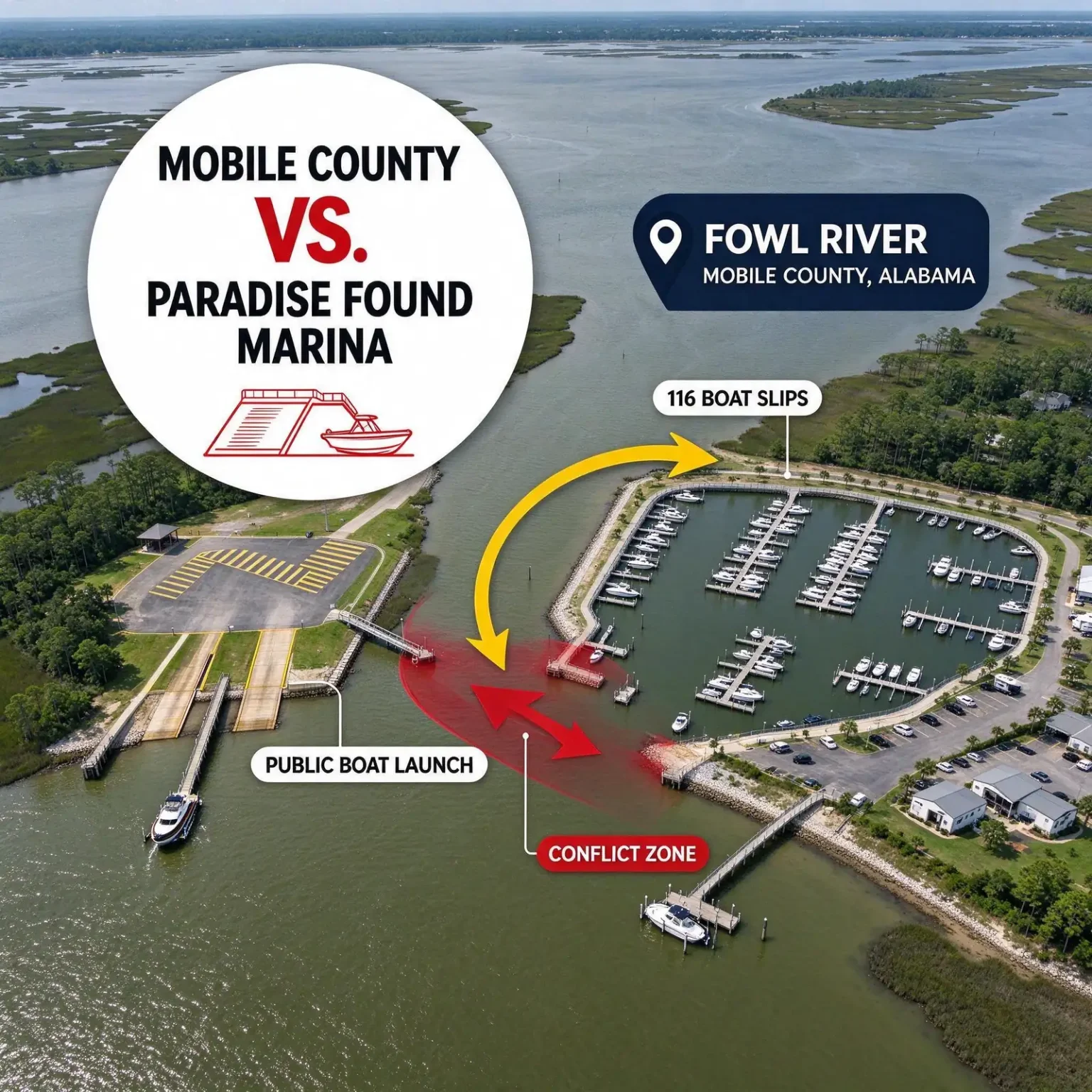
County officials formally objected last week to a permit application from Paradise Found RV Resort & Marine, which is seeking approval from the U.S. Army Corps of Engineers to add 116 boat slips across two basins at the east end of its new development off Dauphin Island Parkway. The county says the marina would “directly interfere” with its planned public launch at the end of Byrnewood Road.
County: deny the permit or require a redesign
In a written comment submitted Oct. 16, Mobile County Environmental Services Director Tina Sanchez laid out the county’s position plainly.
“Mobile County requests that the U.S. Army Corps of Engineers, Mobile District, deny the permit as proposed,” Sanchez wrote.
If the Corps does not deny the application, Sanchez argued, it should require a “substantial redesign” of the marina.
The county’s objections cover a wide range of concerns, including vessel navigation, boater safety, recreation, property ownership, wetlands, water quality and shoreline erosion. Sanchez also stated that one portion of Paradise Found’s plans appears to overlap with property owned by the county.
Two projects, one stretch of shoreline
At the heart of the dispute is a small stretch of Fowl River near where it flows into Mobile Bay. The county acquired riverfront property at the end of Byrnewood Road with plans to give the public a new place to put boats in the water. Paradise Found’s planned marina basins sit right alongside it.
The county’s current plans for the Byrnewood launch include a two-lane boat ramp, a gangway, a bulkhead, parking, lighting and pavilions.
An image submitted by the county overlays both planned facilities. It shows that a proposed boardwalk extending from the Paradise Found property would end directly in front of the county’s planned launch.
If both projects move forward as currently proposed, Sanchez said, boats leaving the private marina basins and boats launching from the public ramp would be competing for the same water.
“These activities will compete for the same near-shore maneuvering area,” she wrote.
A conflict first flagged in 2022
The potential clash is not new. It first surfaced in April 2022, when preliminary plans for Paradise Found’s marina, then proposed with 62 slips, showed a boardwalk extending near the shoreline of the property the county had recently acquired.
At the time, developer Ty Engler acknowledged that the two plans conflicted. He said his company could pull back the boardwalk and eliminate some slips so both projects could coexist.
The current application, however, nearly doubles the number of slips from that earlier concept to 116. Engler did not respond to a request for comment on the county’s filing.
State funding and the “optimal” public site
The county’s launch has significant state money behind it. In August, Gov. Kay Ivey awarded the Byrnewood project an additional $5 million from Alabama’s share of Gulf of Mexico Energy Security Act funding, known as GOMESA. That came on top of a prior $1.2 million allocation used to buy the riverfront property near the river’s outlet into Mobile Bay.
GOMESA, a federal law passed in 2006, shares a portion of revenue from offshore oil and gas leasing in the Gulf with the producing states of Alabama, Louisiana, Mississippi and Texas, as well as with their coastal counties and parishes. In Alabama, the money has been used for coastal conservation, restoration and public access projects.
Sanchez stated that the funding was awarded because the Byrnewood property was the “most practical and environmentally responsible” site for the county’s project, and that the Paradise Found slips would change that.
“The proposed marina would directly interfere with implementation of a site that Mobile County previously identified as the optimal public-access location,” she stated.
Environmental concerns: wakes, dredging and bulkheads
Beyond navigation and property questions, the county raised environmental objections. It cited a 2026 scientific study by the Mobile Bay National Estuary Program that identified recreational boat wakes as a major contributor to marsh erosion on Fowl River. The Mobile Bay National Estuary Program is one of 28 national estuary programs established under the federal Clean Water Act to protect and restore estuaries of national significance.
The county asked the Corps to fully evaluate Paradise Found’s plans for excavation, dredging and 900 feet of new bulkhead, and to consider the cumulative effects the project could have on shoreline hardening along the river.
“Converting the natural marsh edge to hardened bulkhead not only impacts the ecosystem services that highly productive marsh edges provide, but can also affect the productivity of the overall marsh area,” Sanchez wrote.
Coastal scientists have long noted that natural marsh edges help filter runoff, provide nursery habitat for fish, shrimp and crabs, and absorb wave energy. Hard structures such as bulkheads remove that intertidal habitat and can reflect wave energy, which in some cases increases erosion in front of or next to the wall.
How the Corps permit process works
Marinas, docks, dredging and bulkheads in navigable waters and wetlands generally require permits from the Army Corps of Engineers under Section 10 of the Rivers and Harbors Act and Section 404 of the Clean Water Act. When the Corps receives an application for a project of this scale, it typically issues a public notice describing the proposal and opens a comment period so government agencies, neighbors and the public can weigh in.
The Corps then reviews the comments and evaluates the project’s likely effects, weighing factors such as navigation, safety, wetlands, fish and wildlife, water quality and the public interest. It can issue a permit as proposed, require changes or conditions, or deny it. Projects in coastal Alabama also generally need state water quality and coastal consistency approvals from the Alabama Department of Environmental Management.
A Corps spokesperson could not be reached to discuss the status of the Paradise Found application or the public comment period.
What’s next
The Corps’ Mobile District will decide whether the 116-slip marina can proceed as designed, needs to be changed, or should be denied. Mobile County’s filing puts the agency on notice that the county views its publicly funded launch as the priority use of the shoreline at Byrnewood Road.
For boaters in south Mobile County, the outcome could shape how and where they reach Fowl River and Mobile Bay for years to come. Residents interested in the application can contact the Army Corps of Engineers Mobile District regulatory office for information on public notices and comment opportunities.