Black Belt Rail Line Lands $27 Million Federal Grant for Track and Crossing Upgrades
U.S. Rep. Terri Sewell announced a $27 million federal CRISI grant to modernize the Alabama & Gulf Coast Railway and Eastern Alabama Railway. The work includes new rail and ties, modern signals and rehabilitation of 34 at-grade crossings.
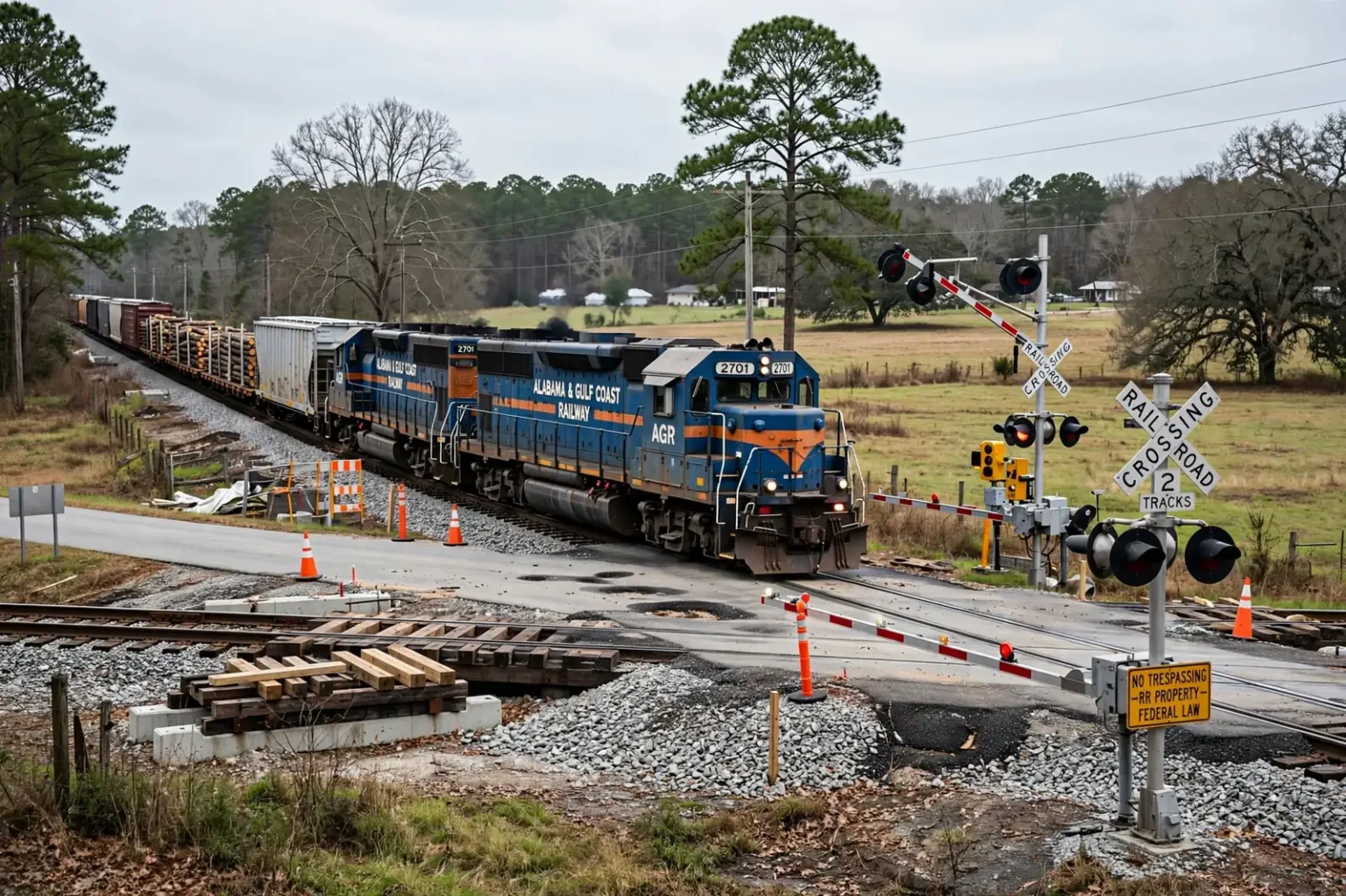
A $27 million federal grant will pay for a broad modernization of the Alabama & Gulf Coast Railway, a freight line that runs through some of Alabama’s most rural communities, U.S. Rep. Terri Sewell announced Friday, Oct. 16. The Alabama & Gulf Coast Railway grant, awarded through a federal rail safety and improvement program, is aimed at making rail service safer and more efficient and at supporting job growth across the Black Belt and Gulf Coast region.
Sewell, a Democrat who represents Alabama’s 7th Congressional District, said the project will especially benefit Monroeville, Pine Hill, Linden, Demopolis, Boligee and Pickensville, towns that sit along the railroad’s route through southwest and west Alabama.
What the money will fund
The award comes from the Federal Railroad Administration’s Consolidated Rail Infrastructure and Safety Improvements program, commonly called CRISI. The project was selected for project development, final design and construction, meaning the grant covers the work from planning through completion.
The project includes track rehabilitation and improvements on the Alabama & Gulf Coast Railway and the Eastern Alabama Railway, with work in both Alabama and Mississippi. Planned improvements include:
- Replacing rail, crossties, turnouts and ballast
- Surfacing and aligning track to improve ride quality and reduce wear
- Modernizing signal and communications systems
- Rehabilitating 34 at-grade highway-rail crossings
- Installing signs to discourage trespassing on railroad property
Each of those components addresses a different part of how a railroad operates. Rail and crossties wear out over decades of heavy loads, and aging track often forces railroads to impose lower speed limits and weight restrictions. Turnouts, the switches that allow trains to move from one track to another, are among the most maintenance-intensive parts of any line. Ballast, the crushed stone that supports the ties and drains water away from the track, degrades over time and must be replenished to keep the track stable.
Upgraded signals and communications help dispatchers and train crews operate more safely and efficiently, while crossing rehabilitation improves the road surface where highways and streets cross the tracks, a benefit for motorists as well as the railroad.
Sewell: ‘More job opportunities’
In announcing the grant, Sewell tied the award to earlier federal investments in the region’s rail network.
“I am thrilled to announce that we have secured $27 million in federal funding to modernize the Alabama & Gulf Coast Railway,” Sewell said. “That means safer, more efficient rail service and more job opportunities for communities across the Black Belt. This investment builds on the $15.8 million in rail grants that we secured for the Black Belt in 2023, and it will be especially beneficial for Monroeville, Pine Hill, Linden, Demopolis, Boligee, and Pickensville.”
Sewell also credited the 2021 federal infrastructure law, which she supported, for making the funding possible.
“The Bipartisan Infrastructure Law continues to deliver for Alabama!” Sewell said. “I was proud to vote for this transformational legislation, and I will keep fighting to bring more opportunities home to our district.”
Sewell has represented the 7th District since 2011 and was the first Black woman elected to Congress from Alabama. Her district includes much of the Black Belt as well as parts of the Birmingham area.
A long history across rural Alabama
The Alabama & Gulf Coast Railway is a regional freight railroad headquartered in Monroeville. Its main line runs from the port of Pensacola, Florida, north through southwest and west Alabama to Columbus, Mississippi, and the railroad also operates a branch that reaches Mobile. Communities along the system include Atmore, Frisco City, Monroeville, Pine Hill, Linden, Demopolis and Boligee.
Parts of the route date to the 19th and early 20th centuries, when a series of railroads built lines connecting the Gulf Coast with the interior. The route later became part of the St. Louis–San Francisco Railway, known as the Frisco, which was absorbed into Burlington Northern in 1980. The Alabama & Gulf Coast Railway was formed in 1997 when BNSF spun off the line between Kimbrough, Alabama, and Pensacola, and it later acquired additional track north to Columbus. Since 2012, the railroad has been owned by Genesee & Wyoming, one of the largest operators of short line and regional railroads in North America.
Railroads like the Alabama & Gulf Coast play a role that is often overlooked: they connect small-town industries, including the forest products businesses that are a mainstay of the region’s economy, to the national rail network and to ports. For many rural employers, reliable rail service can be the difference between staying competitive and moving shipments to trucks on two-lane highways.
About the CRISI program
CRISI is one of the Federal Railroad Administration’s main grant programs for improving the country’s rail network. It funds projects nationwide that improve railroad safety, efficiency and reliability. The program also seeks to reduce congestion at passenger and freight rail bottlenecks, improve connections between different modes of transportation, and create or substantially improve intercity passenger rail corridors.
The program is authorized under federal law at 49 U.S.C. Section 22907. Funding for this round came from several sources: the Full-Year Continuing Appropriations and Extensions Act, 2025 (Public Law 119-4); the Consolidated Appropriations Act, 2026 (Public Law 119-75); and the Infrastructure Investment and Jobs Act of 2021 (Public Law 117-58), commonly known as the Bipartisan Infrastructure Law.
The infrastructure law, signed in November 2021, provided a significant increase in federal money for rail, including multiyear funding for CRISI. Short line and regional railroads, which often operate on thin margins and older infrastructure, have been frequent recipients of CRISI grants because the program allows them to complete large rehabilitation projects that would be difficult to finance on their own.
Why it matters for the Black Belt
The Black Belt takes its name from the dark, fertile soil that once supported the region’s plantation economy. Today the term also describes a band of predominantly rural counties stretching across central and west Alabama that face long-standing challenges, including population loss, limited infrastructure and fewer job opportunities than the state’s metropolitan areas.
The towns Sewell highlighted illustrate the reach of the project. Monroeville is the seat of Monroe County; Pine Hill is in Wilcox County; Linden and Demopolis are in Marengo County; Boligee is in Greene County; and Pickensville is in Pickens County near the Mississippi line. Improved track and crossings along the corridor could help existing businesses ship goods more reliably and make the area more attractive to new industry that depends on rail access.
Safety is another key component. Rehabilitating 34 at-grade crossings and adding trespassing signs addresses two of the leading sources of rail-related injuries nationally: collisions at highway-rail crossings and people walking on or near tracks.
What comes next
Because the project was selected for development, final design and construction, the next steps will include completing engineering plans and finalizing a grant agreement with the Federal Railroad Administration before construction begins. A timeline for when crews will begin work along the line was not included in the announcement.
Motorists and residents along the route should watch for notices of temporary crossing closures once construction is scheduled. Railroad safety advocates also remind the public that railroad tracks, trestles and rights of way are private property, and that trains cannot stop quickly. Drivers should always obey crossing signals and never try to beat a train across the tracks.