Orange Beach Waterfront Park Shoreline Restoration on Wolf Bay to Begin in Late October After a Decade of Planning
A three-phase restoration of the Orange Beach Waterfront Park shoreline on Wolf Bay, funded by the balance of a $12.8 million NOAA grant, is set to begin construction in late October with beach fill, marsh creation and breakwaters.
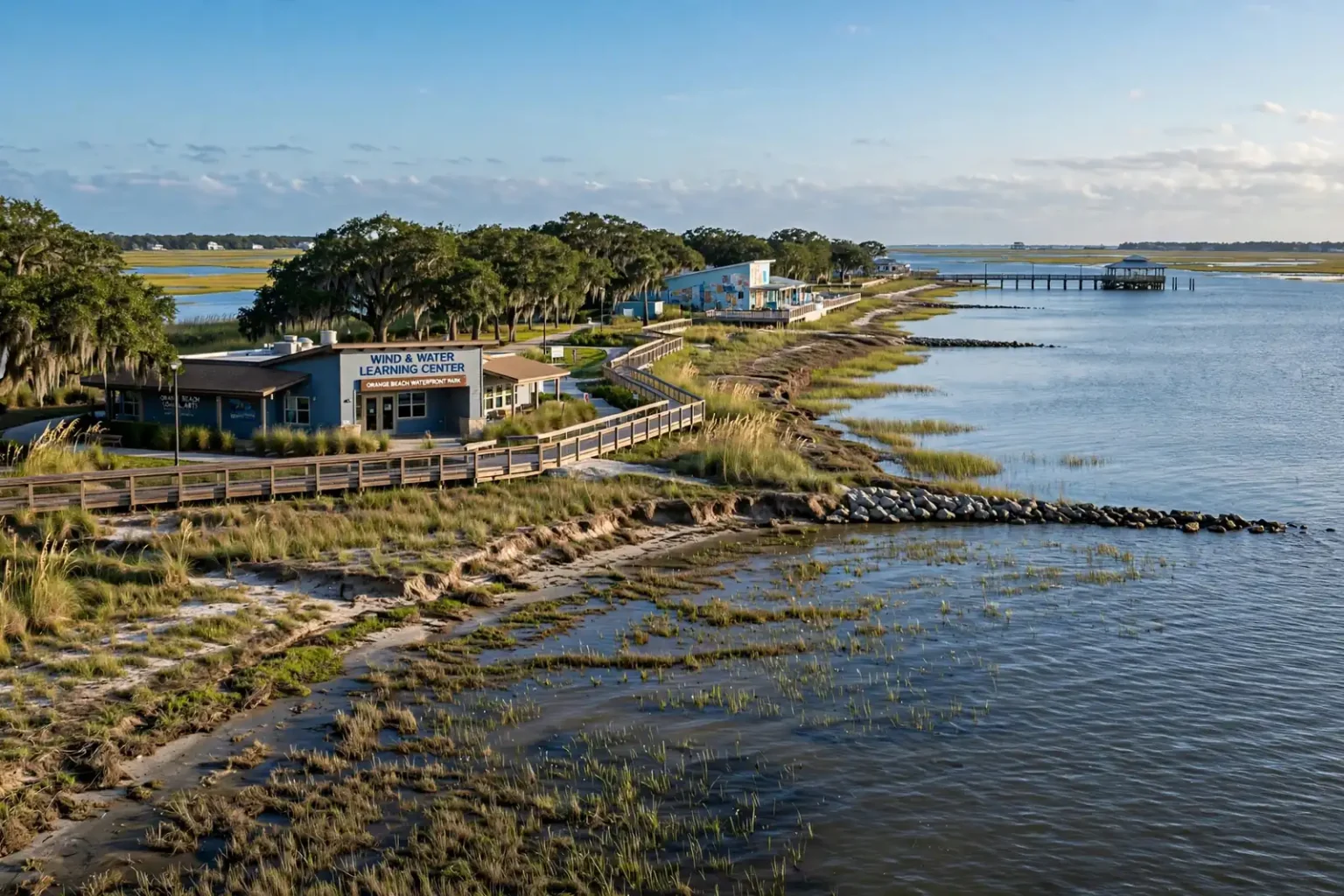
ORANGE BEACH, Ala. — A shoreline restoration project that Orange Beach leaders have talked about for more than a decade is finally headed for construction. Work to restore the eroding Wolf Bay shoreline at Orange Beach Waterfront Park is scheduled to begin in late October, the first of up to three phases designed to rebuild beach and marsh habitat, slow erosion and protect the park’s public walkway.
The Nature Conservancy, the City of Orange Beach and engineering firm Moffat & Nichol are partnering to plan and carry out the restoration. The effort builds on the restoration of Robinson and Walker Islands, which was completed last year.
Coastal Regulatory Manager Woody Speed briefed the Orange Beach City Council on the plans during an early September meeting.
Paid for with the balance of a $12.8 million federal grant
The project will be funded with the remaining balance of a $12.8 million National Oceanic and Atmospheric Administration Transformational Habitat Restoration and Coastal Resilience Grant. NOAA’s transformational habitat grants are aimed at large-scale projects that restore coastal habitat while also helping communities become more resilient to storms, flooding and erosion.
Speed told the council the Waterfront Park work has been under discussion for more than 10 years, and that recent developments have made a bigger project possible than the city once expected.
“We’re excited about it,” Speed said. “Initially, we weren’t really prepared, but things have changed, and it looks like TNC will be able to fund a longer stretch of shoreline than we originally thought.”
Phase one: the Wind and Water Learning Center shoreline
If everything falls into place, the restoration will move forward in three phases.
Phase one focuses on the shoreline in front of the Orange Beach Wind and Water Learning Center. Planned work includes:
- Beach fill to rebuild areas that have been lost to erosion
- Marsh creation using native vegetation
- Low-elevation nearshore riprap breakwaters to reduce wave energy before it reaches the shore and help prevent future erosion
Speed said phase one is fully permitted and is scheduled to begin construction in late October.
Breakwaters of this kind sit in shallow water a short distance offshore. By breaking up waves before they reach land, they create calmer water behind them, where sand can settle and newly planted marsh grasses have a chance to take root. Because they are built low, they are designed to do their job without walling off the shoreline from the bay.
Phase two: about 430 feet at the Coastal Arts Center
Phase two would cover the shoreline at the Orange Beach Coastal Arts Center and restore about 430 feet of bayfront. The design calls for:
- Marsh fill and native marsh plantings
- Rock sills
- Geotextile stabilization
- Strategically placed breakwaters
The scale of the work is significant. The plan calls for roughly 2,975 cubic yards of marsh fill, 750 cubic yards of breakwater material and more than 15,000 native plants.
The phase two design is intended to protect the park’s existing public boardwalk while improving habitat and the look of the Arts Center waterfront. A separate plan to extend the walkway is also underway.
Speed said phase two could begin before the end of 2026 or in early 2027.
Rock sills and geotextile materials are common features in what coastal engineers often call living shorelines. Rather than armoring the edge of the water with a vertical seawall, a living shoreline uses natural materials such as marsh plants, sand and oyster or rock structures to hold the shoreline in place. The plants trap sediment, the rock breaks up waves, and over time the marsh becomes habitat for fish, crabs, birds and other wildlife.
Phase three: renourishing the beach at the pier
If money remains after the second phase, Speed said a third phase would renourish the beach around the base of the Waterfront Park Pier.
Speed noted that continuous erosion along the Wolf Bay shoreline has long been a concern for the city. He added that the breakwaters and new marsh habitat are expected to improve fishing in the area, since structure in the water and healthy marsh tend to attract the small fish and shellfish that larger game fish feed on.
Water quality challenges at the park
The waters at Orange Beach Waterfront Park have faced environmental challenges in the past, including periodic swimming advisories issued by state and local agencies in conjunction with the Alabama Department of Environmental Management because of elevated bacteria levels that exceeded safety thresholds.
Most recently, in September, the Alabama Department of Public Health issued a public swimming advisory for the waters of Wolf Bay at Orange Beach Waterfront Park after two successive water quality tests found enterococci bacteria counts above the Environmental Protection Agency’s threshold of 104 organisms per 100 milliliters for marine water. A swimming advisory is a notice to the public rather than a closure, and it remains in place until routine monitoring shows bacteria counts back below the federal threshold.
Community monitoring programs, such as Mobile Baykeeper’s SWIM report, also regularly track water quality and bacteria levels in the area to help residents make informed decisions about recreation.
The restoration project is primarily focused on erosion and habitat, and officials have not said it is designed to address bacteria levels directly. Still, healthy marsh is widely recognized for its ability to filter runoff, and the restoration is part of a broader effort to improve the health of the Wolf Bay waterfront.
Council members welcome long-awaited project
Council Chairman Pro Tem Jeff Silvers said he was glad to see the project move forward after so many years.
“We’re pretty excited about those improvements,” Silvers said. Seeing it come to fruition after 10 years of talking about it, he said, is “pretty awesome.”
Building on the Robinson and Walker Islands restoration
The Waterfront Park project follows last year’s restoration of Robinson and Walker Islands, two small islands in Orange Beach waters that had been losing ground to erosion for years. That project showed how partnerships between the city, The Nature Conservancy and federal funding sources can rebuild coastal habitat on a large scale.
The Nature Conservancy has been active in coastal Alabama for years, working on projects from Bayou La Batre in Mobile County to Perdido Pass in Baldwin County. Its work along the coast has focused on restoring marshes, oyster reefs and shorelines that protect communities and support the region’s fishing and tourism economies.
Partners behind the project
The Waterfront Park restoration is made possible by the city’s partnership with The Nature Conservancy and the Pensacola and Perdido Bays Estuary Program. Moffat & Nichol is handling the engineering.
The Pensacola and Perdido Bays Estuary Program works across the watershed that drains into Pensacola Bay and Perdido Bay, including the waters along Orange Beach. Its mission centers on protecting and restoring water quality and habitat in those estuaries.
Why the Wolf Bay shoreline matters
Orange Beach Waterfront Park is one of the city’s most visible public spaces on the back bays. The park is home to the Wind and Water Learning Center, the Coastal Arts Center, a public pier and a boardwalk, and it hosts community events throughout the year. In November, for example, the park is scheduled to host Fido Fest, a dog pageant and pet market.
Erosion along the shoreline threatens more than sand. Each year of wave action can undermine walkways, expose infrastructure and wash away the shallow-water habitat that supports marine life. Restoring the shoreline with marsh, sand and low breakwaters is intended to protect both the park’s amenities and the natural resources that draw people to it.
What to expect at the park
With phase one scheduled to begin in late October, visitors to the Waterfront Park area may notice construction activity along the shoreline in front of the Wind and Water Learning Center in the coming weeks. The city has not announced specific closures tied to the work.
Here is a summary of the project as presented to the City Council:
- Location: Wolf Bay shoreline at Orange Beach Waterfront Park
- Partners: City of Orange Beach, The Nature Conservancy, Moffat & Nichol and the Pensacola and Perdido Bays Estuary Program
- Funding: Remaining balance of a $12.8 million NOAA Transformational Habitat Restoration and Coastal Resilience Grant
- Phase one: Wind and Water Learning Center shoreline; fully permitted; construction set for late October
- Phase two: About 430 feet at the Coastal Arts Center; possible start late 2026 or early 2027
- Phase three: Beach renourishment at the base of the Waterfront Park Pier, if funding remains
For a city that has watched its back-bay shoreline wear away year after year, the start of construction marks a milestone more than a decade in the making.