Swimming Advisory Issued for Wolf Bay Waters at Orange Beach Waterfront Park
The Baldwin County Health Department has issued a swimming advisory for Wolf Bay at Orange Beach Waterfront Park after bacteria levels exceeded safe limits.
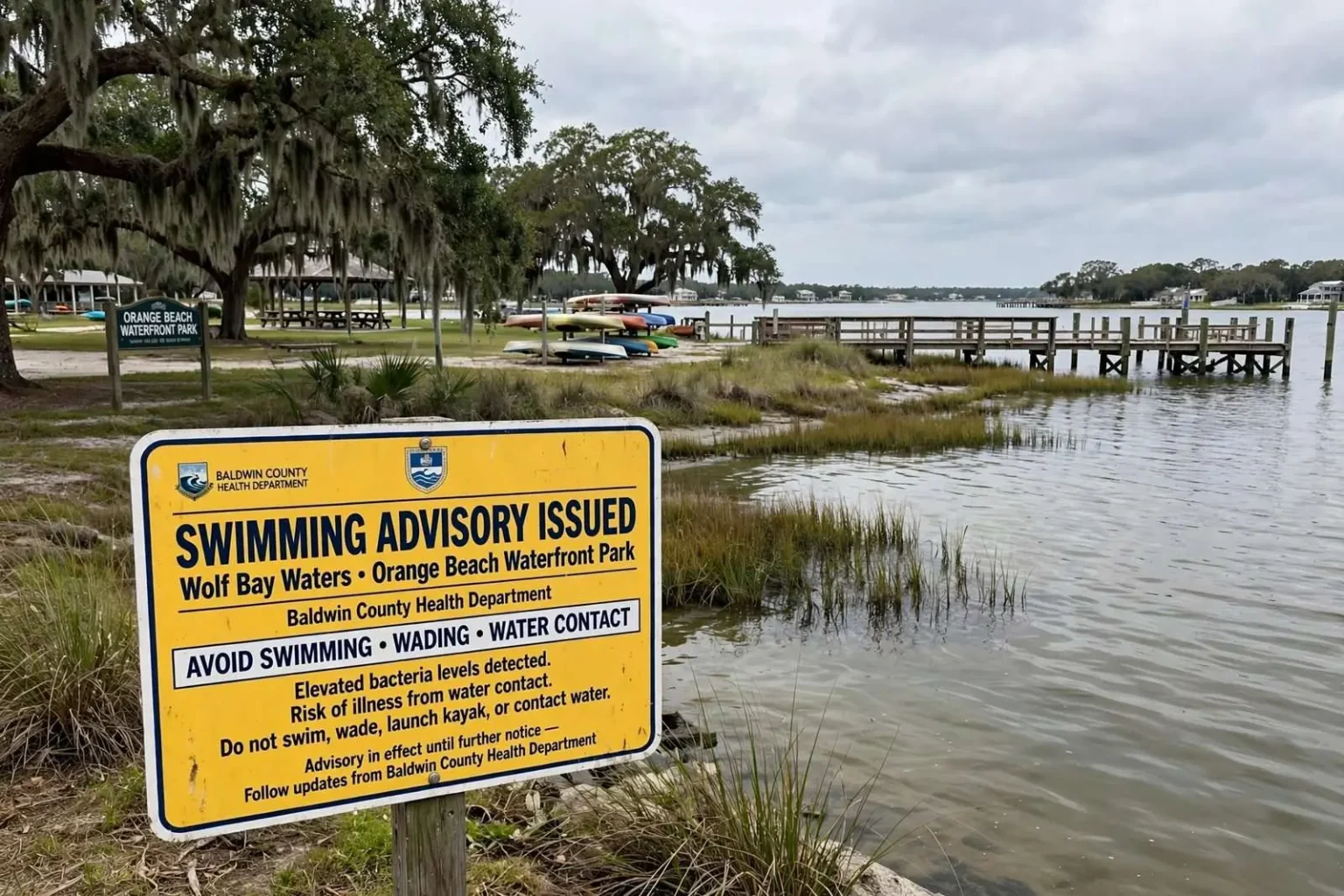
The Baldwin County Health Department has issued a swimming advisory for the waters of Wolf Bay along Orange Beach Waterfront Park after testing showed bacteria levels above what officials consider safe. The advisory applies to the water itself rather than the park’s land-side amenities, but it changes the experience for everyone who uses one of the most popular stretches of public waterfront on the western side of Orange Beach.
The health department is urging residents and visitors to avoid swimming, wading or other direct contact with the water while the advisory remains in effect. Direct contact includes the activities people rarely think of as swimming — launching a kayak, wading in with a toddler, rinsing off after fishing — because the elevated bacteria levels pose a risk of illness through the eyes, ears, nose and any open cuts.
Waterfront Park is a popular public space along the Bear Point Peninsula used for fishing, kayaking and other outdoor activities. The park sits on the shore of Wolf Bay at the end of the peninsula that separates the bay from the Intracoastal Waterway, and its piers, boat launches and picnic grounds make it a fixture of daily life for residents of the Bear Point community and a regular stop for visitors exploring the quieter side of Orange Beach away from the Gulf-front beaches.
What Officials Know So Far
Officials have not identified a specific cause for the elevated bacteria levels and have not given a timeline for when the advisory will be lifted, saying only that new water testing will determine when conditions return to safe limits. The open-ended nature of the advisory is standard practice for bacteria-related notices along the coast, since the levels respond to factors — rainfall, tides, currents, sun exposure — that change day to day and can only be tracked through repeated sampling.
Nichole Woerner with Orange Beach Coastal Resources said several factors could be contributing to the contamination, including charter boats that may be emptying tanks in the back bay and heavy localized rainfall that can cause leaky septic systems to discharge into nearby tributaries. Her comments reflect the complicated plumbing of the coastal environment around Wolf Bay, where recreational and charter vessels, older septic systems and the peninsula’s low-lying geography all intersect with a bay that exchanges water slowly with its neighbors.
She said the city is expanding its water quality testing with help from the Pensacola Perdido Bay National Estuary Program, particularly during conditions that would not typically be expected to cause a spike in bacteria. The partnership with the estuary program, which covers the connected waters of the Perdido system on both sides of the Alabama-Florida line, gives Orange Beach access to additional scientific capacity and a regional view of the water quality patterns that affect the back bays.
The expanded testing is significant for residents of the Bear Point Peninsula, whose canals and shoreline lots connect directly to Wolf Bay. By sampling during dry conditions as well as after storms, scientists can distinguish between the background variability of a coastal bay and the persistent signals that point to specific sources — the kind of distinction that ultimately guides where a community directs its infrastructure spending.
The geography of Wolf Bay plays a role in the problem. The bay sits on the western edge of Orange Beach, fed by tributaries that drain the peninsula and the surrounding lowlands, and its connection to Perdido Bay to the east and the larger coastal system is limited enough that water can sit and warm during quiet weather. Warm, poorly flushed water is precisely the condition in which bacteria levels climb and persist, which is why back-bay sites like Waterfront Park behave differently from the Gulf beaches that flush with every tide.
A Familiar Pattern on the Gulf Coast
Advisories like this one are common along Gulf Coast waterways, especially after heavy rain events. From Mobile Bay to the Florida panhandle, health departments routinely post bacteria advisories at swimming areas in the days after significant storms, when rainfall washes whatever has accumulated on streets and lawns into the nearest bayou and holds coastal systems in a temporary state of imbalance. Most advisories lift within days once sampling shows the water has cleared.
The Baldwin County Health Department monitors water quality at public access points across the county and said it will notify the public as soon as conditions improve. The monitoring program tests for enterococci, the bacteria group used as an indicator of fecal contamination in salt and brackish water, and compares results against thresholds set through federal environmental standards. When a sample exceeds the threshold, the department issues an advisory; when follow-up samples come back within limits, the advisory is rescinded and the public is notified.
The advisory system exists because swimming in contaminated water carries real health risks, most commonly gastrointestinal illness, skin infections and ear infections, with children, older adults and people with weakened immune systems most susceptible. Health officials stress that the advisories are precautionary — many people who swim during an advisory never feel any effect — but the guidance to stay out of the water is meant to remove the risk entirely until testing shows it is gone.
What Waterfront Park Users Should Know
For the time being, the park’s land-side uses remain unaffected. Fishing from the pier is still permitted, though anglers are reminded to wash their hands before eating and to keep any open wounds covered. Kayakers and boaters can still launch, with the sensible precaution of avoiding unnecessary water contact. The advisory changes the swimming and wading experience, not the park itself.
Residents with questions can contact the health department at 251-947-1910 or check the ADEM/ADPH Coastal Alabama Beach Monitoring Program’s website for updates. The monitoring program’s site lists current advisories and recent test results for coastal sampling stations across Alabama, allowing residents and visitors to check conditions at Wolf Bay and other public access points before heading out.
The Wolf Bay advisory also lands amid a broader conversation about water quality in Alabama’s coastal back bays, where rapid development along the peninsulas has put pressure on aging septic infrastructure and on the shallow waters that receive the runoff. Cities like Orange Beach have invested in testing and education in response, and officials say the combination of monitoring data and public awareness is the community’s best tool for protecting the waters that define life on the peninsula.
Until testing shows Wolf Bay’s bacteria levels back within safe limits, the health department’s message to swimmers is simple: enjoy the park, enjoy the bay from a boat or a pier, but stay out of the water — and check back for updates as new results come in.
The Bigger Picture for Wolf Bay
Wolf Bay occupies a special place in Orange Beach life. Generations of local families have fished its grass flats for speckled trout and redfish, paddled its quiet shoreline, and built homes along its banks in the settlement pattern that made the Bear Point Peninsula one of the city’s oldest communities. The bay’s health is therefore not an abstraction to the people who live around it — it is the water they look at every day, launch their boats into and teach their children to fish on.
Local environmental organizations have long made the bay’s protection a priority, monitoring water quality and advocating for the tributaries and wetlands that feed the system. Wetlands along the bay’s fringe act as natural filters, trapping sediment and absorbing nutrients before they reach open water, which is why conservation of those margins is often cited alongside infrastructure work as part of the long-term answer to bacteria problems.
The charter-boat factor Woerner mentioned points to another piece of the puzzle: the etiquette and infrastructure of vessel waste disposal. Recreational and charter vessels are supposed to discharge at pump-out facilities rather than in enclosed waters, and the availability and use of those facilities around the back bays directly affects bacteria levels in poorly flushed water. Cities along the coast have worked to expand pump-out access and educate boaters, and officials say continued vigilance on the water is part of keeping the back bays swimmable.
Staying Informed
Residents who want to track the advisory’s progress have straightforward options. The beach monitoring website updates as new samples are analyzed, typically on a regular testing cycle, and the health department’s phone line can answer questions about specific activities and the science behind the advisory. Orange Beach Coastal Resources also shares water quality information through the city’s channels, giving peninsula residents a local source for the expanded testing results as they come in.
The advisory will remain in place until two consecutive rounds of clean samples show the water is back within safe limits, the standard practice for rescinding bacteria advisories. In the meantime, officials ask the public to treat the notice as seriously as it is intended — a temporary, precautionary measure aimed at keeping the people who love Wolf Bay healthy until the bay itself says otherwise.