University of South Alabama Mobile
New Mobile Bankruptcy Judge Sworn In After Decades Representing Creditors
Henry Callaway was formally sworn in as Mobile's newest federal bankruptcy judge, bringing decades of experience representing both creditors and struggling families.
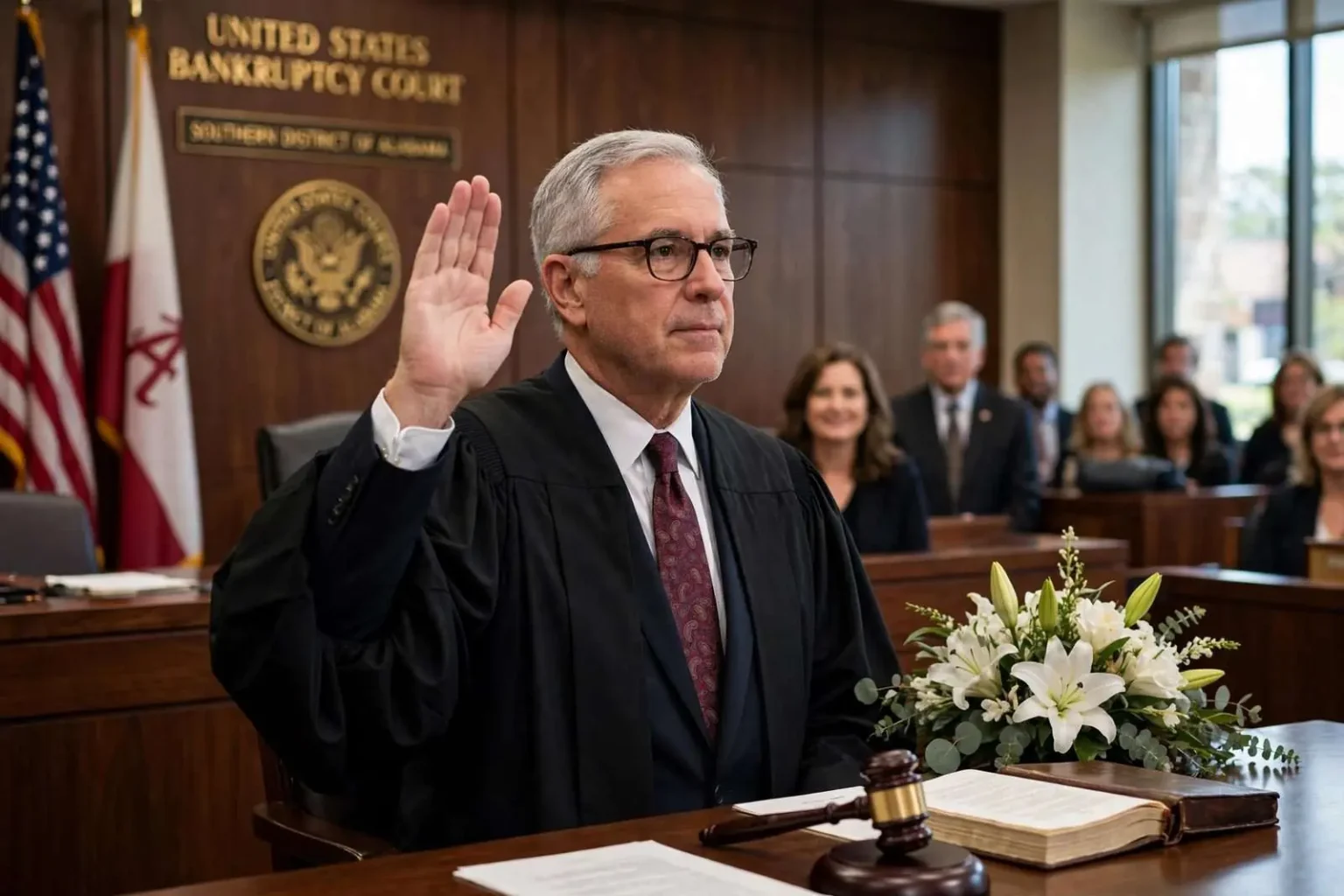
Mobile attorney Henry Callaway was formally sworn in Thursday as the city’s newest federal bankruptcy judge, capping a legal career that colleagues say has been defined as much by compassion as by courtroom skill. Although Thursday marked his ceremonial investiture, Callaway had already been on the job since May 1, having replaced retiring Bankruptcy Judge Margaret A. Mahoney. The investiture filled the courtroom with the people who have known his work longest — judges, family members and the bar of a city where Callaway has practiced for decades — and it gave the Southern District of Alabama’s bankruptcy bench a moment to mark a transition it had been living since the spring.
Appointed by the 11th U.S. Circuit Court of Appeals, Callaway will serve a 14-year term earning $185,012 annually. When Judge William Shulman retires on June 1, Callaway is expected to become the court’s chief judge, overseeing bankruptcy cases across the southwestern counties of Alabama. The sequence makes for an unusual first year: new to the bench, then chief within a month, at a court that will briefly run with a reduced bench before it is whole again. Bankruptcy Clerk Chip Maldonado said Shulman is expected to continue working through September, after which Callaway may serve as the sole judge for several months until a replacement is appointed. The prospect of a one-judge bankruptcy court in a district covering Mobile and the surrounding counties underscores how thin the region’s federal judicial coverage can run, and how much rides on the transition going smoothly.
Speaking before a courtroom packed with fellow judges, family members and attorneys, Callaway reflected on his decades spent representing creditors in bankruptcy proceedings, while also noting his extensive pro bono work representing people facing financial hardship. “I know how fine the line is between financial survival and financial disaster for many Alabamians,” he told the gathering. The line he described is the one he will administer daily: bankruptcy court is where the stories of crushed small businesses, medical debts and failed marriages arrive in the cold language of schedules and claims, and a judge who has seen both sides of that line — creditor and debtor — brings a perspective the bar says will serve the district well.
Character testimony
Mobile County Circuit Judge Sarah Stewart offered a personal anecdote to illustrate Callaway’s character during the ceremony, describing how, years earlier, Callaway had informally stepped in as guardian for a young boy whose only useful piece of information for authorities was that he was a Boy Scout whose troop leader was “Mr. Henry.” Callaway took the child into his home until a permanent arrangement could be made. Stewart noted that the child now works part time for the University of South Alabama football team. The story drew the kind of silence a courtroom gives to the unexpected: the measure of a man taken not from a résumé but from a child’s description of his scout leader.
Stewart said Callaway possesses the intelligence and temperament essential for the bench, adding that in all the roles she has seen him in, “I have never seen him lose his temper or even raise his voice.” For a court that spends its days presiding over people in the worst financial moments of their lives, temperament is not a courtesy — it is the working instrument. Debtors facing foreclosure, business owners winding down a lifetime of work and creditors pursuing lawful claims all appear before the same chair, and the tone set from it shapes how the system feels to everyone in the room.
Callaway, 56, began practicing law at Hand Arendall in 1983 after graduating from Harvard University and earning his law degree from Vanderbilt University. His career has included representing William Ziegler in a successful effort to overturn a death penalty conviction, an unsuccessful attempt to block a new area code from taking effect in Mobile in 1995, and representation of Waste Management in a 1994 dispute with the city of Prichard. The range is striking even by the standards of a general-practice commercial bar — capital post-conviction work, administrative fights with BellSouth over a 251 area code, and municipal contract litigation — and it reflects a lawyer whom courts and clients alike trusted with matters that could not be handed off.
The ceremonial investiture also served, in effect, as a public accounting of Mahoney’s departure and the court’s near future. Mahoney, whose retirement opened the seat Callaway now fills, presided over the district’s bankruptcy docket through years that included the recession’s tidal wave of consumer filings and the slow rebuilding after. Transitions between bankruptcy judges are infrequent — a 14-year term means a district can go more than a decade between openings — and the Mobile bar treats them as generational events, which is why Thursday’s gallery held so much of the city’s legal establishment in one room.
The overlap of the three judgeships in a single summer — Mahoney retired, Shulman retiring June 1, Callaway new — compresses into a few months what the court usually absorbs gradually. Maldonado’s outline of the staffing math made the challenge plain: two judges through May, one active judge plus a working retiree through September, and then potentially Callaway alone for an unknown interval until the circuit court fills the vacancy. Bankruptcy courts nationwide have learned to cross-assign judges from neighboring districts during such gaps, and local practitioners expect the 11th Circuit to do the same if Mobile’s docket demands it.
For residents of southwestern Alabama who have never set foot in a federal courthouse, the change still touches lives they know. Bankruptcy court is where the local restaurant’s closure is finalized, where the hospital bill is discharged, where the family farm is reorganized, and where the wage earner’s plan either saves a house or does not. The person sitting in the judge’s chair shapes those outcomes case by case, and Callaway’s investiture remarks — the fine line between survival and disaster — suggested he intends to remember that when the schedules and exhibits make it easy to forget.
He has been active with the Mobile Bar Association’s Volunteer Lawyers Program since its founding in 1989, and in 2006 received the association’s Liberty Bell Award, which honors a local citizen’s efforts to promote understanding of the U.S. Constitution. He was also a nominee for Mobilian of the Year in 2007. The Volunteer Lawyers Program pairs private attorneys with clients who could never pay for representation, and founding involvement in 1989 — followed by decades of continuing service — marks Callaway as one of those lawyers whose pro bono work is a career rather than a line item. The Liberty Bell Award placed that work on the public record; the boy who once identified himself only as a scout of “Mr. Henry” placed it on a more personal one.
Callaway said becoming a judge was never a lifelong ambition, but that bankruptcy law had always appealed to him because, unlike many other areas of law, “it usually makes sense.” It is a characteristic observation from a practitioner known for plain speaking, and it captures the quiet logic of the field: bankruptcy law is the legal system’s attempt to impose fairness and order on the aftermath of failure, a process governed by rules that can actually be explained to the people living through them. Lawyers who love the field tend to describe it the way Callaway does — not as a specialty but as a calling adjacent to public service.
What the transition means for the district
The court Callaway joins handles the bankruptcy caseload for Alabama’s southwestern counties, a docket that moves with the region’s economy. When the economy tightens, filings climb; when the port and the petrochemical and aerospace sectors hire, consumer cases recede and complex business reorganizations take their place. A chief judge must manage that ebb and flow with a bench that is about to run short-handed, prioritizing cases and stretching calendars until a successor is confirmed — a task that will fall to Callaway almost immediately after his investiture flowers fade.
The appointment process itself is worth noting for local readers. Bankruptcy judges are not nominated by presidents or confirmed by the Senate; they are appointed to 14-year terms by the judges of the federal circuit court of appeals, which for Mobile means the 11th Circuit in Atlanta. The selection emphasizes judicial administration and bankruptcy expertise over political profile, and it gives the circuit court of appeals — the body Callaway’s court answers to on appeals of its own rulings — the responsibility of choosing the person who will run the district’s bankruptcy docket through 14 years of economic cycles.
For the lawyers who practice before him, Thursday’s ceremony was also a valediction of sorts for a colleague they have known as opposing counsel, co-counsel, bar leader and friend. The anecdotes from the investiture — the boy with the scout troop, the temper that has never flared, the line between survival and disaster — will now be tested daily in a courtroom on St. Louis Street where Callaway takes the chair that Mahoney held and Shulman passes on. By all accounts from the people who filled that courtroom, the court is getting what the bar has known for years: a judge who understands the law and, more rarely, the people it falls upon.