Baldwin County Jury Views Arrest Video in Fatal Gulf Shores Crash Trial
A Baldwin County jury viewed police video in the manslaughter trial over a fatal Spring Break crash that killed a college student in Gulf Shores.
Jurors in Baldwin County heard graphic details this week in the manslaughter trial of a Montgomery man accused of striking and killing a 19-year-old college student with his truck during a Spring Break trip to Gulf Shores in March 2014. The case, which has drawn attention across the Alabama Gulf Coast, returned this week to the hours surrounding the crash itself, with prosecutors walking jurors through video and physical evidence gathered in the minutes and hours after the collision.
Prosecutors allege that Justin Lott, 30, was driving through the 1400 block of West Beach Boulevard in the early morning hours when his truck struck Kasey Waychoff, a 19-year-old Oklahoma State University student who was walking back to her condominium with sorority sisters on the final night of their trip. Lott is accused of leaving the scene before he was later located and arrested. He faces charges including manslaughter and leaving the scene of an accident causing injury or death.
West Beach Boulevard, the stretch of coastal highway where the crash occurred, carries a mix of condominiums, rental properties and through traffic along the Gulf Shores beachfront. On Spring Break nights, the corridor fills with pedestrians walking between rentals and restaurants, a combination of foot traffic and late-night driving that residents and city officials have long recognized as one of the area’s persistent safety challenges.
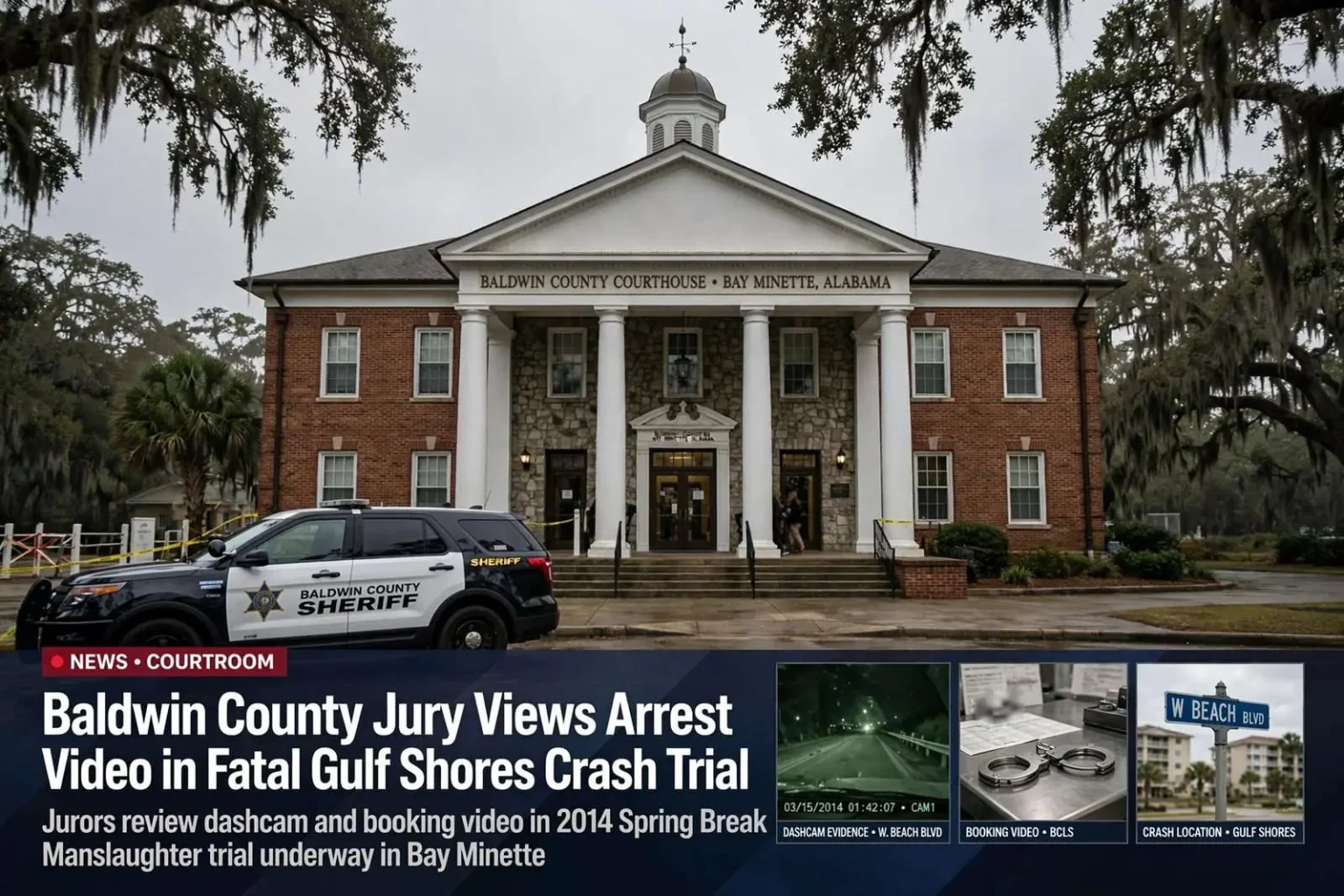
Dashcam and booking video shown to jurors
Testimony this week focused on the hours surrounding the crash, including a bachelor party Lott had attended in Orange Beach earlier that night. Prosecutors used the party and the drive that followed to build the timeline they say connects Lott’s vehicle to the collision and to the decision, alleged in the charges, to leave the scene afterward.
Jurors were shown police dashcam and booking video documenting Lott’s arrest by a Baldwin County Sheriff’s deputy, his transport to the Gulf Shores Police Department, and the time he spent there before being formally booked. The recordings have become the centerpiece of this week’s testimony, offering jurors an unedited record of Lott’s condition and statements in the hours after the crash.
In the recordings, Lott can reportedly be heard reacting to the crash while sitting handcuffed in the back of the patrol car, at one point saying he understood he had hit someone and that his life had changed as a result. Those statements, captured on video before any formal questioning began, are likely to figure prominently in both sides’ arguments as the trial progresses.
Sobriety tests and a declined breathalyzer
The deputy who conducted the traffic stop testified that he detected a strong odor of alcohol coming from Lott during the stop and that Lott struggled to complete standard field sobriety tests, including walking heel-to-toe and balancing on one leg. The tests, which officers across Alabama use to evaluate impairment on the roadside, formed the basis of the deputy’s decision to take Lott into custody on suspicion of DUI.
Lott was arrested on suspicion of DUI at the scene and later declined to take a breathalyzer test at the police station, according to testimony. Under Alabama law, refusing a chemical test carries administrative consequences for a driver’s license independent of any criminal charge, and prosecutors and defense attorneys typically frame such refusals differently — one as an attempt to hide evidence, the other as a constitutional right the defendant was entitled to exercise.
Investigators also documented the condition of Lott’s truck following the crash, noting open containers and other evidence inside the vehicle consistent with the events of that night. Photographs and video of the vehicle were entered into evidence during the proceedings, giving jurors a detailed look at the truck and its interior as it was found after the arrest.
Building the timeline of the final night
Earlier testimony in the trial focused on Waychoff’s activities and those of her sorority sisters in the hours leading up to the crash, as prosecutors worked to establish a timeline of the night’s events for jurors. The timeline stretches from the group’s evening activities through the walk back to their condominium — a walk that, in the early morning darkness along West Beach Boulevard, ended in the collision at the center of the case.
Waychoff, an Oklahoma State University student, had traveled to Gulf Shores with sorority sisters for Spring Break, an annual migration that brings thousands of college students to Alabama’s beaches each March. Her death stunned the campus community in Stillwater and the Gulf Shores community alike, and members of both have followed the case through its long path toward trial.
The trial, held in Baldwin County, was expected to continue with additional testimony in the days following the video evidence presentation. Attorneys on both sides are expected to work through the sequence of the stop, the arrest and the processing at the Gulf Shores Police Department as the case moves toward closing arguments and deliberation.
A case that resonates on the coast
The case drew significant attention along the Alabama Gulf Coast, where Spring Break traffic and late-night driving incidents involving impaired motorists remain a persistent public safety concern for coastal communities such as Gulf Shores and Orange Beach. The Baldwin County District Attorney’s Office has made the prosecution a priority, and the trial’s progress has been closely watched by families and residents who remember the aftermath of the crash.
Local law enforcement agencies in Baldwin County have repeatedly emphasized DUI enforcement during peak tourist seasons in response to incidents like this one. Increased patrols, checkpoints and coordination between municipal departments and the sheriff’s office are standard practice during spring and summer weekends, when the population of the beach communities swells far beyond its year-round base.
The manslaughter charge Lott faces carries the possibility of a lengthy prison sentence under Alabama law, and the leaving-the-scene charge adds a separate count tied to his alleged conduct after the crash. As the trial continues, jurors will weigh the video evidence, the testimony of the arresting deputy and the physical evidence from the truck against the defense’s account of the night.
For now, the case remains where it has been for much of the past year — in a Baldwin County courtroom, with a jury sorting through the details of a Spring Break night that ended in the death of a 19-year-old college student far from her Oklahoma home.
Under Alabama law, manslaughter differs from murder in that it involves the death of another person committed recklessly or under circumstances where the defendant causes death while driving under the influence — a definition that matches the theory prosecutors have laid out in this case. The distinction matters at sentencing, where manslaughter carries a maximum prison term measured in decades rather than the potential life sentences attached to murder convictions.
The leaving-the-scene charge stands on its own. Alabama requires drivers involved in crashes that cause injury or death to remain at the scene, provide information and render aid, and prosecutors argue that the decision to drive away after striking a pedestrian compounds the underlying offense. The arrest that followed, located by deputies after Lott had left the area, forms part of the record jurors have now seen on video.
The Baldwin County courtroom setting
The trial is being held in the Baldwin County court system, which handles the county’s most serious felony matters at the county courthouse in Bay Minette. Cases moved from the coastal municipalities to the county level follow that path because felony prosecutions in Alabama are handled by the district attorney’s office rather than municipal prosecutors, and because grand juries review the evidence before any felony case proceeds to trial.
By the time a case like this one reaches a jury, more than a year has typically passed since the arrest — time filled with the grand jury review, defense motion practice, evidence disputes and scheduling. Each side in the Lott trial has spent that time preparing its account of the March 2014 crash, and this week’s video presentations marked the point at which jurors finally saw the night unfold for themselves.
Spring Break and the coast’s safety challenge
The crash occurred at a moment of peak Spring Break activity in Gulf Shores, when college students from across the region fill the beach rentals and the roads that serve them. City officials in Gulf Shores and Orange Beach have spent years adjusting to that seasonal wave, adding patrols, adjusting traffic patterns and publicizing pedestrian safety rules along the beach highway corridors.
West Beach Boulevard, where Waychoff was struck, is one of those corridors. Lined with condominiums and vacation rentals, it funnels both local and visitor traffic along the shore, and on busy nights pedestrians cross and walk along it between destinations. The combination is manageable most nights, but a single impaired driver in the wrong place turns the ordinary into a tragedy, which is the lesson local officials say cases like this one keep teaching.
For Waychoff’s sorority sisters, who were walking with her when the crash happened, the trial has meant reliving the final night of a trip that was meant to be a celebration. Their testimony about the evening’s timeline — where the group went, when they left, and what they saw — forms part of the record prosecutors assembled, and their presence in the courtroom has underscored the human stakes behind the charges.
As the trial continues in the days ahead, the focus will shift from the hours after the crash to the arguments over what those hours mean. The jury’s eventual verdict will close one chapter in a case that has already left its mark on two communities — one in Montgomery, one in Stillwater, Oklahoma, and one on the Alabama coast where the crash occurred.