South Baldwin County Officials Weigh Next Steps on New Regional Jail
A completed feasibility study shows south Baldwin County needs a new regional jail, with officials from Foley, Gulf Shores and Orange Beach reviewing options.
A long-awaited feasibility study examining whether south Baldwin County needs its own jail facility has been completed and delivered to police leadership in Gulf Shores, Orange Beach and Foley, setting the stage for local governments to weigh their next steps. The study, conducted by an Ohio-based consulting firm, cost roughly $15,000, an expense split among the four government entities involved: the Baldwin County Sheriff’s Office and the cities of Gulf Shores, Orange Beach and Foley.
Baldwin County Sheriff Huey “Hoss” Mack said the completed report should become public within the next month or two, once he meets with area police chiefs to discuss its findings. According to Mack, the study confirms there is a genuine need for additional jail capacity in the county’s southern half and finds that consolidating booking and holding operations among the four entities is a viable path forward.
The cooperation itself is noteworthy. Baldwin County’s beach cities are fierce municipal competitors in tourism and development, but law enforcement operates under different math: inmates generated in Gulf Shores, Orange Beach and Foley all funnel to the same county facility, and every government involved pays in officer-hours for the trip. A joint study is the cheapest way to establish whether that arrangement still makes sense.
What the Study Found
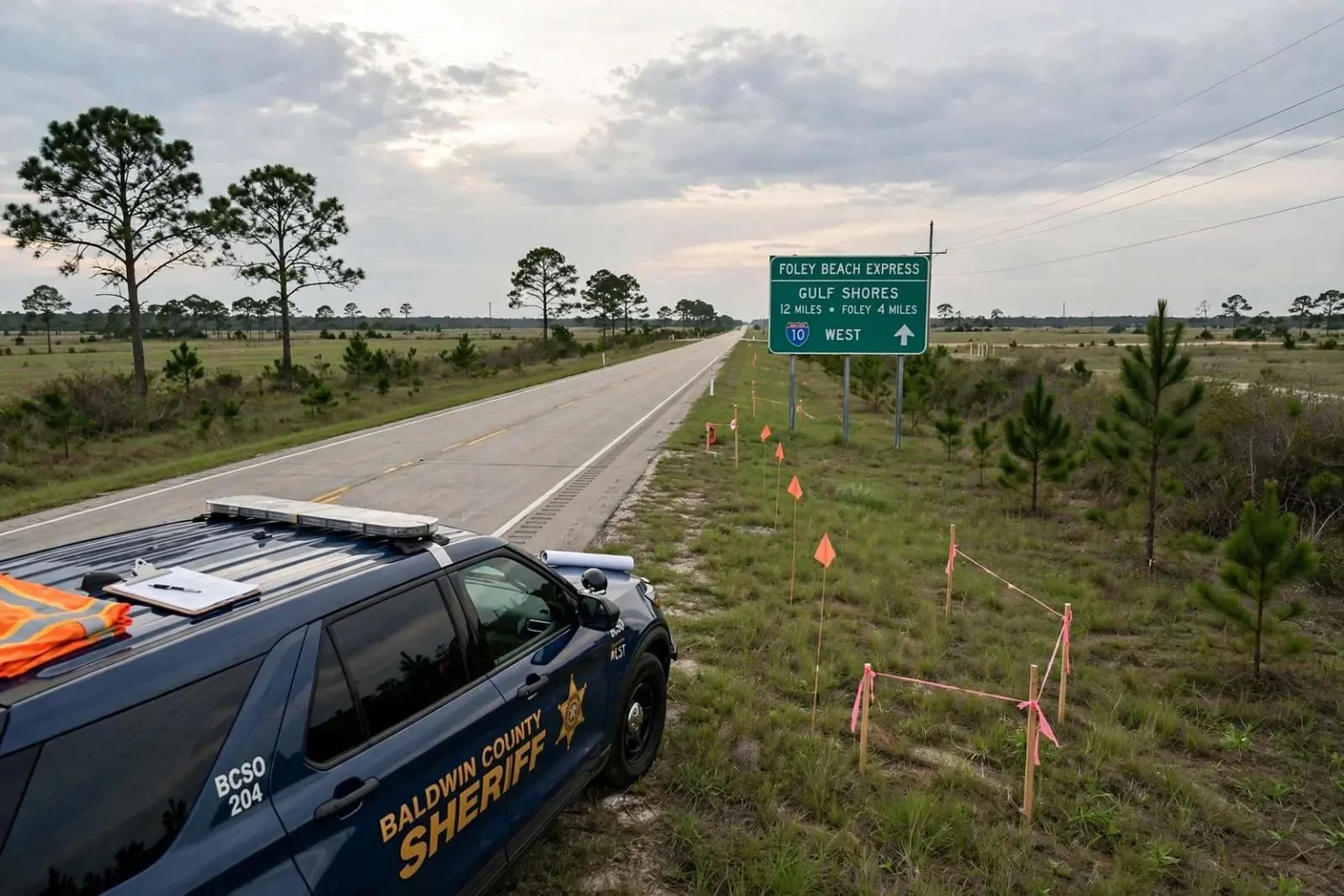
The report identifies a potential site somewhere in the area spanning south Foley and north Gulf Shores, near the Foley Beach Express corridor. Estimated construction costs range broadly from roughly $30 million to $50 million, a spread Mack attributed to whether the facility is built out fully from the start or expanded in phases. He said the recommended minimum size is a 100-bed facility, though the fuller vision calls for capacity exceeding 200 beds to keep pace with growth along the county’s southern coastline.
The Beach Express corridor has become the natural answer to questions like this one. The toll-and-free highway route, built to connect the beach cities directly to Interstate 10, opened up a band of rural land that is close to both the coast and the interstate, commercially zoned in stretches, and large enough for a secure campus. Sitting the facility between Foley and Gulf Shores puts it within a short drive of the three cities whose officers would use it most, while remaining accessible to sheriff’s deputies patrolling the county’s southern half.
The cost spread also reflects a familiar dilemma in public construction. Building 200 beds up front costs more on day one but avoids the disruption and expense of expanding an operating jail later. Phasing keeps the initial appropriation smaller — a real consideration for cities that would share the bill — but risks the same capacity crunch recurring as Baldwin’s coastal population and visitor counts keep climbing.
Orange Beach Mayor Tony Kennon said pooling resources across the involved cities and the county should create efficiencies that benefit taxpayers, and Mack noted federal funding could also help offset costs. Federal justice-assistance grants have historically supported regional detention projects of this kind, and a multi-agency facility is precisely the sort of shared infrastructure such programs were designed to encourage.
Why the Current System Is Strained
The push for a new facility stems largely from strain on existing infrastructure. The Baldwin County Corrections Center in Bay Minette is rated for up to 700 inmates but currently operates with about 650 beds. Each coastal city also runs its own smaller jail for non-felony offenders, with Foley’s 55-cell facility the largest of the three. Gulf Shores’ jail, more than 40 years old, is particularly ill-suited to handle the surge in arrests that accompanies Spring Break and peak tourist season.
Baldwin County’s growth is the backdrop for all of it. The county has ranked among the fastest-growing in Alabama for years, and its southern tier — the beach cities and the communities feeding them — absorbs much of that expansion along with a tourist population that swells the streets on summer weekends, holidays and Spring Break. Jail capacity that seemed adequate when the facilities were built now runs against a population that has multiplied since.
The mismatch between a 40-year-old city jail and a modern Spring Break crowd illustrates the problem concretely. Gulf Shores’ population multiplies several times over during peak weekends, and the arrests that come with it — alcohol-related offenses, disorderly conduct, traffic and theft cases — are overwhelmingly short-stay bookings. A small, aging facility built for a quieter era cannot flex to meet that surge, which is why municipal chiefs have been pushing the countywide conversation.
The county’s main jail faces the opposite pressure: a facility operating near its rated capacity has no slack for the transfers, holds and special-population separations that jails must manage daily. Operating at roughly 650 beds against a 700-inmate rating leaves little margin, and state requirements for housing classifications mean that a jail can be short on a specific kind of bed even when it has vacancies overall.
The Transportation Problem
Transportation logistics remain a significant driver behind the proposal. Gulf Shores Mayor Robert Craft said the roughly hour-long drive required to transport inmates to Bay Minette currently pulls an officer and patrol car off the street during peak tourist periods when staffing is already stretched thin.
The math is unforgiving for a beach-city police department. Every arrest made in Gulf Shores or Orange Beach during a busy weekend costs a round trip of roughly two hours of officer time plus booking time at the receiving facility. During Spring Break weeks, when the streets need every patrol unit they can field, those trips function as a hidden tax on public safety — one paid not in dollars but in patrols that never run.
Bay Minette, the county seat, sits in the northern reaches of a county that stretches some 60 miles from the state line down to the Gulf. The geography that made a single central jail sensible decades ago has become a burden as the county’s population and arrests have shifted decisively south. Mack said roughly 80 percent of arrests countywide involve people living south of Interstate 10, meaning a south Baldwin facility could handle the bulk of local bookings and relieve pressure on the Bay Minette facility.
That statistic reframes the debate from convenience to allocation. If four of every five arrests originate below I-10, the county is running a detention system pointed opposite from where its workload sits. A southern facility would not replace the Bay Minette center — the county would still need major capacity in the north — but it would rebalance a system whose geography no longer matches its demand.
He also raised the possibility of relocating the county’s community corrections work-release program, which places select inmates in jobs mostly located south of I-10, to a new southern site. Work-release programs depend on daily transportation between the facility and employers, and housing work-release inmates an hour from the businesses that employ them burns resources that a southern location would recapture.
A Corridor That Fits
Officials see the Foley Beach Express corridor as a relatively uncontroversial site, given its rural, commercially zoned character and its direct connection to the beach cities and Interstate 10. Siting a jail is among the hardest tasks in local government — residential neighbors object reliably — and a commercially zoned stretch of highway corridor near the population it serves is about as favorable as the geography offers. The route also gives transport officers a straight shot to I-10 for prisoner transfers to state facilities.
The corridor’s development pattern makes the proposal practical in another way. Land along the Beach Express remains available in parcels large enough for a secure compound with parking, sally ports and expansion room, unlike the beach cities themselves where buildable land is scarce and expensive. Building near — rather than inside — the communities generating the inmates balances proximity against the realities of a jail’s presence.
What Happens Next
No formal decision on funding, design or a construction timeline has been made, but officials say the completed study gives the four governments a concrete basis for negotiating a path toward a shared regional facility. The sequence from here is familiar in intergovernmental projects: the chiefs and the sheriff review the findings, the councils and county commission weigh the cost split, and the public gets its look at a report that so far has circulated among the officials who paid for it.
Financing will be the decisive question. A $30 million to $50 million facility shared by a county commission and three beach cities requires an interlocal agreement that specifies each party’s share, its bed allocation and its obligations over decades of operation. Such agreements are routine in Baldwin County’s fastest-growing corners — the beach cities already share infrastructure ventures — but jail financing carries the added weight of long-term staffing costs that will outlast the construction bonds.
The alternative scenarios sharpen the argument. Without a shared southern facility, the coastal cities would eventually face individual jail upgrades — Gulf Shores’ aging facility chief among them — and the county would face expanding Bay Minette into a system where most inmates arrive from an hour south. Multiple smaller projects cost more in combination than one regional facility and solve the transportation problem not at all.
For south Baldwin County residents, the study marks the moment a years-long conversation moved from talk to groundwork. The findings — a documented need, a viable site, a cost range and a recommended size — give the four governments everything a serious negotiation requires. What remains is the political work: agreeing on how to divide a $30 million to $50 million project so that every party pays in proportion to what it saves, and getting a facility sited and built before the growth that inspired it outruns the county’s capacity to house the people its officers arrest.