Baldwin County Commission Approves Raises for Top Appointed Directors
Baldwin County commissioners approved 3.5 to 4 percent raises for eight appointed directors after Sheriff Hoss Mack raised questions.
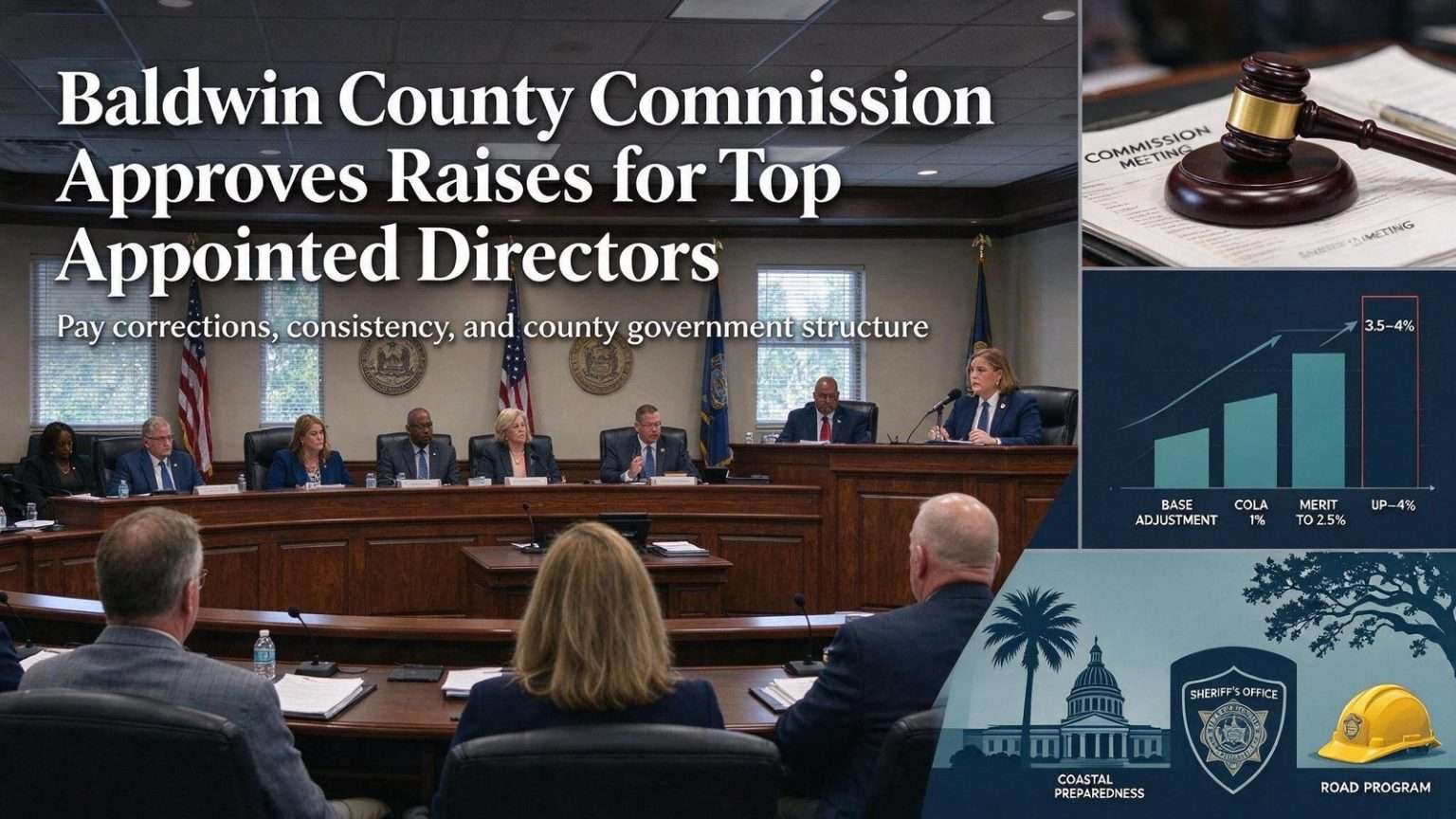
The Baldwin County Commission approved pay raises this week for eight appointed county directors, a move that prompted Sheriff Huey “Hoss” Mack to ask commissioners to keep his office better informed on how personnel compensation decisions are made going forward. The discussion, held during the commission’s regular meeting in Bay Minette, laid bare the delicate balance county governments strike between correcting long-standing pay disparities and maintaining consistency across departments that answer to different elected and appointed officials.
Mack told commissioners during the meeting that he understood the county was operating under a plan calling for a 1 percent cost-of-living increase along with merit raises of up to 2.5 percent for the fiscal year that began Oct. 1. He noted that his own department includes seven employees outside the county’s merit system whose pay he adjusts directly as head of the roughly 300-employee Sheriff’s Office, one of the largest law enforcement agencies on the Gulf Coast, responsible for patrolling the unincorporated county, operating the county jail and providing court security across a jurisdiction that has grown into one of Alabama’s fastest-losing-that-description counties.
Mack said he was not objecting to the raises given to the appointed directors, calling them highly qualified, but said the Sheriff’s Office has traditionally tried to mirror commission pay decisions to maintain consistency across county government. Because the sheriff is an independently elected constitutional officer, his personnel decisions do not flow through the commission’s merit process, and he told commissioners that keeping the two systems aligned has been a deliberate practice of his administration, one that becomes harder when director-level salaries move sharply outside the standard plan.
What the raises look like
The commission-approved raises, which ranged from 3.5 to 4 percent, came after base salaries for several directors were adjusted upward to correct years of underpayment relative to peers, with final amounts also reflecting each commissioner’s evaluation of job performance. The two-step approach — fixing the base first, then applying the percentage increase — accounts for the variations in the final figures, and commissioners debated each adjustment individually rather than approving a single blanket number.
Among those receiving raises were Budget Director Ron Cink, whose pay rose 4 percent to $93,570, with an additional stipend while he continues serving as interim county administrator; Building Official Michael Howell, whose base pay was raised before his salary increased 3.8 percent to $93,447; and Personnel Director Andrea Rider, who saw a 3.9 percent increase to $93,534 after her base pay was adjusted to reflect her interim director duties over the past four years. Rider’s case illustrated the underlying problem the commission was trying to correct: an employee performing director-level work for years without the corresponding title or compensation.
Solid Waste Director Terri Graham received a 3.5 percent increase to $93,179 after her base salary was corrected from an outdated pay schedule. Clerk/Treasurer Kim Creech’s salary rose 4 percent to $101,900, while EMA Director Mitchell Sims and CIS Director Brian Peacock each saw increases of 3.8 percent, bringing their salaries to $98,629 and $101,684 respectively. Juvenile Detention Center Director Jennifer Lee received a 3.5 percent raise to $95,248. Each of those offices carries a distinct mandate — from the clerk’s stewardship of county finances and records to the EMA director’s command of storm preparedness in a coastal county where hurricane season is an annual operational test.
The county engineer question
County Engineer Cal Markert’s salary was not addressed during the meeting, an omission that drew attention given the scale of the department he leads. Baldwin County’s road program is one of the largest county operations in Alabama, and the engineer’s office oversees the design, resurfacing and maintenance of hundreds of miles of roads — a workload that has grown with the county’s explosive residential growth and the bridge and drainage demands that come with it.
Commissioner Frank Burt Jr. said he wants Markert to receive a larger increase than originally proposed and asked to delay the vote until the commission’s Dec. 16 meeting, since Commissioner Chris Elliott was absent while attending a new county officials training session in Montgomery. The delay reflected the commission’s preference for full membership on salary votes, and it left Markert’s adjustment in limbo until the following session, when commissioners will return to the question of how to price the county’s top engineering post in a labor market where public-sector engineers compete with private firms along the entire Gulf Coast.
Commission Chairman Charles “Skip” Gruber said he was open to reviewing salaries within the Sheriff’s Department going forward, a commitment that appeared to satisfy Mack’s central request. Gruber has led the commission through a period of rapid change in Baldwin County, where population growth has strained roads, schools and public safety budgets alike, and the chairman’s willingness to open the sheriff’s salary review suggested the two offices intend to close the gap between merit-system and non-merit pay decisions rather than let it widen.
The director raises themselves take effect under the fiscal year that began Oct. 1, folding into a county budget that must fund services for a population that has swelled for two decades straight. For the directors themselves, the adjustments close a chapter of catching up; for the commission, they open the harder question of how to keep every county salary, from the sheriff’s office to the road department, tied to a consistent and defensible standard.
How Baldwin County government is organized
The structure behind this debate is worth understanding for Baldwin County residents who wonder who sets the pay of whom. The county commission, made up of commissioners elected from geographic districts with a chairman chosen by the full body, controls the budget and the merit-system pay plan that covers most county employees. But Alabama’s constitution places a handful of offices — sheriff, probate judge, and others — outside that direct chain of command, run by officials elected in their own right who set salaries for certain members of their staffs independently.
That split is why Mack’s request for advance information matters. When the commission adjusts director salaries, the sheriff’s office traditionally follows with parallel adjustments for its own top staff to keep pay across county buildings from drifting out of line — an important consideration when sheriff’s deputies and county clerks alike can weigh job offers from private employers across Mobile Bay or in Florida. Without advance notice, the sheriff’s office risks either falling behind on retention or overcorrecting against a budget built on commission assumptions.
The appointed directors themselves occupy a middle tier: professionals hired to run complex operations on the commission’s behalf, whose salaries are set by the commission but whose duties often extend beyond what the old pay schedules anticipated. The underpayments the commission corrected this week accumulated slowly, as job descriptions grew faster than salary bands — a pattern familiar to growing counties across the Southeast.
What it means for taxpayers and employees
For county taxpayers, the raises carry a modest price tag in a budget measured in hundreds of millions of dollars, but they set a reference point for every future negotiation with county labor. Salary corrections at the director level ripple outward: employees just below those salaries look for their own adjustments, and the merit plan’s 1 percent cost-of-living and 2.5 percent merit framework gets tested against the reality that some positions have been undervalued for years.
For the county’s workforce, the message cuts both ways. Employees who saw the commission correct underpayment for directors took the move as evidence that the merit system can respond when pay data shows someone doing director work on a lower grade. At the same time, employees whose raises came in at the standard 1 to 2.5 percent watched director salaries jump 3.5 to 4 percent plus base adjustments, and their departments will hear about it in the next round of budget hearings.
Gruber’s own position gives the commitment added weight. As chairman, he signs off on the agenda items that bring salary matters before the board, and his statement that the sheriff’s salaries can be reviewed going forward effectively creates a standing channel between the two offices on compensation questions. Mack, who has led the Sheriff’s Office since 2007 and built it into one of the most visible agencies in south Alabama, has made intergovernmental cooperation a hallmark of his tenure, and the exchange in Bay Minette — an objection raised politely, a commitment offered in kind — was an example of that working relationship holding under a genuine disagreement.
The Dec. 16 meeting, where commissioners expect to take up Markert’s raise with the full board present, will complete the picture. Until then, Baldwin County’s salary season — an annual exercise that most residents never see — continues its quiet work of aligning pay with the jobs a fast-growing county now demands, one director and one debate at a time.