Baldwin County to Display ‘In God We Trust’ Banner in Commission Chambers
Baldwin County plans to hang an 'In God We Trust' banner in its commission chambers in Bay Minette, following a similar move in Mobile County.
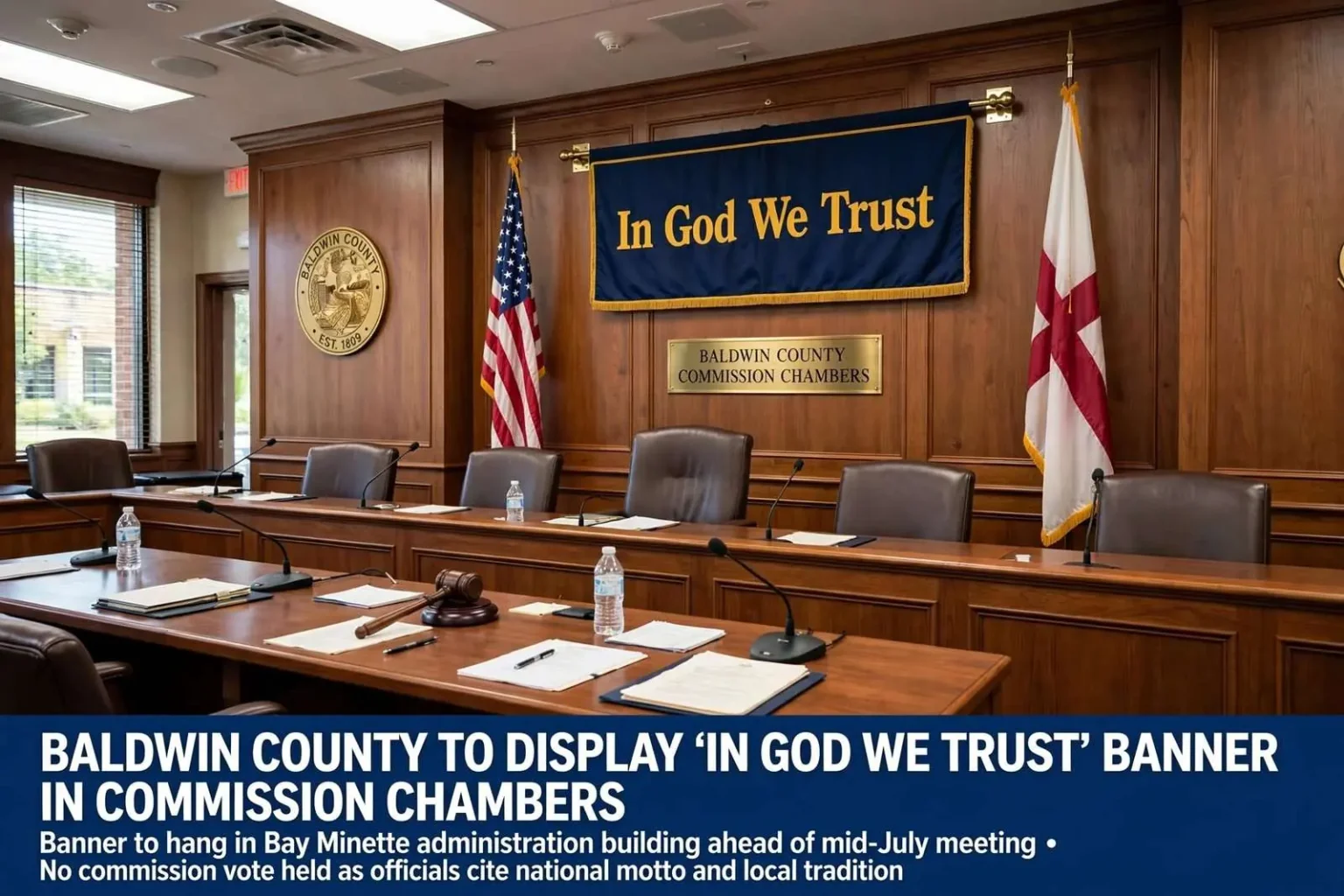
Baldwin County officials are preparing to display an “In God We Trust” banner inside the commission chambers at the county administration building in Bay Minette, joining a wave of local governments across the region making similar moves this summer. The banner is expected to be ready for the commission’s mid-July meeting, with an early-August meeting serving as a backup date if the sign isn’t finished in time. The display will hang in the room where the county’s governing body conducts its public business, making Baldwin County the latest Gulf Coast government to put the national motto on permanent show.
Commission Chairman Skip Gruber said the decision followed a broader trend among cities and counties throughout Baldwin and Mobile counties, where local leaders have opted to post the national motto in government buildings after requests from residents. Gruber pointed to the phrase’s presence on U.S. currency as part of his reasoning for supporting the display, noting that if it’s acceptable on money carried daily, it should be acceptable on the wall of a public meeting room.
No vote, no objection from commissioners
Unlike Mobile County, where commissioners held a formal vote on a similar plaque, Baldwin County’s commission does not plan to take an official vote on the banner. Gruber’s fellow commissioners indicated in interviews that they support his decision to move forward without one. The contrast between the two counties’ approaches has drawn attention from observers of both government procedure and the church-state debate: Mobile County’s vote turned its plaque into a contested public decision, while Baldwin County’s chairman is treating the banner as an administrative matter within his authority to arrange.
Commissioner Tucker Dorsey said Baldwin County has a long tradition of invoking divine guidance in local government, calling it appropriate given the phrase’s status as the national motto. Commissioner Frank Burt Jr. echoed that sentiment, noting the words appear on currency and that commission meetings traditionally open with prayer, calling the banner a fitting testimony. Commissioner Bob James said he wasn’t concerned about any backlash the decision might generate. Taken together, the commissioners’ comments signal a united front on a question that has divided other public bodies — and a shared expectation that the county’s residents, by and large, will welcome the display. The interviews also served a practical purpose: by lining up public support in advance, the commissioners effectively preempted the kind of split vote that made Mobile County’s plaque a controversy, presenting the banner as a settled matter of consensus rather than a contested choice.
The phrase itself carries a long governmental pedigree. “In God We Trust” first appeared on American coinage during the Civil War era and was made the official national motto by act of Congress in 1956, appearing on paper currency ever since. Courts have generally treated the motto’s display in public buildings as constitutional, a legacy of the principle that ceremonial references to a generic deity differ from state endorsement of a particular faith — a distinction critics dispute and supporters lean on, often in the same breath.
The Mobile County precedent
The Baldwin County move comes on the heels of a contentious vote in neighboring Mobile County, where commissioners approved a similar plaque for Government Plaza by a narrow 2-1 margin after a public meeting in which the large majority of speakers voiced opposition. That decision drew a formal objection from the Freedom From Religion Foundation, a national organization that argues such displays inappropriately favor religious belief in government spaces and can exclude residents who are not religious. The Mobile County debate made the motto a fixture of local headlines for weeks, with public meetings drawing crowds on both sides and commissioners weighing constituent sentiment against the objections raised at the podium.
A staff attorney for the organization argued that while “In God We Trust” may be a legitimate personal sentiment, placing it inside government buildings sends an implicit message that excludes non-religious residents, regardless of the phrase’s long history as the national motto. The argument is the foundation’s standard one: that the appropriate test is not whether a majority supports the display, but whether a resident of any belief or none feels equally represented in the room where public decisions are made.
That objection appears unlikely to change plans in Baldwin County, where commissioners have expressed confidence that the banner reflects longstanding local values rather than an overreach by government. The county’s political culture leans strongly conservative, its commission has traditionally opened meetings with prayer without controversy, and no organized local opposition to the banner had emerged by the time the display was being prepared. Commissioners noted that the banner’s cost and placement are minor administrative matters compared with the county’s road, budget and growth agenda.
A regional and national trend
The debate mirrors similar disputes playing out in communities nationwide as local governments weigh religious-themed displays in public buildings against concerns about inclusivity, with South Alabama emerging this year as one of the more active regions for the trend. Legislatures in several states have passed measures encouraging or requiring motto displays in public buildings, and county commissions across the Southeast have followed, often at residents’ urging, creating a patchwork of chambers, courthouses and city halls where the motto now hangs in letters of varying size.
Legal observers note that the motto displays have rarely fared poorly in court, in contrast to displays such as the Ten Commandments that carry explicit religious content. That track record is part of why motto banners have become the preferred vehicle for communities looking to make a statement: the phrase is statutory, its currency pedigree is familiar, and challenges to it have generally foundered on the ceremonial-deism rationale. Opponents respond that the trend’s momentum — display after display, county after county — is itself the message they object to.
For Baldwin County, the banner lands in a chamber that already reflects the faith traditions of its constituents. The commission’s meetings open with prayer offered by local clergy on a rotating schedule, a practice common among Alabama county commissions and one that has drawn little public complaint. Gruber and his colleagues describe the banner as an extension of that existing practice rather than a new direction — words on the wall to match the words spoken at the podium.
Bay Minette, the county seat, houses the county administration building and the courts in a downtown that anchors the county’s governmental functions, while the population center of gravity has shifted south toward the Eastern Shore and the beach communities. Residents from across the county — from Stockton to Gulf Shores — conduct business in the building where the banner will hang, appearing before the commission on zoning, road and licensing matters, which means the display will be part of the backdrop for the county’s most routine public interactions.
The commission itself is a five-member body whose districts span the county’s geographic range, and its meetings draw the mix of agenda items any Alabama county government handles: road projects, industrial incentives, courthouse operations and the perpetual business of managing one of the fastest-growing counties in the state. Against that full docket, the banner arrived as a small item — but one that, in the current climate, has drawn more attention than any single road contract on the same agendas.
The timing of the display, this summer, places Baldwin County in the middle of a wave rather than at its leading or trailing edge. Municipal councils in the county’s fast-growing cities have considered or adopted motto displays of their own, and the regional conversation has made the question a familiar one at candidate forums and public meetings. What was once an occasional action by a single board has become, in the space of a few months, a regional pattern.
Whether the banner provokes any objection in Baldwin County remains to be seen. The Freedom From Religion Foundation’s letter concerning Mobile County’s plaque did not extend to Baldwin’s plans, and no local resident group had announced a challenge as the display was being readied. Commissioners, for their part, have been consistent: the motto is on the money, the courts have allowed it, the residents asked for it, and the county will hang it. When the commission convenes at its mid-July meeting, “In God We Trust” is expected to be looking down on the dais — the newest installment in a statewide series of motto displays, and the latest chapter in a debate that shows no sign of ending.
What the episode demonstrates, whatever one’s view of the display, is how quickly a four-word phrase can become a measure of a community’s values. In Baldwin County, the answer arrived without a vote, without a divided dais and, so far, without the contention that followed the same decision across Mobile Bay — a quieter installment in a very public trend.