Baldwin Beach Express Speed Study Weighs 55 vs. 65 MPH
Baldwin County is studying traffic data on the Baldwin Beach Express as drivers push to raise the 55 mph limit toward 65.
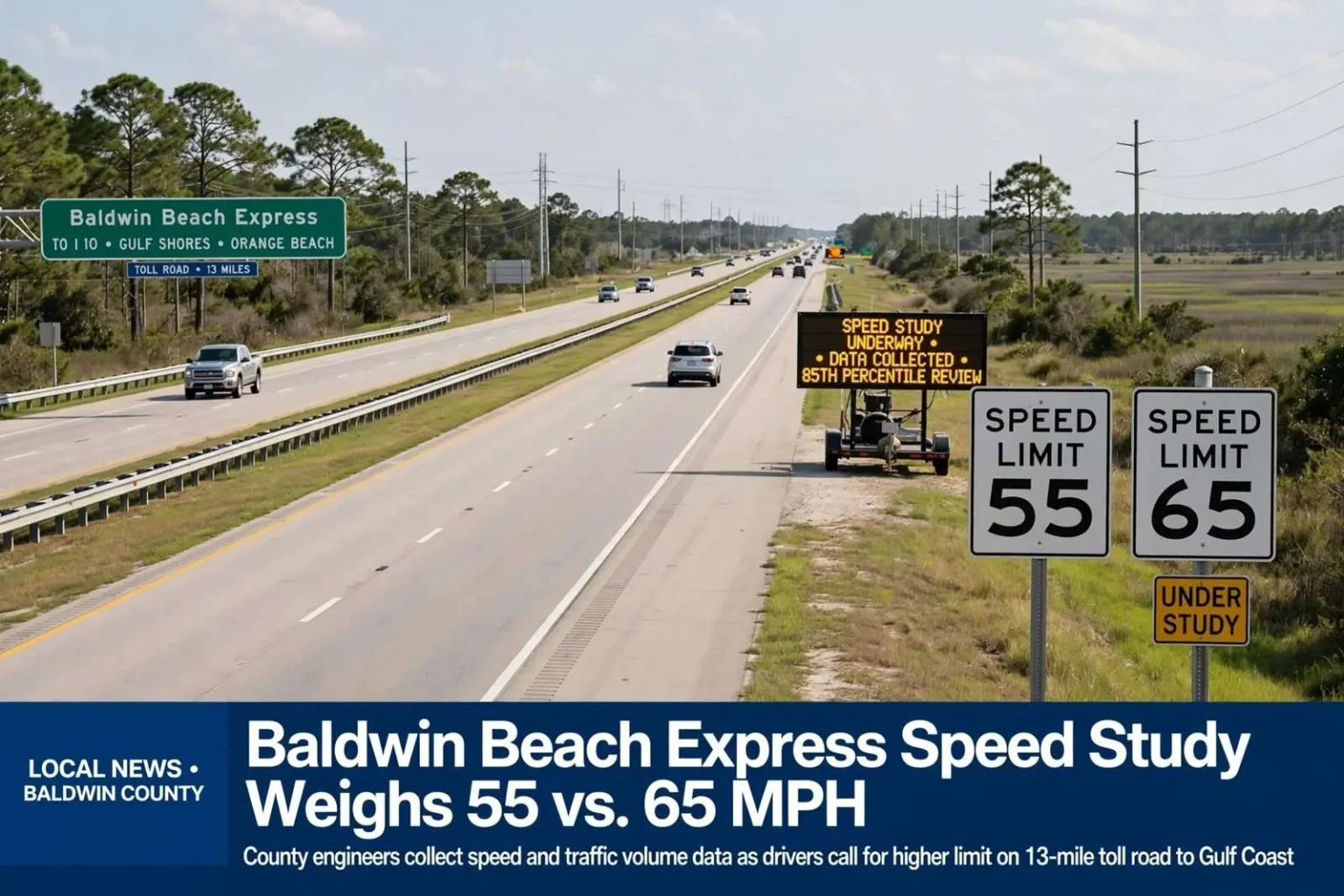
A stretch of four-lane highway connecting Interstate 10 to the Gulf Coast beaches in Baldwin County has become the subject of a lively public debate over how fast drivers should be allowed to go. The Baldwin Beach Express, a roughly 13-mile toll road built to relieve congestion on Alabama 59 and shorten the trip to the beach, currently carries a 55 mph speed limit for most of its length, dropping to 35 mph on a short segment near the interstate interchange.
Many regular users of the road argue that speed limit is too conservative for a modern, divided highway with limited access points. The Beach Express was designed as a high-speed alternative to the stop-and-go corridor of Alabama 59, with interchanges and turnarounds spaced far apart and no driveways or cross streets feeding directly onto the mainline. To drivers accustomed to interstate-style travel, a 55 mph limit on such a road can feel out of step with the highway’s design, and the complaint has grown louder as the route has become a fixture of daily life for south Baldwin County residents.
An informal online poll drew more than 200 responses, with roughly three out of four participants saying they would support raising the limit to 65 mph. The response showed how strongly drivers feel about the issue, and it gave county officials a clear picture of public sentiment even as they cautioned that polls do not decide speed limits.
Drivers who use the route frequently, including retirees and commuters from Foley and other south Baldwin communities, have said publicly that motorists already tend to travel faster than the posted limit, particularly during peak beach travel periods. On summer weekends, when vacation traffic funnels toward Gulf Shores and Orange Beach, the expressway carries waves of vehicles that flow together at speeds above the posted number, a pattern familiar to anyone who has made the Friday-afternoon run to the coast.
County officials urge caution
County officials have been more cautious, noting that any change to the speed limit needs to be grounded in engineering data rather than public sentiment alone. Speed limits on public roads carry safety and legal implications that go beyond convenience, and a limit set too high can increase crash severity, while one set too low invites widespread violations and speed differences between vehicles that can themselves contribute to collisions.
Baldwin County’s engineering department began gathering traffic speed and volume information along the corridor, with plans to collect two to three weeks of data before making a formal recommendation to the county commission. The study period was chosen to capture a representative sample of conditions on the road, including weekday commuter traffic and the heavier, more varied flows that come with weekend beach travel.
How the 85th percentile method works
Traffic engineers typically rely on what is known as the 85th percentile method when evaluating whether a speed limit should change. Under this approach, engineers measure the speed at or below which 85 percent of vehicles are traveling under free-flow conditions, then weigh that figure alongside crash history, road geometry, sight distance, and access points before recommending a limit. The premise behind the method is that the speed most drivers choose on a given road, absent heavy congestion, generally reflects a reasonable judgment about what the roadway can safely handle.
That process was described by county engineering staff as the standard being applied to the Baldwin Beach Express review. By pairing the percentile measurement with the road’s crash record and its physical characteristics — the width of its lanes, the length of its sight lines, the spacing of its interchanges — the department aims to produce a recommendation that can stand up to scrutiny from drivers, county leaders and anyone who questions the result.
At least one county commissioner said he was hopeful the data would support an increase, though he emphasized that any final number would depend on what the engineering analysis showed rather than public preference. The position reflects the balance the commission must strike between responding to constituents’ wishes and ensuring that the county’s roadways are managed according to accepted engineering practice.
A road built for beach traffic
The $86.7 million roadway was constructed specifically to give beach-bound traffic an alternative to the often-clogged Alabama 59 corridor, and its speed limit has been a topic of interest since it opened. For decades, the drive from Interstate 10 to the coastal towns funneled almost entirely onto Alabama 59, passing through Foley’s commercial strip and a series of signalized intersections before reaching the beach communities. The Beach Express bypasses that stretch, allowing drivers to reach the coast without wading through in-town traffic, and toll revenue funds the road’s operations.
The review comes at a time when traffic along the beach corridor continues to grow during the busy summer travel season, adding urgency to questions about how the road should be managed going forward. Baldwin County’s population has expanded rapidly in recent decades, and the same growth that fills subdivisions north of the bay also multiplies the volume of vehicles heading for the shoreline each weekend. Every minute saved on the trip to the beach matters to the region’s tourism economy, and the expressway’s speed limit directly affects how attractive the route is compared with its alternatives.
Supporters of a higher limit also point to the road’s modern construction standards. Divided highways with controlled access are generally engineered for higher operating speeds than older two-lane or signal-heavy routes, and the Beach Express was built to contemporary design criteria with generous shoulders and turnarounds designed for emergency access. Those features form part of the engineering context that the study will weigh alongside actual measured speeds and crash data.
What happens next
A decision on any speed limit change would ultimately rest with the Baldwin County Commission after engineers complete their review of the collected data. The commission would be responsible for authorizing any new limit and for the signage changes that would follow, and members have indicated they intend to let the numbers guide the outcome. If the analysis supports keeping the current limit, drivers can expect the 55 mph posting to remain, with the county able to point to data rather than opinion as the basis for its decision.
Residents and visitors who use the Baldwin Beach Express regularly are encouraged to follow posted signage in the meantime, particularly through the reduced-speed section near the interstate, where enforcement has reportedly increased as drivers adjust to the corridor’s traffic patterns. The 35 mph zone approaching the interchange exists because merging traffic, toll operations and ramp geometry all demand slower speeds than the open mainline, and law enforcement has focused attention there to keep the transition safe.
Until the county commission acts, the debate remains exactly that — a debate. The engineering study is expected to answer it with measurements rather than anecdotes, and whatever the outcome, the review illustrates how a growing coastal county works through the trade-offs of managing the infrastructure its explosive growth has built. For now, drivers heading for the Gulf will continue doing so at 55, watching their mirrors for the troopers and deputies who are watching their speedometers.
Why speed limit debates linger
Arguments over speed limits tend to persist on toll roads and bypasses across the Gulf Coast because the roads are relatively new and drivers’ habits evolve faster than the rules. When a highway opens, engineers often set an intentionally conservative limit while the corridor builds a real-world record of traffic behavior and crash experience. As months pass and the data accumulates, limits are sometimes revisited — and drivers who have spent two years comfortably cruising a road at highway speeds are quick to ask why the sign still says otherwise.
The Beach Express case also illustrates a tension specific to Baldwin County: a road paid for largely by the drivers who use it is expected to serve them as efficiently as possible, while the county remains responsible for their safety. Toll road users feel a direct financial stake in the quality of the facility, and many see the speed limit question as part of getting fair value for their tolls. County officials, meanwhile, answer to the same drivers in their other role as residents who share the road with visitors unfamiliar with the corridor.
Local experience elsewhere on the Gulf Coast suggests that whatever the commission decides, compliance will depend on how well the posted limit matches driver behavior. Roads where the posted speed runs far below the speed most traffic actually travels tend to produce chronic violations and uneven traffic flow, while limits aligned with the 85th percentile speed generally see better compliance and fewer complaints. That principle is precisely why the engineering department has framed its study around measured speeds rather than the volume of public comments.
For now, the county has committed to letting the process run its course. The engineering department will finish its two to three weeks of collection, analyze the results against crash history and roadway characteristics, and bring a recommendation to the commission. The commissioners will then weigh that recommendation against everything they have heard from constituents — the poll respondents, the retirees and commuters who drive the route daily, and the safety-conscious voices urging restraint. However the vote goes, the study’s publication will give south Baldwin County residents a data-backed answer to a question they have been asking since the toll road opened, and it will set the engineering baseline for any future review of the corridor as traffic patterns continue to change.