Saraland Elementary Opens School Year with Focus on Safety
Saraland Elementary opened the school year with new safety measures, including radios for staff and stricter visitor check-in rules.
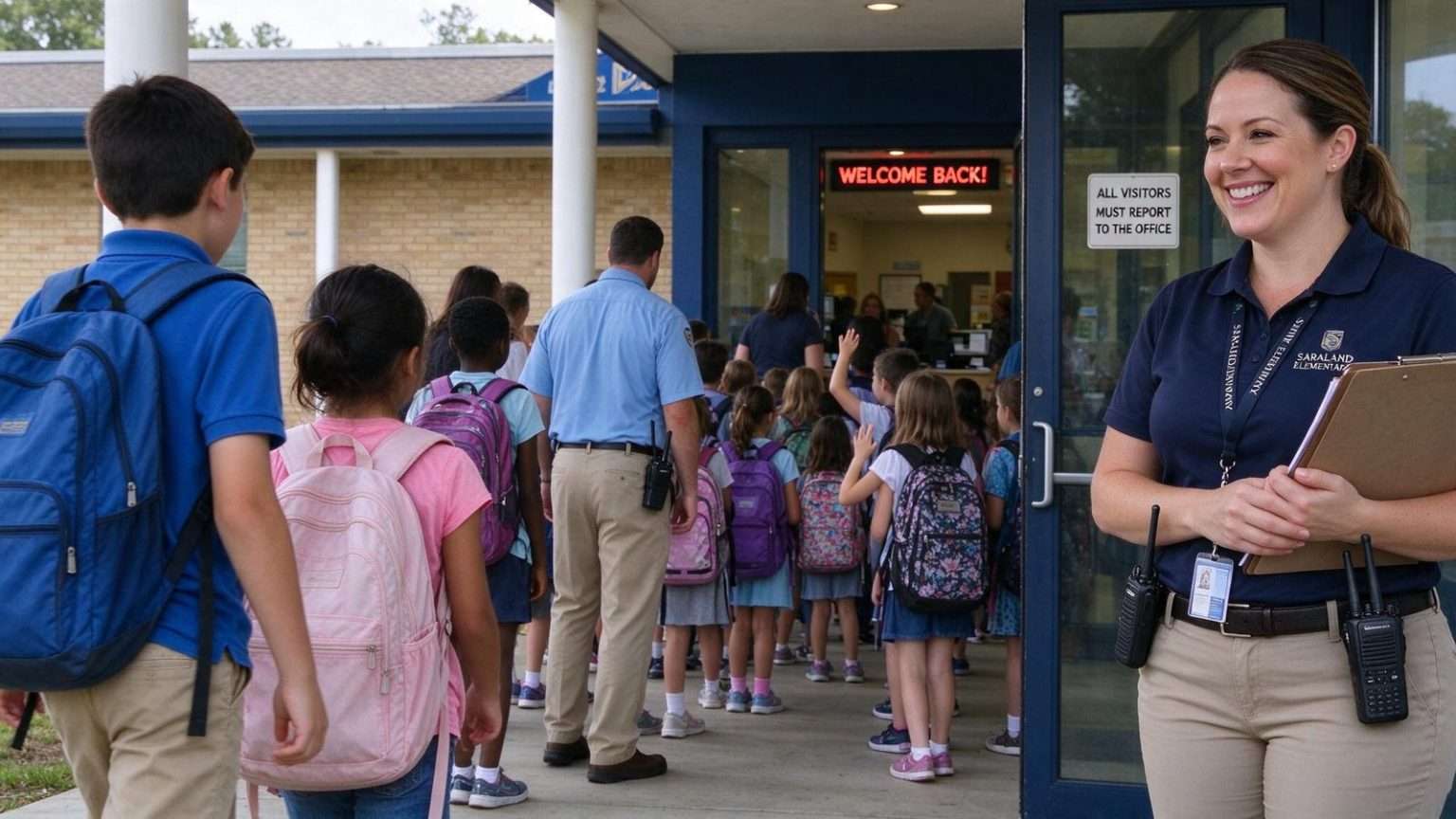
The first day of school at Saraland Elementary brought the usual mix of nerves and excitement, but this year the opening morning also came with new safety measures that had some parents adjusting their routines. Families gathered outside the building well before the scheduled opening time, with several parents and their children waiting by the front doors, backpacks assembled and first-day photographs taken against the brick facade before anyone had been let inside.
A number of families said they had received an automated phone call the evening before informing them of a later start time than in previous years, though not everyone reported getting the message, leading to some early confusion outside the building. Parents who had arranged their mornings around the old schedule found themselves waiting longer than expected, while those who got the call arrived at the new time and found the crowd already assembled. Doors ultimately opened a bit ahead of the newly announced time, easing the wait for the crowd that had gathered.
The school’s new principal explained that the adjusted schedule was a deliberate change from prior years, driven largely by supervision concerns. With parents sometimes arriving as early as 7 a.m., school leaders wanted to avoid a situation where children were left waiting inside without adequate staff oversight, particularly since many teachers have their own children enrolled at other schools and need time to drop them off before arriving for the day. The change reflects a reality familiar to schools across the region: the gap between when parents need to leave for work and when teachers can reasonably be on duty has widened, and schools have had to redraw their morning plans accordingly.
Safety at the Center of the Morning
Safety emerged as a central theme throughout the morning. The school’s Parent Teacher Organization recently put roughly $15,000 toward purchasing two-way radios for every teacher, giving staff a fast way to communicate during an emergency. The radios close a gap that has concerned school leaders for years: in a lockdown or evacuation, a teacher without a radio has no immediate way to reach the office or colleagues, and cell phones are slow, unreliable and impractical for young classes in motion. With a radio in every classroom, any teacher can raise an alarm or receive instructions in seconds.
Administrators also said the school would run through a series of safety drills in the coming week, including a full lockdown drill, so that students and staff practice the procedures while the year is fresh. Administrators also announced that visitors to the building are now required to show identification, sign in, and be buzzed through a secure entry point before being allowed inside, a controlled-access model that has become standard in newer schools and is being tightened across districts that operate older buildings. The combination of radios, drills and controlled entry amounts to a layered approach, the style school safety experts recommend over any single measure.
For parents, the visible changes required some adjustment. Dropping children at a door that no longer swings open freely, waiting for a buzzer and presenting identification at the front desk adds a minute or two to each morning, but families waiting outside on the first day seemed to take the changes in stride, with several noting that the inconvenience was a fair trade for knowing exactly who is inside the building with their children.
Excitement Wins the Morning
Beyond the security changes, the mood among students and staff leaned toward excitement. A first-year teacher, new to the area, said she had already grown fond of the community and was focused on making her classroom feel welcoming from day one, emphasizing to her students that they belonged and mattered. Several young students described themselves as simply excited to be back, with matching enthusiasm as they lined up to head inside, greeting friends they had not seen since May and comparing class assignments in the doorway.
First days tend to run on a rhythm of small moments, and Saraland Elementary’s morning had its share: kindergartners gripping new supplies, older students steering younger siblings to their lines, and teachers meeting parents they will work with for the next nine months. The later start gave the morning a slightly unhurried quality despite the confusion, and by the time the last students filed in, the schedule change had faded into the school year’s ordinary noise.
A District Still Growing
The opening day also reflected the broader growth trend within Saraland’s school system, which has expanded steadily since the district was formed in 2008, when the city broke away from the Mobile County Public School System to run its own schools. Enrollment climbed from roughly 2,700 students across grades K-12 the previous year to more than 2,840 this year, with administrators anticipating the number could approach 2,900 as the year progresses. For a district that started from scratch, those numbers tell the story of a city that has used its school system as a foundation for growth, attracting families who move to Saraland specifically for the schools.
Growth of that pace brings its own management challenges. Classroom space, staffing and transportation all have to expand a step ahead of the enrollment line, and each new school year begins with administrators calculating how many students arrived over the summer and where they will fit. Saraland has responded over the years by adding facilities and staff, and the district’s trajectory has made it one of the notable success stories among Alabama’s newer city systems, frequently cited in discussions of how municipal school districts perform when communities invest in them.
The system’s superintendent, now entering his second year in the role, expressed optimism about the year ahead as students settled into their classrooms. Leadership continuity combined with steady enrollment gives the district a stability that many systems its size lack, and the opening day’s smooth landing, despite the start-time confusion, offered an early sign that the year’s logistics are in hand.
What the New Measures Mean Going Forward
The changes at Saraland Elementary reflect a broader push among area schools to balance welcoming, comfortable first-day experiences with tightened security protocols, a balance administrators say will remain a priority as enrollment continues to grow. The PTO’s investment in radios shows how school communities are sharing that burden, with parent organizations increasingly funding safety equipment that falls outside the reach of district budgets. The coming week’s drills will turn the morning’s announcements into practiced routines, and by the end of the month the lockdown procedure, visitor check-in and radio protocols should feel as ordinary as the morning announcements.
For the elementary school specifically, the year begins with a new principal learning the community’s rhythms while implementing changes on the fly. The start-time adjustment, made for supervision reasons, will likely be revisited as the year progresses and patterns settle, and the school’s leaders have signaled they will adjust if the morning logistics prove awkward for working families. What will not be rolled back is the safety infrastructure: the radios are purchased, the entry system is in place and the drills are scheduled.
Across Saraland and the surrounding communities in Mobile County’s northern suburbs, the first day marked the start of another year of expansion, with more students, more security and the same first-day nerves that every school year brings. If the district’s enrollment projections hold, the halls of Saraland Elementary will be a little fuller by spring than they were Monday morning, and the balance the school struck on day one, between open arms and locked doors, will define how the year unfolds from here.
The Radios in Practice
Two-way radios for every teacher may sound like a small purchase, but safety planners consider classroom communication one of the highest-value investments a school can make. In an emergency, the first minute matters most: a teacher who sees something wrong can alert the office instantly, and the office can broadcast instructions to every room at once, rather than relying on intercoms that only work in certain spots or runners sent down hallways. The PTO’s $15,000 purchase puts that capability in the hands of every adult in the building, and it came from the kind of fundraising that parent organizations across the region have increasingly directed toward safety rather than playgrounds alone.
The radios will also serve everyday purposes that make them worth carrying. Teachers can coordinate car-line duty, recess coverage and schedule changes without leaving their classes, and substitute teachers gain a direct line to the office on days when they know no one in the building. Schools that have adopted all-staff radio systems typically report that the devices become part of the daily routine within weeks, which in turn keeps them charged, working and familiar by the time an actual emergency arrives.
A Community Built Around Its Schools
Saraland’s rise as a school district has reshaped the city around it. Since forming its own system in 2008, the city has seen its schools become the centerpiece of its identity, the deciding factor for families choosing where to buy homes north of Mobile. That dynamic creates a cycle in which strong schools attract residents, residents support school funding, and the district keeps growing, but it also means every school year begins under expectations that few small-city systems carry. Parents in Saraland track enrollment figures the way sports fans track standings, and this year’s climb toward 2,900 students will be read as one more sign of momentum.
The first day’s mixture of adjustment and enthusiasm captured that dynamic in miniature. A district confident enough to change its start times for safety’s sake, a parent organization wealthy enough to buy radios for every teacher and a new principal steering her first opening day all pointed in the same direction: a school system that believes it is still building toward something. The students lining up Monday morning, nervous and grinning in roughly equal measure, were the latest class in that ongoing project, and by the time the last bell rang them out for the afternoon, the year was already under way on the terms their teachers had promised, a place where they belong and where they matter.