Father-Son Murder Trial Opens Over Deadly Theodore Trailer Park Shooting
A Mobile County murder trial opened this week over a 2012 shotgun killing at a Theodore trailer park, with father and son both charged.
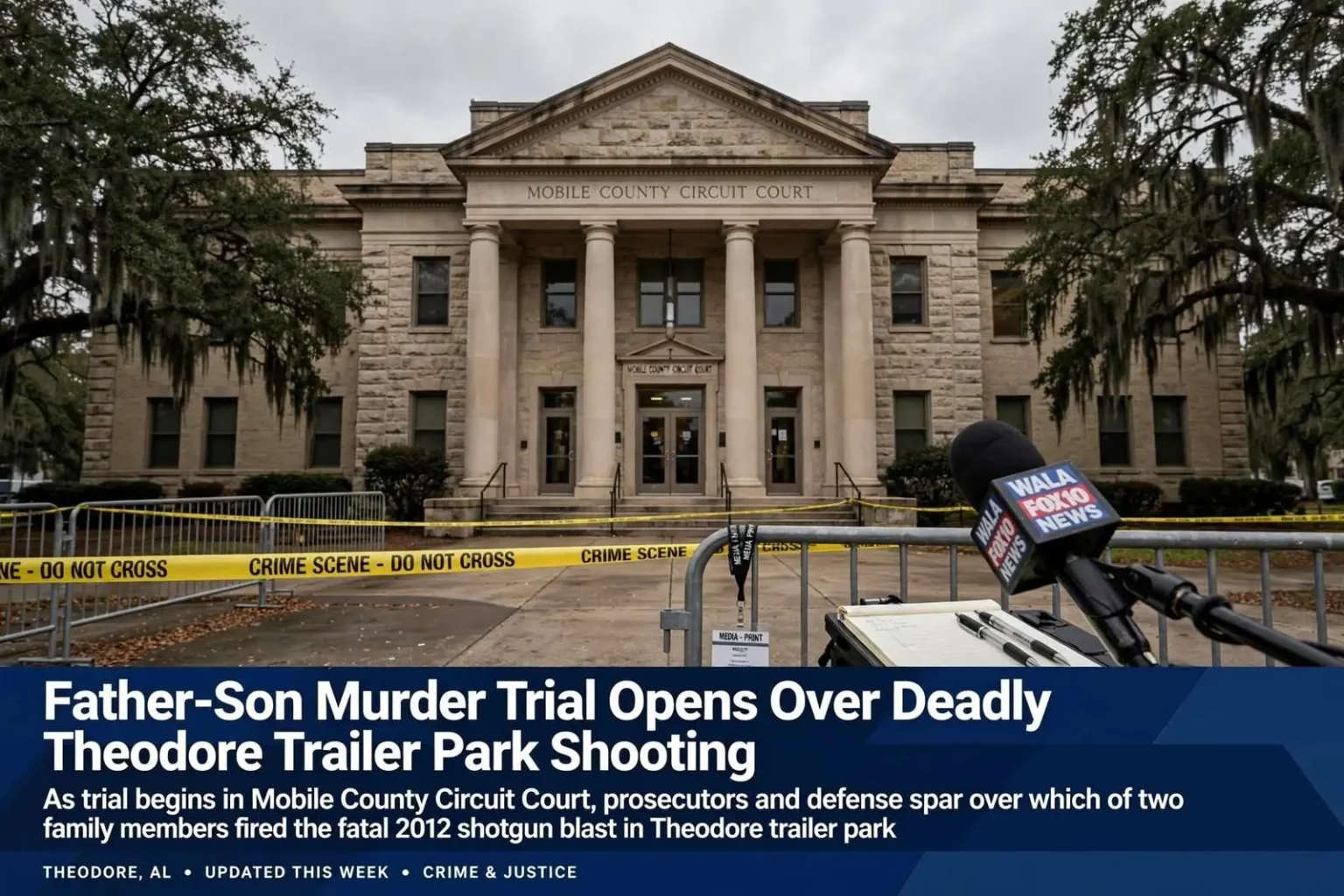
A murder trial got underway this week in Mobile County Circuit Court centered on a fatal shooting at a trailer park off Bellingrath Road in Theodore, with prosecutors and defense attorneys sparring over which of two family members, a father and his son, actually fired the fatal shot.
The case stems from a June 2012 confrontation that left a Theodore man dead from a shotgun wound to the chest after an argument escalated inside his trailer. The victim reportedly stumbled outside and collapsed on a concrete slab near the doorway before he died.
Two men, a father and his adult son, are jointly charged in connection with the killing, and opening statements this week made clear the central dispute at trial will be which of them pulled the trigger. Prosecutors do not dispute that one of the two men fired the shot that killed the victim; the question the jury must answer is which one, and under what degree of intent and culpability Alabama law allows.
The prosecution’s theory: a father covering for his son
Prosecutors told jurors the case largely amounts to a father shielding his son from responsibility, describing the younger of the two defendants as quick-tempered and suggesting his anger got the better of him that night. The state indicated it plans to introduce several recorded statements from the father, adding up to multiple hours of audio, in which he reportedly claimed responsibility for the shooting in order to protect his son.
Recorded statements carry particular weight in a case like this. Hours of audio, taken at different times and in different circumstances, give prosecutors the chance to show a pattern rather than a single utterance — and give the defense the chance to point to inconsistencies, coaching or emotion in what was said. Jurors in Mobile County will hear the recordings played in court, a process that can take days depending on their length and the number of witnesses called to establish where and how each statement was made.
The state’s framing of the son as quick-tempered is intended to supply the missing piece: a motive and a temperament that make his firing the shot plausible, even while his father took the blame. Prosecutors will need to connect that characterization to the evidence of the night itself — the argument, the shotgun and the physical layout of the trailer.
Two defenses, pointing in different directions
Defense attorneys for both men presented competing narratives. Attorneys for the son argued that a physical altercation broke out between the two men earlier that evening, during which the victim, a much larger man, allegedly struck the defendant in the head with a piece of cinder block. The defense contends the son was left incapacitated on the ground from the blow and could not have been the shooter.
That account, if jurors credit it, does two things at once: it removes the son from the trigger, and it begins to build a self-defense narrative around whoever did fire. A head injury from a cinder block is the kind of injury that leaves medical and forensic traces, and the defense is expected to lean on any documentation of the son’s condition from the night in question — hospital records, photographs or witness recollections of his state afterward.
Meanwhile, the father’s attorney argued that regardless of any statements her client made afterward, he was not actually involved in the shooting, suggesting instead that other family members drew him into the situation after the fact. Her task is the harder of the two on its face: her client’s own recorded words claim responsibility. Her answer is that those words were the product of a father’s panic and love, not a confession — that he said what he said to take the weight off his son, and that the physical evidence will show he was not the shooter.
The strategy leaves the two defenses in tension. If the son was incapacitated on the ground and the father was not involved, someone else fired the shot. But the jury has only two defendants before it, and Alabama law does not permit an alternate-villain theory to be conjured without evidence. How each side reconciles that arithmetic will shape the closing arguments to come.
The state’s first witness
A neighbor who lived within view of the trailer testified as the state’s first witness, telling jurors he had been sharing a drink with the father when the confrontation began. First witnesses in murder trials carry a specific burden: they must orient the jury in time and place, establishing the ordinary rhythm of the evening before it turned lethal, so that the violence that followed stands out against a credible backdrop.
Neighbors in cases like this often provide the timeline the forensic evidence cannot. They can speak to who was where, when the argument began to rise, and the sequence of sounds — voices, a struggle, the shot — as it unfolded. In a trailer park setting, where units sit close together and life happens outdoors in warm months, there are typically multiple sets of eyes on any given evening, and both sides can be expected to call on them.
The testimony about drinking that evening is likely to matter on both sides. For the prosecution, alcohol can support the portrait of a volatile, escalating night; for the defense, it cuts toward chaos and unreliable memory — a reason to doubt that anyone’s recollection, including the father’s own statements, captures what actually happened at the trigger moment.
The place and the case
The shooting occurred at a trailer park off Bellingrath Road in Theodore, an unincorporated community in southern Mobile County. Bellingrath Road runs through a part of the county where mobile and manufactured homes make up much of the housing stock, and where the communities along the road sit between Theodore’s commercial strip and the attractions and waterways to the south. It is the kind of place where residents know their neighbors’ routines, which is why the neighbor’s testimony anchored the state’s opening days of proof.
June 2012 is more than a decade in the past, and the delay between the shooting and trial is itself a fact jurors will weigh. Cold-case prosecutions turn on records: the recorded statements the state plans to play, the physical evidence collected from the trailer and the concrete slab where the victim collapsed, and the files of the Mobile County Sheriff’s Office, which investigates unincorporated Mobile County. Defense attorneys routinely use the passage of time to test whether memories have hardened into certainty or softened into guesswork.
The shotgun adds its own layer of technical proof. Shotguns used at close range leave patterns and residue that forensic examiners can read, and the position of the victim’s body on the slab near the doorway will be matched against the ballistics and the accounts of who stood where. Expect testimony from crime-scene investigators and the medical examiner’s office as the state builds the physical case around the recordings.
What the jury must decide
Alabama law treats murder and lesser homicide degrees differently, and the distinction turns on intent and state of mind at the moment of the killing. Provocation, self-defense and the question of who actually acted are the classic battlegrounds when two defendants face a single fatal act, and this trial contains all three.
The prosecutors’ task is to prove beyond a reasonable doubt which man fired — or, in the alternative, that both share criminal culpability under the law’s rules for accomplices. The defenses’ task is simpler to state and harder to do: plant that reasonable doubt. With a father who confessed out of love and a son who was allegedly unconscious after a beating, the defense narrative, if jurors buy it, explains the recordings without excusing the crime — but it also leaves the question of who to punish hanging in the air.
The trial continues in Mobile County Circuit Court, where the recorded statements — hours of them — are waiting their turn on the docket. When the jury finally retires, its verdict will answer a question that has hovered over a Theodore trailer park since June 2012: on the night a man died on a concrete slab outside his own door, whose hand was on the gun?
Joint trials of family members are uncommon enough that the seating arrangements themselves tell a story. Two defense tables, two sets of attorneys, and a state’s case built on hours of one defendant’s own voice: the jury will spend the trial toggling between the father’s words and the son’s alleged injuries, weighing which tells the truth about the same trigger pull.
Legal observers note that when a defendant’s own recorded statements are the centerpiece of the state’s case, the defense usually attacks on two fronts: the circumstances under which the statements were made, and the reason they were made. A statement is not automatically a confession — intent matters, and a claim of responsibility offered to protect a child is legally different from an admission of guilt, even if the words are similar. The prosecution will counter that the statements were voluntary, repeated and detailed, and that a parent’s love does not extend to falsely confessing to murder.
For the son’s attorneys, the cinder block allegation converts the trial into a medical question as much as a factual one. If records or witnesses substantiate a serious head injury that evening, the claim that he was incapacitated becomes very hard for jurors to dismiss — and the state will need a compelling answer for why the man allegedly knocked senseless was the one with the temper that “got the better of him.”
However the verdict comes down, the trial’s outcome will resolve one of the more unusual prosecutions to reach a Mobile County courtroom in recent years: a case where the state does not have to prove who died, or how, or even that either defendant denies the killing — only which of two men, father or son, actually did it.