Theodore Man Charged After Friend Fatally Shot in Gun Mishap
A Theodore man faces a manslaughter charge after authorities say a loaded handgun accidentally discharged, fatally wounding a close, longtime friend.
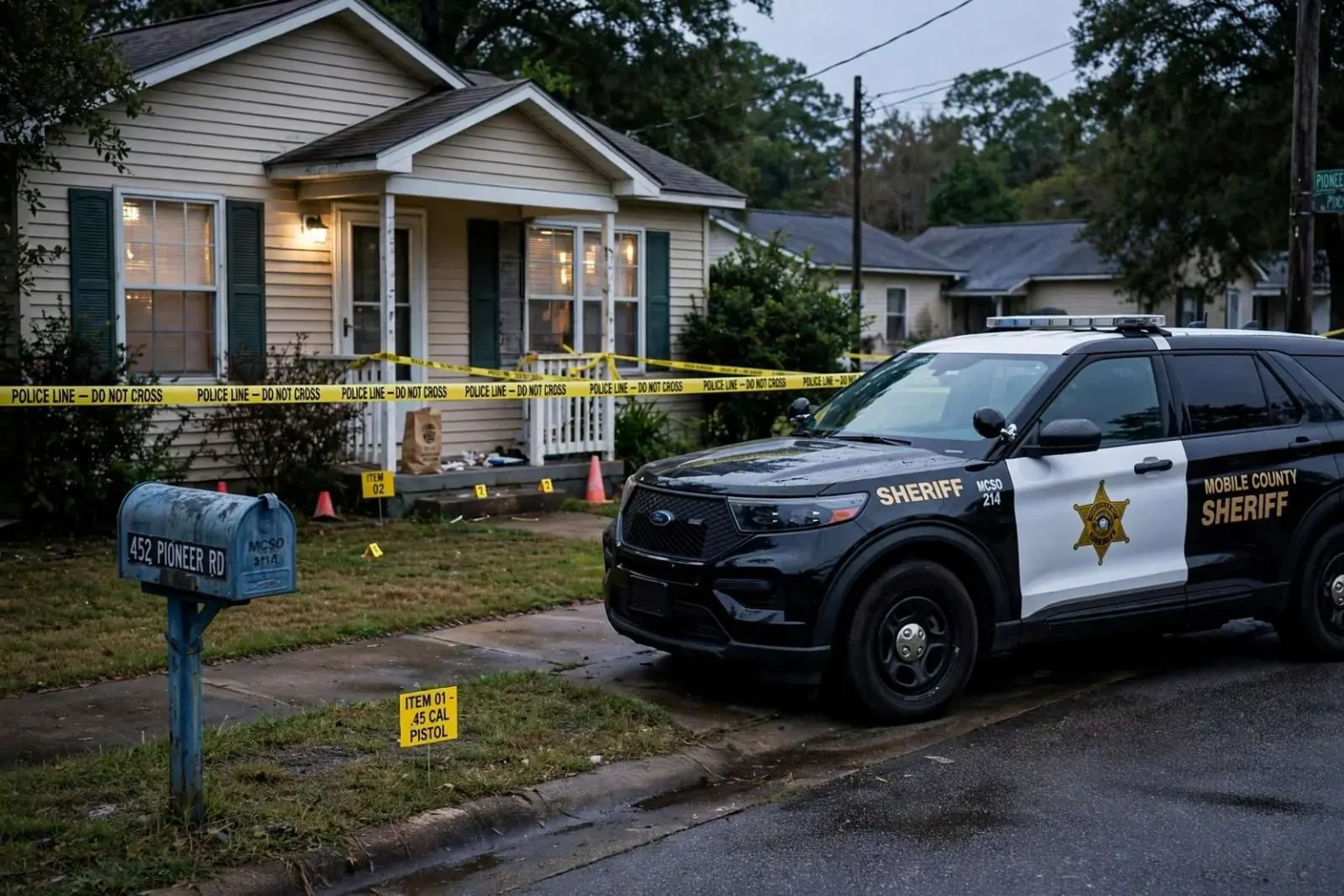
A Theodore man has been charged with manslaughter after authorities say a handgun he was handling went off accidentally, fatally wounding a friend at a home on Pioneer Road.
Mobile County Sheriff’s Office deputies responded to a report of a shooting at the residence on the evening of Aug. 7. According to a criminal complaint filed in Mobile County District Court, the man had a .45-caliber pistol in his hand and was spinning it on his finger when it discharged unexpectedly. The bullet struck a 24-year-old friend in the cheek, and he died from the wound.
Early the following morning, deputies booked the 23-year-old Theodore man into Mobile County Metro Jail on one count of manslaughter in connection with the shooting.
The circumstances described in the complaint — a loaded pistol being spun as a stunt — transformed a moment of showmanship between friends into a fatal shooting that ended one young man’s life and put another in jail facing a felony charge. Deputies arriving at the Pioneer Road home found the aftermath of the discharge and began the work of piecing together exactly what happened inside the residence in the minutes before the shot rang out.
Building the Case
Investigators continued working the case in the days that followed, though the Sheriff’s Office had not released additional details about the exact circumstances leading up to the shooting.
That silence left several questions unanswered as the case moved toward its first court appearance: where inside the home the men were when the gun fired, whether others witnessed the discharge, who owned the weapon, and what the two friends had been doing in the hours before the shooting. Detectives routinely re-interview witnesses in accidental shootings, collect the firearm for examination, and compare the account given in the criminal complaint against physical evidence collected at the scene.
Court records also show the man had separate pending menacing and harassment charges out of Mobile, tied to confrontations from 2013, though authorities said there was no clear connection between those older cases and the fatal shooting. He had no other previously known arrests in Mobile County.
The older charges will be handled separately from the manslaughter case, but their presence in the record paints a more complicated portrait of the defendant than a single first arrest would. Prosecutors weigh a defendant’s history when making charging decisions and sentencing recommendations, and pending matters can affect bond discussions as the case moves through the system.
A Charge With Serious Consequences
The manslaughter charge carries the possibility of a prison sentence if he is ultimately convicted, though the case was still in its early stages as of the initial court filing.
Under Alabama law, manslaughter is a felony, and a conviction can bring a substantial prison term. The charge occupies a middle ground in the state’s criminal code: unlike murder, it does not require proof that the defendant intended to kill, but it reaches conduct that shows a disregard for human life — precisely the category authorities use when a death results from extremely careless handling of a firearm. That distinction matters in cases like this one, where prosecutors must show that what happened on Pioneer Road went beyond a tragic accident into the realm of criminal recklessness.
The man was scheduled to appear before a Mobile County District Court judge later in the month for a preliminary hearing, where prosecutors were expected to lay out additional evidence gathered during the investigation.
Preliminary hearings serve as an early checkpoint in Alabama felony cases. A judge hears enough of the state’s evidence to determine whether probable cause exists to bind the case over to a grand jury, which decides whether to return an indictment. Defense attorneys frequently use the hearing to lock in witness accounts and probe the strength of the state’s case, and the proceedings often foreshadow the issues that will matter if the case is later resolved by plea or by trial in Circuit Court.
A Recurring Kind of Tragedy
The case highlights the risks associated with careless handling of loaded firearms, an issue Mobile County authorities say surfaces periodically in accidental shooting cases involving friends or family members rather than confrontations between strangers.
Across south Alabama, sheriff’s deputies and city police respond each year to shootings that begin as horseplay, show-and-tell, or casual handling of a weapon believed to be unloaded or made safe. The victims and the shooters alike are often young men, and the shootings frequently occur in homes, at gatherings, or in the presence of people who never imagined a gun pointed their way as a joke would fire. When the dust settles, families are left planning funerals and young defendants are facing felony charges that will mark the rest of their lives.
Sheriff’s officials have previously urged gun owners to treat every firearm as loaded and to avoid handling weapons in ways that could lead to an accidental discharge.
Those warnings echo the safety rules taught in every reputable firearms course: keep the muzzle pointed in a safe direction, keep a finger off the trigger until ready to shoot, and never assume a gun is unloaded. The revolver-and-rifle drills that make stunts like spinning a pistol look effortless in movies conceal how dangerous the practice is with a real, loaded weapon — a revolver’s exposed hammer can be vulnerable to an accidental strike, and a semi-automatic pistol’s trigger takes only a few pounds of pressure to release a round. Modern handguns are engineered with multiple internal safeties, but no mechanical feature can protect a user who deliberately ignores the basic rules of handling.
Law enforcement agencies across Alabama reinforce those messages through hunter education courses, community outreach and public statements after accidental shootings, hoping that repetition will prevent the next tragedy. The Alabama Department of Conservation and Natural Resources requires hunter education for many young hunters, and firearms instructors statewide drill students on safe storage as well as safe handling — a point that takes on added weight in households where children or guests may encounter an unsecured weapon.
Sheriff’s officials said the investigation remained open, and it was not immediately clear whether any additional charges might be filed as the case moved through the court system.
For the family of the 24-year-old man who died, the court process that begins with the preliminary hearing will unfold over months, moving from district court to a grand jury review and, if an indictment follows, to Circuit Court for eventual resolution. For the 23-year-old now charged in his friend’s death, the case stands as the consequence of a few seconds of careless handling — a decision that ended one life and upended another.
The Sheriff’s Office continued to ask anyone with information about the shooting to come forward as detectives completed their work on the case.
Theodore, the unincorporated community in southern Mobile County where the shooting occurred, sits between Tillmans Corner and the Bayou La Batre area, a patchwork of subdivisions, rural parcels and small businesses south of Mobile. Calls to homes in the community fall to the Mobile County Sheriff’s Office, which patrols the county’s unincorporated areas while the Mobile Police Department handles the city proper. The Sheriff’s Office handles a full range of calls in Theodore, from property crimes to domestic disputes to shootings, and its investigators work out of precinct facilities spread across the county.
When deputies arrived at the Pioneer Road home on the evening of Aug. 7, their first tasks were the standard ones for any shooting call: secure the scene, render aid to the wounded man, and begin separating witnesses so their accounts could be taken independently. Despite those efforts, the friend struck in the cheek could not survive his wound. Facial gunshot wounds are among the most dangerous a body can sustain, with major blood vessels, the airway and the brain all lying in the bullet’s path.
The mobile booking process that followed was equally standard. Deputies transported the 23-year-old to the Mobile County Metro Jail on Government Street, where he was processed, photographed and held ahead of an initial appearance before a district court judge. At that first appearance, the judge formally advised him of the charge, addressed bond, and set the schedule that led to the preliminary hearing planned for later in the month.
Manslaughter prosecutions arising from accidental discharges present particular challenges for both sides. Defendants typically argue that a true accident — no matter how careless — falls short of criminal conduct, while prosecutors point to the deliberate acts that set the tragedy in motion: picking up the gun, loading or failing to clear it, and handling it in a way no trained gun owner would. Juries weighing those arguments must decide where carelessness ends and criminal disregard for life begins, a line that ultimately falls to twelve residents of Mobile County to draw.