A Chickasaw Politician’s Quiet Campaign to Free a Louisiana Governor
Former Mobile County Tax Assessor Ken Malone planned a public crusade to free imprisoned ex-Louisiana Gov. Edwin Edwards. After a two-hour prison visit in 2007, he agreed to fight quietly instead.
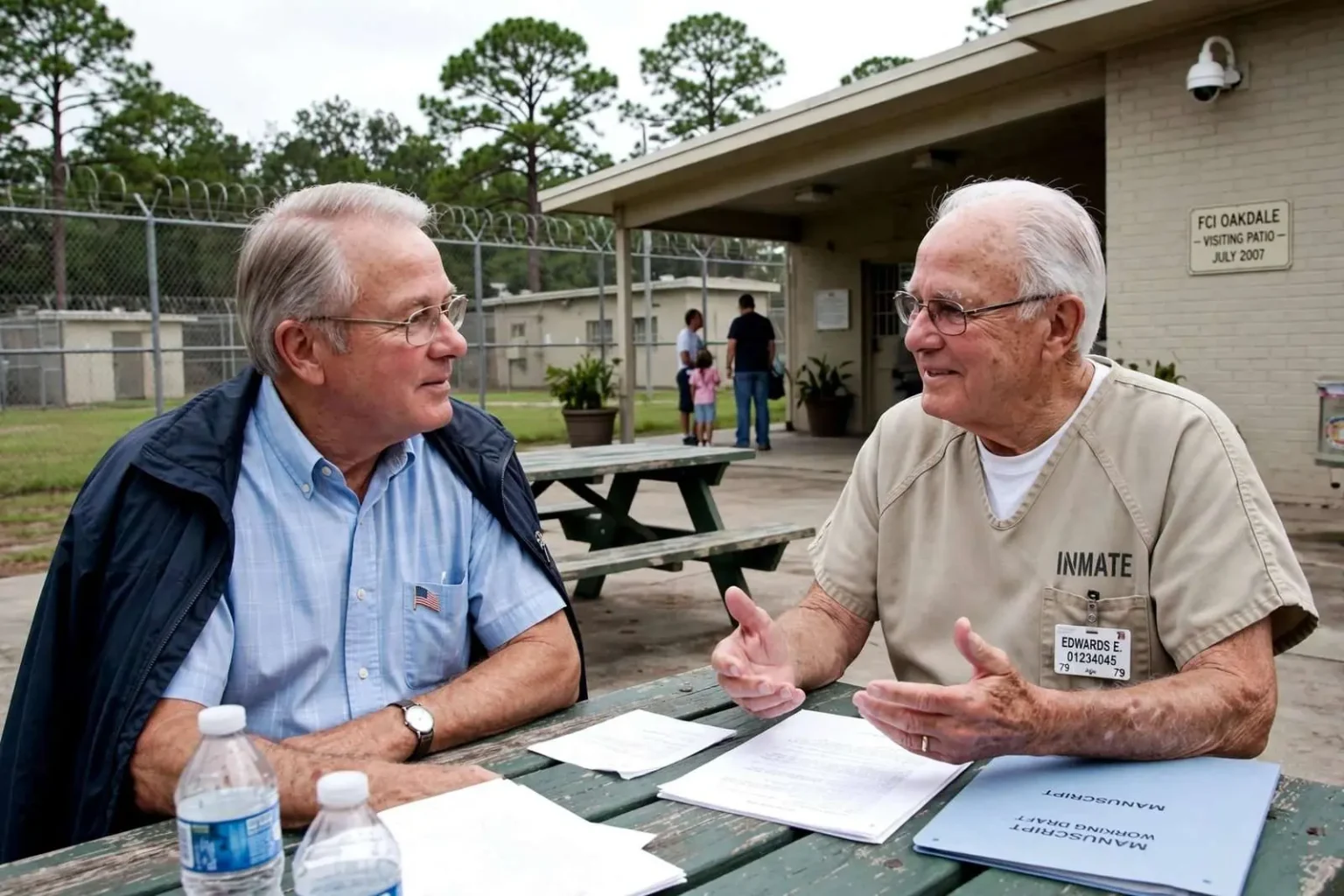
Ken Malone had a last campaign in mind, and it was not for office. The former longtime Mobile County tax assessor, a veteran Chickasaw political figure, had envisioned a public crusade to win the release of Edwin Edwards, the four-term Louisiana governor then serving a federal racketeering sentence. By July 2007, after roughly two hours with Edwards inside a federal prison at Oakdale, Louisiana, Malone had changed his approach.
The Prisoner’s Advice
Malone said he came away agreeing with Edwards’ own conclusion: that pursuing release quietly, through official channels, was the better course for the moment. Executive clemency, Malone acknowledged, was the only realistic path, and he called it a long, long, long shot. The public crusade he had imagined — the rallies, the petitions, the pressure — was set aside after a single conversation in a visiting area.
Edwards, convicted in 2001 and sentenced to 10 years on charges arising from riverboat casino licensing, had begun his sentence in October 2002 in Fort Worth, Texas, before being moved to Oakdale, northwest of Lake Charles. He was eligible for release in 2011 and would turn 80 that August. The case that put him there had followed years of investigations into Louisiana’s licensing of riverboat casinos, and it ended a political career that had made Edwards the dominant figure in his state for a generation.
For Malone, the drive west from the Mobile area was the act of a political man paying a call on another political man — one free, one not. What he found inside surprised him, and what he heard sent him home with a different mission than the one he arrived with.
Why an Alabama Official Cared
Malone’s admiration was partly for the style — Edwards was a legendary figure even by Louisiana standards, and rarely far from the shadow of scandal — but mostly for a favor. Malone recalled a constituent who came to his office seeking help for a relative imprisoned in Louisiana. With the woman still sitting there, Malone telephoned the governor’s office in Baton Rouge. Edwards was in a meeting; Malone left a message for a man he had never met.
He said he was astonished when Edwards called back within five minutes, grasped the situation and immediately set about correcting it. A tax assessor’s office is not the natural first stop for a problem in a Louisiana prison, and a governor has no obligation to return a stranger’s call — least of all within minutes. But Edwards, Malone concluded, understood two things instantly: that a constituent’s family problem was his problem, and that doing something about it cost him nothing and bought him a friend across the state line forever.
That transactional generosity — favors done quickly, remembered permanently — was the currency of Gulf Coast politics in the era both men came up in. Malone had spent decades in Mobile County government, first as an elected official and then as a fixture of the Chickasaw political scene, and he knew exactly what he had witnessed in that five-minute callback. He never forgot it.
Inside the Visiting Yard
Malone described an inmate in good health, mentally and physically, who had recently finished writing an account of his times and was editing it down at his publisher’s request. The manuscript project suited Edwards, whose storytelling had been as much a part of his legend as any election he won. Even in prison, he was working — trimming his own history to length.
Edwards, he said, was deeply curious about Alabama politics and its old giants, asking in particular about George Wallace and Big Jim Folsom. The interest was natural. Wallace and Folsom belonged to the same generation of Southern populists Edwards grew up watching, and their careers — Wallace’s four terms and endless national ambitions, Folsom’s genial, patronage-rich administrations — were the Alabama versions of the politics Edwards practiced across the line.
The visit took place in a patio area near the entrance to a visiting room, and Malone said a steady parade of prisoners, visitors and children came and went the entire time. Edwards interrupted their conversation to greet every one of them. “I said, old habits die hard,” Malone recounted, “and he said, I guess you’re right; it goes with the job.”
“The man is at peace with God,” Malone said. “He said he felt comfortable with his life and, whatever the Lord’s decision, he will abide by it with no malice toward anybody.” For a politician whose career had been built on fight — on debates, comebacks and campaigns no one gave him a chance in — the equanimity struck Malone as its own kind of statement. Malone said he planned to visit again.
The decision to drop the public crusade followed directly from that visit. Malone had arrived willing to lead a movement; he left persuaded that the man the movement was for wanted quiet instead. Agreeing to stand down because the prisoner asked him to was, in Malone’s telling, simply the same favor-keeping instinct that had carried him to Oakdale in the first place.
What Happened Next
No clemency came from the Bush administration, and Edwards served out most of his term. He was released to home confinement in January 2011 and completed his sentence later that year, after which he returned to Louisiana public life, married again, appeared in a short-lived reality television series and made an unsuccessful run for Congress in 2014. He died in 2021 at age 93.
The clemency Malone hoped for never arrived, and the long shot he called it proved exactly that. But the trajectory that followed — release at last, a return to the public stage, a marriage, a book, one more campaign — gave the story an ending Edwards himself might have scripted: the old politician back in the game, on his own terms, to the end.
What the Episode Says
The episode is preserved here less for its outcome than for what it says about a particular strain of Gulf Coast politics — personal, transactional in the older sense of favors remembered, and stubbornly loyal. In that world, a phone call returned in five minutes could create a debt that survived a federal conviction, and a seventy-nine-year-old inmate could still command the loyalty of a former Alabama county official willing to drive across two state lines for a visit.
Malone spent decades in Mobile County government and knew the region’s political generations well. That he would drive across the state line to sit with a disgraced governor, and then agree to drop his own publicity campaign because the prisoner asked him to, was in character. The men who ran county offices in that era traded in relationships, not ideologies, and a relationship once formed did not expire at sentencing.
It is also a reminder of how porous the border has always been between Alabama and Louisiana politics, two states that have traded operatives, scandals and storytelling traditions for a century. Mobile sits closer in temperament and history to Baton Rouge and New Orleans than to Atlanta, and its politicians have always known their Louisiana counterparts as colleagues in the same trade — flamboyant, personal, indulgent of a good story, and unforgiving only when loyalty is betrayed.
Edwards was the finest practitioner that trade ever produced, and Malone’s visit caught him practicing it from inside a federal prison: greeting every visitor in the yard, remembering favors, editing the memoir, advising a friend to work the system rather than the headlines. The crusade Malone had imagined never happened. The friendship that replaced it was, by the standards both men had lived by, worth more.
The Office Malone Held
Understanding Malone’s standing helps explain why the visit mattered. The Mobile County tax assessor’s office is one of the quiet power centers of local government — a constitutional office that touches every property owner in the county, answerable to voters in regular intervals and to no one else. Malone held it for a generation, and in that time he became part of the fabric of Chickasaw and northern Mobile County politics, a community whose civic life has always run on a relatively short list of familiar names.
An assessor’s office is also a place where the public shows up with problems, which is how the constituent at the center of this story walked in. Assessors field complaints about valuations, exemptions and paperwork, but in practice the men and women who hold those offices hear everything — and in an era before constituent services became a professionalized function, a courthouse official who picked up the phone for someone was doing what the community expected of him.
Edwards and the Alabama Parallel
The curiosity Edwards showed about Wallace and Folsom was more than small talk. Edwards came to power in Louisiana in 1972, at the tail end of the Wallace era next door, and he governed in the same mold the two Alabamians had established: a coalition of rural and working-class voters held together by personality, patronage and an unstated promise that government would look out for its friends. Folsom’s folksy administrations and Wallace’s iron-fisted populism were the case studies every Louisiana politician of Edwards’ generation knew.
That Edwards would ask a visiting Alabama county official about those two men, by name, said something about how he filled his days at Oakdale — thinking and talking about the political world that had defined him, now from the outside. For Malone, who had lived through the Alabama versions, the conversation was a meeting of two eras of the same politics, held on a prison patio between interruptions from passing visitors.
Clemency, Explained
The path Malone called a long shot has a specific meaning in federal law. Executive clemency — a commutation shortening a sentence or a pardon erasing it — rests with the president alone, exercised on the Justice Department’s advice through the pardon attorney. It is granted sparingly, usually well after a sentence has been served, and almost never for a prisoner still serving his term. A governor’s celebrity, his age, or the sympathy of friends carries no formal weight; the petition competes with thousands of others in a process famous for its caution.
That is what made Edwards’ own advice to Malone practical rather than proud. A noisy public campaign might feel like action, but it could not move the clemency machinery, and it risked painting the petitioner as someone serving his sentence with one eye on the cameras. Quiet channels — lawyers, filings, time — were the only realistic route, and the man inside the fence saw it more clearly than the advocate outside.