Mobile County Commission Meeting Draws Hours of Debate Over Religious Displays
A Mobile County Commission meeting turned into a two-hour debate over whether to allow additional religious and secular displays at Government Plaza.
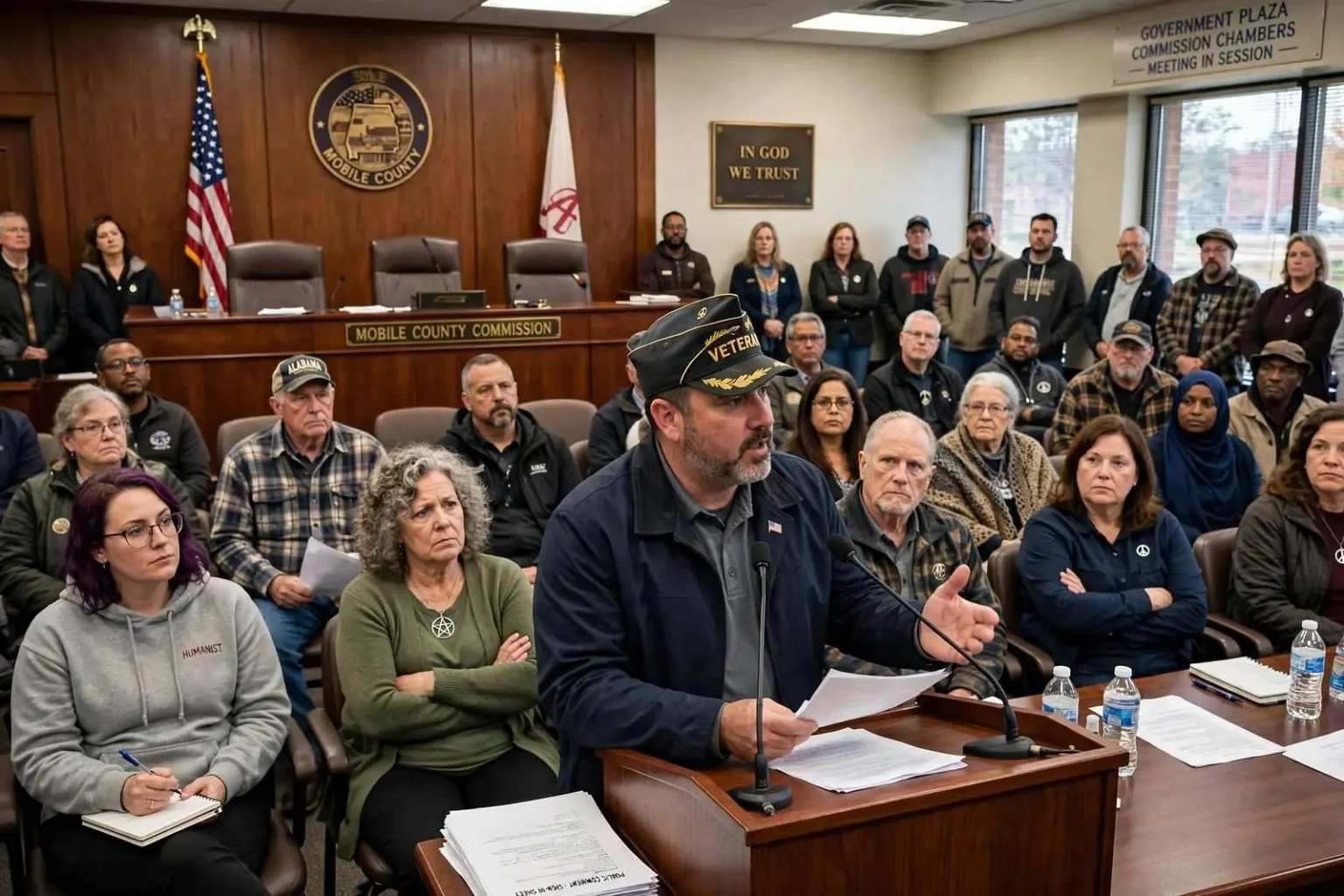
A routine biweekly planning session of the Mobile County Commission stretched into a marathon two-hour public hearing this week, as residents packed Government Plaza to weigh in on a contentious question: should the county allow only a Christian-themed display in its public building, or open the door to other belief systems as well. The question had been building since the summer, and by the time the hearing opened, the chambers had drawn one of the largest crowds gathered for a county meeting in recent memory. What was scheduled as ordinary county business became an extended public argument over religion, history and the meaning of a government building’s walls.
At the center of the dispute is a plaque or seal bearing the national motto, “In God We Trust,” which commissioners approved for display in Government Plaza back in June. Government Plaza, the shared downtown building that houses both city and county offices, is where residents pay fees, attend meetings and conduct the routine business of local government — which is precisely why the question of what hangs on its walls resonated beyond the commission chamber. The June approval passed without the controversy that followed, but word of the display spread, and the requests soon arrived.
In the weeks that followed, local atheist, humanist, and Pagan groups asked the commission for the same opportunity to post messages reflecting their own beliefs, setting up this week’s extended debate. The requests put commissioners in a familiar bind for public bodies: once a government building accepts a belief-themed display, the principle of equal treatment hands every other group an argument for the same space. Deny the follow-on requests and the county invites claims of favoritism; grant them and it reopens the question it thought it had settled in June.
Two Hours at the Podium
Close to two dozen speakers took the podium, ranging from clergy and youth pastors to atheist advocates and self-described Pagan and Wiccan community members. The speaker list traced the breadth of the community’s views, and the hearing’s length reflected how many residents had asked for their two minutes at the microphone. Speakers frequently applauded their own allies, and the commission’s president repeatedly reminded the chambers that order would hold while every signed-up speaker had a turn.
One speaker, a military veteran and co-founder of a local atheist organization, argued that nonbelievers make up a significant share of county residents and deserve equal recognition, pointing to the country’s founding treaties as evidence that the government was not established on explicitly religious grounds. He proposed an alternative phrase rooted in secular reasoning as a parallel display. The treaty argument — a reference long deployed in these debates to documents from the nation’s founding era that describe a secular government — was among the most substantive of the evening, and it framed the issue as one of equal treatment rather than opposition to religion itself.
Other speakers pushed back firmly. Several argued that “In God We Trust” is the official national motto and carries patriotic rather than religious weight, drawing comparisons to its appearance on currency and in the national anthem. That argument — that the phrase has been adopted so broadly into civic life that it no longer functions as a religious statement — is the one most commonly offered by governments defending such displays, and speakers leaned on the everyday familiarity of the motto: printed on the money in the audience’s wallets, sung in the anthem at ballgames, engraved on public buildings across the country.
A former congressional candidate told the commission the nation’s founding was rooted in Christian tradition and argued that random competing statements from various groups didn’t belong alongside the official motto. Other residents worried that opening the door to one alternative display would trigger a cascade of requests from many different groups, eventually overwhelming the building’s available wall space. The cascade argument, half serious and half not, made a genuine point about public forums: a wall that is open to one message is, in principle, open to any of them, and someone must decide where the line falls.
Representatives from the Pagan community pushed back on being characterized as a fringe group, noting that their faith tradition is formally recognized by the U.S. military chaplaincy and arguing that social progress throughout history has often required expanding, rather than narrowing, who gets a seat at the table. The chaplaincy point carried particular weight from speakers who identified themselves as veterans of the armed services, for whom the military’s own accommodation of their faith was a matter of firsthand experience rather than abstraction. Their argument was that Mobile County’s public buildings belong to residents of many faiths and none, and that the standards for recognition ought to match that reality.
A Long National Argument, With Alabama at Its Center
The debate in Mobile is a local chapter of an argument the country has carried on for decades. “In God We Trust” has appeared on American coins since the Civil War era and was adopted as the official national motto by Congress in 1956, at the height of the Cold War, when its display was promoted partly as an expression of national identity in contrast to officially atheistic adversaries. Since then, courts have repeatedly been asked to decide whether the motto’s presence on currency and in public buildings amounts to a religious endorsement by government — and courts have largely allowed it to stand, reasoning that its use has become a form of civic tradition rather than worship.
Alabama knows this terrain well. The state’s own decade of battles over a Ten Commandments monument in the state judicial building in Montgomery made national headlines and produced landmark federal court rulings on religious displays in government spaces. Those cases established the practical framework local governments still navigate: displays of religious content in public buildings survive challenges most often when they are part of a broader secular presentation, and governments that open a forum to one perspective usually find it difficult to close it to others. County commissioners across Alabama have inherited the lesson — that a plaque can be a bigger legal commitment than it looks.
Local governments that have faced the same requests have taken different paths. Some have adopted display policies that treat Government Plaza-style walls as limited public forums, open on equal terms to any group that meets neutral criteria. Others have declined to host belief-themed displays of any kind, removing the original rather than adding competitors. Each approach carries its own costs — the first invites a rotating gallery of messages the building’s owners may not have anticipated, and the second draws criticism from the display’s original supporters. What almost no government has done successfully is accept one group’s display and refuse everyone else’s.
The Commission’s Ruling
After hearing the full slate of public comments, the commission’s president ruled that the board would not take up the question of adding alternative displays, characterizing the existing motto as simply the official language of the nation and suggesting that residents who object should direct their concerns to federal lawmakers rather than the county. She indicated no further plaques would be considered unless a different official motto were adopted at the federal level. The ruling effectively ended the evening without a vote, leaving the audience — which had waited two hours to hear it — to file out of the chambers with the dispute unresolved in substance even though it had been settled in procedure.
Not all three commissioners were in agreement. One commissioner said she believed no religious expression of any kind belonged in a government building and had cast the lone dissenting vote when the original display was approved back in June, later telling reporters that her opposition reflected concerns about divisiveness rather than any conflict with her own Christian faith. Her position — that a believer can oppose government religion displays on neutrality grounds — occupied a distinct corner of the argument, one that separates the question of personal faith from the question of what a county building should host.
Another commissioner said his personal religious convictions informed his vote in favor of the original display. That candor drew little reaction in the chamber, but it illustrates the tension at the heart of the debate: commissioners are simultaneously private citizens with beliefs and public officers bound to govern for residents of all of them. How those two roles reconcile is precisely the question the two-hour hearing put on the record, and no speaker or commissioner resolved it.
With no formal vote scheduled, the debate leaves the existing display in place for now, though the underlying disagreement among county residents over religion’s place in public buildings appears far from resolved. The groups that asked for equal space can return to the commission, seek other venues, or take their argument to court as other Alabama groups have done before them. The commission, having heard two hours of argument and ruled on procedure rather than principle, has left itself room to revisit the question — and every indication that it will be asked to.