Inside the Herman Thomas Trial: First Impressions From a Crowded Mobile Courtroom
The trial of former Mobile Circuit Judge Herman Thomas opened in October 2009 on more than 70 charges, with a retired judge presiding, a combative defense and a jury of 16 seated for a case expected to last weeks.
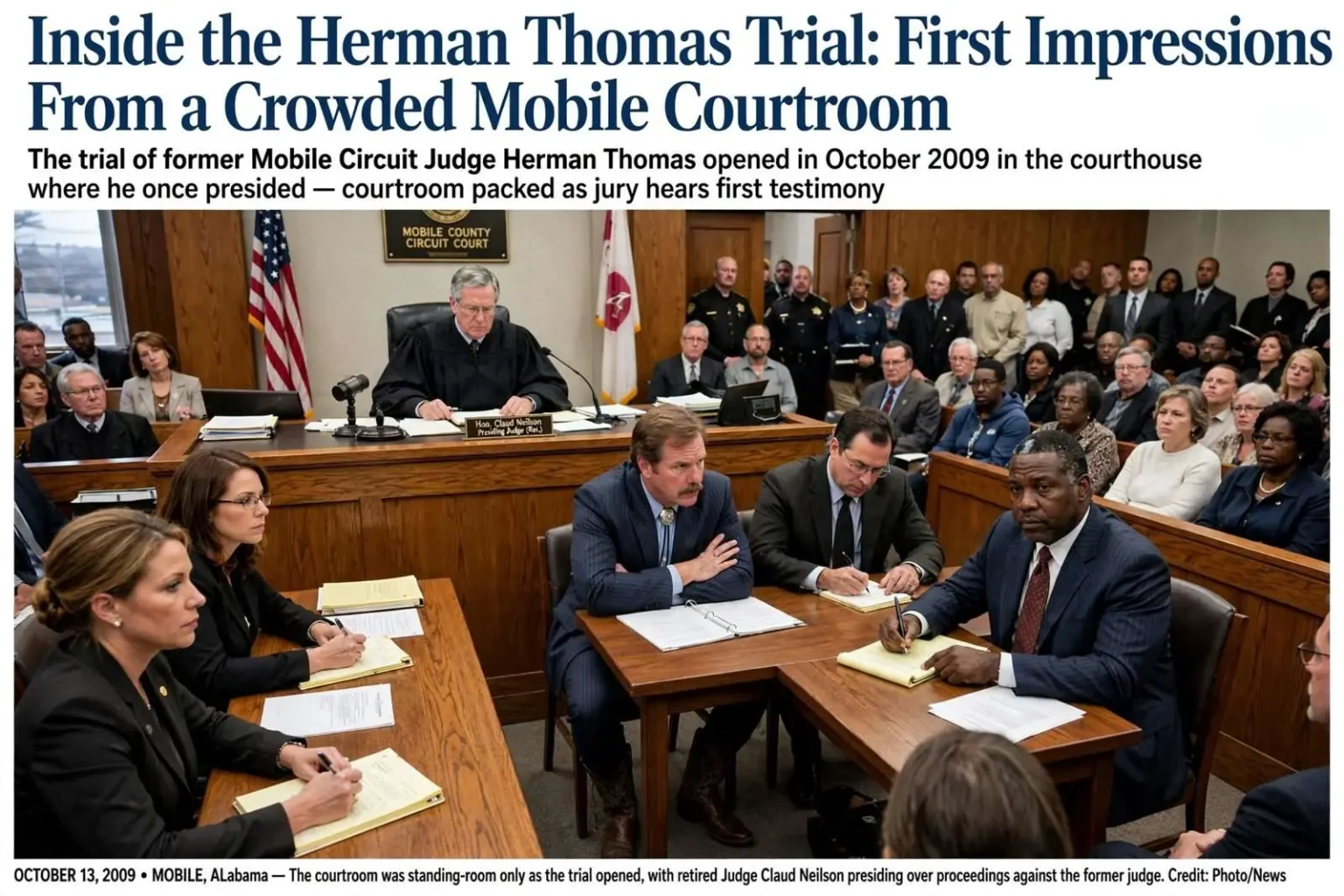
The trial of former Mobile Circuit Judge Herman Thomas opened in the middle of October 2009 in the courthouse where he once presided, and by the end of its first days the shape of the case — and of the fight over it — was already visible to the lawyers, clerks and spectators packing the gallery. Thomas faced more than 70 charges arising from allegations that he removed young inmates from jail and paddled them in a spare courthouse office. The proceeding was expected to run more than two weeks, and from the first morning it was clear the trial would be about far more than the counts on the indictment: it would put the internal culture of the Mobile County Circuit Court itself on the witness stand.
The Bench
Presiding was Claud Neilson, a retired Marengo County circuit judge brought in from outside Mobile to hear a case in which the local bench was itself a witness. Recusing the Mobile County judges was essential — several of them were potential witnesses to the conduct under examination — so the assignment went to an outsider with no history in the building. Grey-haired and unhurried, Neilson set a deliberately calm tone. He adjourned the first day half an hour early to drive back to Demopolis in time to watch his grandson play football on a Friday night, and returned the following Tuesday to ask the jurors whether they had enjoyed the weekend and whether their teams had won. His had, he told them.
The small ritual told observers something about how the trial would be run: unhurried, personal and resistant to the melodrama the case had generated during its pretrial phase. In a proceeding where the defendant had once held the gavel in the same building, the presence of an outsider on the bench was itself part of the trial’s meaning — proof that when a judge is charged, the system can still find a neutral set of hands.
The Lawyers
Leading the prosecution was Nicki Patterson, a veteran state advocate whose opening statement was delivered quietly and, by general agreement in the courtroom, effectively. She was assisted by Martha Tierney. Patterson’s reputation for measured presentation set the state’s strategy: let the documents and the testimony carry the outrage rather than the tone of the argument.
For the defense, Thomas was represented by Robert “Cowboy Bob” Clark and Jeff Deen. Clark, whose pretrial exchanges with prosecutors and reporters had been anything but restrained, arrived in a navy pin-striped suit and cowboy boots and, to the surprise of some who had predicted a blowup before the first witness, kept his energy directed at the record. Deen, better known locally for his work on the stage than for courtroom theatrics, gave the opening statement for the defense; after a shaky start, observers said, he found his footing.
The pairing gave the defense a combination of aggression and polish — Clark cross-examining, Deen narrating — and the early days showed the division of labor working as designed. Where the prosecution’s openings were quiet, the defense’s were sprawling, reaching back years before the alleged events to paint a picture of a courthouse full of rivalries.
The State’s First Witness
The prosecution called Presiding Circuit Judge Charlie Graddick first, and Clark used the cross-examination to lay the foundation of the defense’s theory: that Thomas, the court’s only African-American judge, had been singled out by colleagues for conduct that differed from theirs, at most, in degree. Clark suggested that judges routinely swap cases on one another’s dockets and argued that Thomas tried an unusually large number of cases because he worked harder than his colleagues.
He alleged that Graddick and former county prosecutor Jason Botop had searched Thomas’s office for evidence. Graddick denied ever searching the office, saying he had visited it on occasion and could not recall going there with Botop. The exchange was the first direct collision of the trial — a sitting presiding judge defending his own conduct against a defense theory of coordinated targeting.
Clark also pressed Graddick on his relationship with attorney Lee Hale Jr., the son of a former political ally, contending that Graddick had appointed Hale to criminal cases generating more than $250,000 in fees in a single year. Under questioning, Graddick acknowledged that he and other judges permitted Hale to continue handling cases on their dockets even while the lawyer faced outstanding criminal charges of his own. The point the defense wanted the jury to take away was comparative: if the courthouse tolerated that, the defense argued, then the conduct charged to Thomas should be read against the same loose standards rather than in isolation.
The Allegations
Prosecutors told jurors the evidence would show that Thomas ordered recognizance bonds to have young inmates released from the county jail, brought them to a private courthouse office and paddled their bare bottoms for his own sexual gratification. In exchange, they said, the men received leniency — typically long probation terms that required continued contact with the judge. The alleged victims, prosecutors noted, were frequently represented by attorneys Thomas himself had appointed.
The structure of the alleged scheme, as described by the state, was what made it so serious: every element of it ran through powers that belonged to a judge alone. Recognizance bonds, appointment of counsel and sentencing leniency are all tools the court controls, and the prosecution’s account described them being turned into instruments of coercion over men with the least power in the building — young defendants awaiting disposition, dependent on the judge deciding their futures.
The defense’s task, as it emerged in the opening days, was to persuade the jury that what the state called a corruption of the criminal justice system was instead an unorthodox and aggressive approach to case management by a judge who had made enemies in the courthouse. That theory required the jury to believe two things at once: that the paddling allegations were exaggerated or mischaracterized, and that the judges, prosecutors and lawyers who built the case were motivated by grievance rather than evidence.
The Defendant and the Jury
Thomas, who spent nearly two decades on the district and circuit benches before resigning in 2007, sat impassively through the proceedings, occasionally whispering to Clark or taking notes on a legal pad. He had set aside his signature bow ties for conventional neckties, though not for subdued ones. His wife, Linda, sat in the front row of the gallery each day, as composed as her husband. For a man who had spent years as one of the most visible figures in the courthouse — presiding over the same courtrooms where he now sat at the defense table — the daily routine of the trial had the quality of a role reversal played out in public.
The jury seated to hear the case numbered 16 — 12 jurors and four alternates, more alternates than usual in recognition of the length of the trial and the risk of a mistrial for want of a juror. Eleven of the 16 were Black and five were white. The composition drew attention in a community where the case had become a subject of intense debate, with supporters of Thomas viewing the prosecution through the lens of his standing as the court’s only Black judge. The larger-than-usual panel also carried a practical signal: prosecutors had submitted a long witness list, and the defense had promised an equally long cross-examination campaign, so the court wanted insurance against the attrition that multi-week trials routinely produce. Alternate jurors hear the same evidence as the rest and are dismissed only at deliberations, which meant the courthouse gallery included more people with a vote on the outcome than in nearly any other proceeding then underway in the county.
Whatever the verdict, the trial had already put the internal workings of the Mobile County Circuit Court on public display: how cases are assigned, how lawyers are appointed and paid, and how much discretion a single judge can exercise over the lives of the people who come before him. Court watchers noted that few trials anywhere in Alabama had ever exposed so much of a courthouse’s daily mechanics — the case swaps, the appointment patterns, the fee flows — to public scrutiny, and that the record being assembled would outlast whatever the jury decided.
The opening week set the stakes for the weeks to come. The state promised testimony about young men taken from jail and punished for a judge’s gratification; the defense promised a counter-narrative of courthouse politics and selective prosecution. Between those two stories sat a jury of sixteen, several weeks of schedule, and a building in which every participant in the trial had once worked or still did.